
Cups to Grams Converter
Turn cups into grams, or grams back into cups, for flour, sugar, butter and 52 common ingredients. Pick US, metric, UK or Japanese cups and get the exact weight, the nearest kitchen fraction and the spoon equivalent.
Source: King Arthur Baking ingredient weight chart
All-purpose flour: common cup amounts in grams
Quick answer
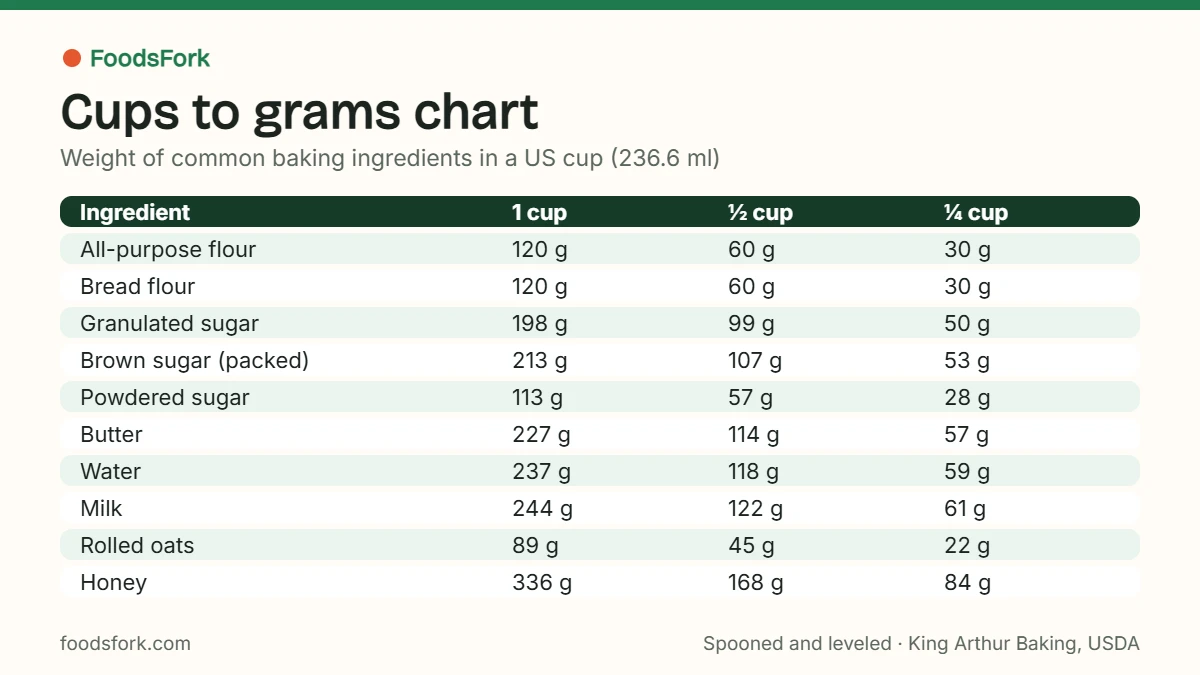
1 US cup of all-purpose flour weighs about 120 grams. A cup of granulated sugar is about 198 g, butter about 227 g, milk about 244 g and water about 237 g. Every ingredient is different because a cup measures volume, not weight, so always convert using the weight of that specific ingredient.
Key facts
- 1 US cup holds 236.6 ml, but its weight depends on the ingredient.
- 1 cup of all-purpose flour = 120 g (spooned and leveled).
- 1 cup of granulated sugar = 198 g; packed brown sugar = 213 g.
- 1 cup of butter = 227 g, which is 2 US sticks.
- 1 cup of water = 237 g; 1 cup of milk = 244 g.
How to use the cups to grams converter
The converter at the top of this page works in both directions and updates as you type. It takes about five seconds:
Alongside the main result you also get the weight in ounces, the same amount in tablespoons and milliliters, and how much one cup of that ingredient weighs. Below the converter, a ready-made list shows the gram weight of every common cup size for the ingredient you picked, from ⅛ cup up to 4 cups.
How to convert cups to grams
There is no single number that turns cups into grams for every food, because a cup is a measure of space and different ingredients weigh different amounts in the same space. What you need is the weight of one cup of the ingredient you are using. Once you know that, the maths is simple:
Here are a few worked examples using the weights in our chart:
- 1½ cups of all-purpose flour: 1.5 × 120 g = 180 g.
- ¾ cup of brown sugar (packed): 0.75 × 213 g = about 160 g.
- ⅓ cup of melted butter: 0.333 × 227 g = about 76 g.
- 2 cups of milk: 2 × 244 g = 488 g.
- 500 g of flour in cups: 500 ÷ 120 = 4.17, or just over 4 cups.
If your recipe uses a different cup size, the converter scales the weight for you. A metric cup holds 250 ml instead of 236.6 ml, so a metric cup of flour weighs about 127 g instead of 120 g.
Cups to grams chart
This chart shows the weight in grams of common cup amounts for 52 ingredients, measured in US cups and rounded to the nearest gram. Choose a group to see its ingredients. Dry baking ingredients use the King Arthur Baking ingredient weight chart, and liquids use USDA FoodData Central values.
| Ingredient | ¼ cup | ⅓ cup | ½ cup | ⅔ cup | ¾ cup | 1 cup |
|---|---|---|---|---|---|---|
| All-purpose flour | 30 g | 40 g | 60 g | 80 g | 90 g | 120 g |
| Bread flour | 30 g | 40 g | 60 g | 80 g | 90 g | 120 g |
| Cake flour | 30 g | 40 g | 60 g | 80 g | 90 g | 120 g |
| Whole wheat flour | 28 g | 38 g | 56 g | 75 g | 85 g | 113 g |
| Self-rising flour | 28 g | 38 g | 56 g | 75 g | 85 g | 113 g |
| '00' pizza flour | 29 g | 39 g | 58 g | 77 g | 87 g | 116 g |
| Almond flour | 24 g | 32 g | 48 g | 64 g | 72 g | 96 g |
| Coconut flour | 32 g | 43 g | 64 g | 85 g | 96 g | 128 g |
| Oat flour | 23 g | 31 g | 46 g | 61 g | 69 g | 92 g |
| Rye flour | 26 g | 35 g | 53 g | 71 g | 80 g | 106 g |
| White rice flour | 36 g | 47 g | 71 g | 95 g | 106 g | 142 g |
| Semolina | 41 g | 54 g | 82 g | 109 g | 122 g | 163 g |
| Cornmeal | 34 g | 46 g | 69 g | 92 g | 104 g | 138 g |
| Cornstarch | 28 g | 37 g | 56 g | 75 g | 84 g | 112 g |
| Ingredient | ¼ cup | ⅓ cup | ½ cup | ⅔ cup | ¾ cup | 1 cup |
|---|---|---|---|---|---|---|
| Granulated sugar | 50 g | 66 g | 99 g | 132 g | 148 g | 198 g |
| Brown sugar (packed) | 53 g | 71 g | 106 g | 142 g | 160 g | 213 g |
| Powdered sugar | 28 g | 38 g | 56 g | 75 g | 85 g | 113 g |
| Caster (superfine) sugar | 48 g | 63 g | 95 g | 127 g | 142 g | 190 g |
| Honey | 84 g | 112 g | 168 g | 224 g | 252 g | 336 g |
| Maple syrup | 78 g | 104 g | 156 g | 208 g | 234 g | 312 g |
| Molasses | 85 g | 113 g | 170 g | 227 g | 255 g | 340 g |
| Corn syrup | 78 g | 104 g | 156 g | 208 g | 234 g | 312 g |
| Agave syrup | 84 g | 112 g | 168 g | 224 g | 252 g | 336 g |
| Ingredient | ¼ cup | ⅓ cup | ½ cup | ⅔ cup | ¾ cup | 1 cup |
|---|---|---|---|---|---|---|
| Butter | 57 g | 76 g | 114 g | 151 g | 170 g | 227 g |
| Vegetable oil | 54 g | 73 g | 109 g | 145 g | 164 g | 218 g |
| Olive oil | 54 g | 72 g | 108 g | 144 g | 162 g | 216 g |
| Coconut oil | 56 g | 75 g | 113 g | 151 g | 170 g | 226 g |
| Vegetable shortening | 46 g | 61 g | 92 g | 123 g | 138 g | 184 g |
| Ingredient | ¼ cup | ⅓ cup | ½ cup | ⅔ cup | ¾ cup | 1 cup |
|---|---|---|---|---|---|---|
| Water | 59 g | 79 g | 118 g | 158 g | 178 g | 237 g |
| Milk | 61 g | 81 g | 122 g | 163 g | 183 g | 244 g |
| Buttermilk | 61 g | 82 g | 122 g | 163 g | 184 g | 245 g |
| Heavy cream | 60 g | 79 g | 119 g | 159 g | 178 g | 238 g |
| Sour cream | 58 g | 77 g | 115 g | 153 g | 172 g | 230 g |
| Plain yogurt | 61 g | 82 g | 122 g | 163 g | 184 g | 245 g |
| Cream cheese | 58 g | 77 g | 116 g | 155 g | 174 g | 232 g |
| Ingredient | ¼ cup | ⅓ cup | ½ cup | ⅔ cup | ¾ cup | 1 cup |
|---|---|---|---|---|---|---|
| Rolled oats | 22 g | 30 g | 44 g | 59 g | 67 g | 89 g |
| White rice (uncooked) | 50 g | 66 g | 99 g | 132 g | 148 g | 198 g |
| Quinoa (uncooked) | 44 g | 59 g | 88 g | 118 g | 133 g | 177 g |
| Cocoa powder | 21 g | 28 g | 42 g | 56 g | 63 g | 84 g |
| Chocolate chips | 42 g | 57 g | 85 g | 113 g | 128 g | 170 g |
| Peanut butter | 68 g | 90 g | 135 g | 180 g | 202 g | 270 g |
| Walnuts (chopped) | 28 g | 38 g | 56 g | 75 g | 85 g | 113 g |
| Pecans (diced) | 28 g | 38 g | 57 g | 76 g | 86 g | 114 g |
| Almonds (whole) | 36 g | 47 g | 71 g | 95 g | 106 g | 142 g |
| Raisins | 37 g | 50 g | 74 g | 99 g | 112 g | 149 g |
| Shredded coconut (sweetened) | 21 g | 28 g | 42 g | 57 g | 64 g | 85 g |
| Breadcrumbs (dried) | 28 g | 37 g | 56 g | 75 g | 84 g | 112 g |
| Parmesan (grated) | 25 g | 33 g | 50 g | 67 g | 75 g | 100 g |
| Cheddar (grated) | 28 g | 38 g | 56 g | 75 g | 85 g | 113 g |
| Ingredient | ¼ cup | ⅓ cup | ½ cup | ⅔ cup | ¾ cup | 1 cup |
|---|---|---|---|---|---|---|
| Mashed banana | 57 g | 76 g | 114 g | 151 g | 170 g | 227 g |
| Pumpkin purée | 57 g | 76 g | 114 g | 151 g | 170 g | 227 g |
| Applesauce | 64 g | 85 g | 128 g | 170 g | 191 g | 255 g |
Need an amount that is not in the chart? Use the converter at the top of the page, which handles any amount and every cup size.
Why one cup of flour can weigh 120 g or 150 g
Flour is the ingredient that causes the most confusion, because its weight per cup depends heavily on how you fill the cup. Flour is light and fluffy when it is loose and becomes much denser when it is pressed together.
- Spoon and level: you spoon flour loosely into the cup and sweep off the excess with a straight edge. This gives about 120 g per cup and is the method most American recipe writers assume.
- Dip and sweep: you push the cup into the bag and level it. The flour compresses as you scoop, and a cup can easily reach 140 to 150 g.
- Sifted flour: sifting adds air, so a cup of sifted flour can weigh as little as 100 to 110 g.
That difference of 25 percent or more is enough to turn a soft cake into a dry one, or a chewy cookie into a crumbly one. It is also why some charts list 125 g or even 140 g for a cup of flour: they are simply describing a different way of filling the cup. If a recipe tells you the weight per cup it was written with, use that number. If it does not, 120 g for spooned and leveled flour is the safest assumption, and weighing removes the guesswork completely.
Tip: if your baking often turns out dry or dense, scooped flour is the most likely cause. Try spooning and leveling, or weigh 120 g per cup.
US, metric, UK and Japanese cups
A “cup” is not the same size everywhere, and using the wrong one changes how much of each ingredient you add. The differences are small for one cup but add up quickly in a recipe that uses several cups.
| Cup | Volume | Where it is used | Flour per cup |
|---|---|---|---|
| US customary cup | 236.6 ml | United States recipes and cookbooks | 120 g |
| US “legal” cup | 240 ml | US nutrition labels | 122 g |
| Metric cup | 250 ml | Australia, New Zealand, Canada, South Africa | 127 g |
| UK imperial cup | 284 ml | Older British recipes | 144 g |
| Japanese cup | 200 ml | Japanese recipes | 101 g |
Most modern British recipes are written in grams, so you will usually only meet the imperial cup in older family recipes. If a recipe comes from Australia or New Zealand, switch the converter to metric cups. For a US recipe, keep the default US cup.
Flour, sugar and butter: the conversions you will use most
Flour
All-purpose, bread and cake flour all weigh about 120 g per US cup when spooned and leveled. Whole wheat and self-rising flour are slightly lighter at about 113 g, while almond flour is much lighter at 96 g and semolina much heavier at 163 g. Because gluten-free and nut flours vary so much, never swap one flour for another cup for cup without checking the weight.
Sugar
Granulated sugar is dense and pours evenly, so it is one of the most reliable ingredients to measure by cup: about 198 g, usually rounded to 200 g. Brown sugar must be packed firmly to reach its 213 g per cup. Powdered sugar is the opposite, light and airy at about 113 g, and it compacts in the bag, so spoon it in gently. Honey and syrups are far heavier than dry sugar: a cup of honey weighs about 336 g.
Butter
Butter is easy, because it is sold by weight. In the US, one stick weighs 113 g and equals ½ cup or 8 tablespoons, so 1 cup of butter is two sticks or about 227 g. A 250 g block, common in Europe and Australia, is just over 1 US cup. Melted butter weighs the same as solid butter, so 1 cup of melted butter is still about 227 g.
Why bakers weigh instead of using cups
You do not need an expensive scale. A basic digital kitchen scale that reads in 1 g steps and has a tare button is accurate enough for almost all home cooking and baking.
Measuring tips by ingredient
Common cups to grams mistakes
- Using one conversion for everything. “1 cup = 240 g” is only true for water-like liquids. A cup of flour weighs half that.
- Scooping flour from the bag. This packs the flour and adds up to a quarter more than the recipe intended.
- Mixing up cup sizes. An Australian recipe in metric cups uses about 6 percent more of everything than a US recipe.
- Confusing weight ounces and fluid ounces. A cup is 8 fluid ounces of volume, but a cup of flour weighs only about 4.2 ounces.
- Not packing brown sugar. Loosely filled brown sugar can weigh 20 to 30 percent less than the recipe expects.
Is a cup of flour 120 g or 125 g?
This is the question bakers ask most. You will see both numbers online, and both are honest. They just describe a slightly different cup.
Where 120 g comes from
King Arthur Baking weighs flour that is spooned into the cup and leveled with a knife. That gentle fill gives 120 g per cup of all-purpose flour. FoodsFork uses this number because it matches how most American recipes are tested.
Where 125 g comes from
USDA nutrition data lists about 125 g per cup. Many recipe sites copy that figure. It reflects a slightly firmer fill, closer to what you get when you dip the cup into the bag.
Which number should you use?
If the recipe is American and gives cups only
Use 120 g. Spoon and level when you measure, and the recipe will behave the way the writer meant.
If the recipe gives grams
Trust the grams. The writer weighed the flour, so you do not need a cup at all. A scale removes the guesswork.
If you scoop straight from the bag
A scooped cup can reach 140 g to 150 g. That extra flour makes cakes dry and cookies thick. Switch to spooning, or weigh the flour.
Spoons and liquids work differently
Small amounts are easier in spoons. One cup holds 16 tablespoons, so 1 tablespoon of flour is about 7.5 g. Use the tablespoons to cups converter for spoon maths. For milk, water and oil, volume is reliable, so the ml to cups converter is often all you need. Butter has its own wrapper markings, and the butter converter covers sticks, cups and grams.
Frequently asked questions
How many grams are in 1 cup of flour?
One US cup of all-purpose flour weighs about 120 grams when you spoon it into the cup and level it off. That is the figure King Arthur Baking uses, and it is what this converter uses. Many charts round it to 125 grams, and if you scoop straight from the bag a cup can weigh 140 grams or more, so weighing is the safest option for baking.
How many grams is 1 cup of sugar?
One US cup of granulated white sugar weighs about 198 grams, which most recipes round to 200 grams. Packed brown sugar is heavier at about 213 grams per cup, and powdered sugar is much lighter at about 113 grams per cup.
How many grams of butter are in 1 cup?
One US cup of butter weighs about 227 grams. That is the same as two standard American sticks of butter, each weighing 113 grams, or 16 tablespoons.
How many grams is half a cup?
It depends on the ingredient. Half a US cup of all-purpose flour is about 60 grams, granulated sugar about 99 grams, butter about 114 grams and milk about 122 grams. Choose the ingredient in the converter and tap ½ to see the exact figure.
Why does a cup of each ingredient weigh something different?
A cup measures volume, the space an ingredient takes up, not its weight. Dense ingredients like honey pack more mass into the same space than light, airy ones like flour or oats, so a cup of honey weighs almost three times as much as a cup of flour.
Is a US cup the same as a UK or metric cup?
No. A US customary cup holds about 236.6 ml. The metric cup used in Australia, Canada, New Zealand and South Africa holds 250 ml, and the old UK imperial cup holds about 284 ml. A Japanese cup is smaller, at 200 ml. Pick the right cup in the converter to match your recipe.
How many grams of water are in a cup?
One US cup of water weighs about 237 grams, because 1 milliliter of water weighs 1 gram. A metric cup of water weighs 250 grams.
Is it better to measure ingredients by weight or by cups?
Weighing with a digital kitchen scale is more accurate and gives the same result every time, which matters most in baking. Cups are fine for forgiving recipes such as soups, stews and stir-fries.
Is 1 cup of flour 120 g or 125 g?
Both numbers are common. FoodsFork uses 120 g, the King Arthur Baking weight for all-purpose flour spooned into the cup and leveled. Many other charts use 125 g, which matches USDA data and a slightly firmer fill. The 5 g gap is about 4%, and most recipes handle it fine.
How many grams is 1 cup of rice?
One US cup of uncooked white rice weighs about 198 g in our data. Charts range from about 185 g to 200 g, because long, medium and short grains pack differently. Weigh rice if the recipe gives grams.
How many grams is 1 cup of milk?
One US cup of milk weighs about 244 g. Milk is slightly heavier than water, which weighs about 237 g per cup. For most recipes you can measure milk by volume in a liquid cup.
How many grams is a quarter cup?
It depends on the ingredient. A quarter cup of all-purpose flour is 30 g, granulated sugar is about 50 g, butter is about 57 g and water is about 59 g.
Related tools
Sources: King Arthur Baking ingredient weight chart (dry ingredients, butter and purées); USDA FoodData Central (milk, buttermilk, cream, sour cream, yogurt, cream cheese and oils). Weights are averages for typical home measuring; brands and technique can change them slightly. See our disclaimer.