
Grams to Cups Converter
Turn grams into cups for flour, sugar, butter and 52 common ingredients. Get the nearest cup fraction plus an easy measuring-cup combination, in US, metric, UK or Japanese cups.
Source: King Arthur Baking ingredient weight chart
All-purpose flour: common gram amounts in cups
Quick answer
100 g of all-purpose flour is about ¾ cup plus 1½ tablespoons (0.83 US cups). 100 g of granulated sugar is about ½ cup, 100 g of butter is 7 tablespoons, and 250 g of flour is just over 2 cups. There is no single grams-to-cups number, because every ingredient has its own weight per cup.
Key facts
- Cups = grams ÷ the weight of 1 cup of that ingredient.
- 100 g of all-purpose flour ≈ 0.83 cup (¾ cup + 1½ tbsp).
- 200 g of granulated sugar ≈ 1 cup.
- 250 g of flour is just over 2 cups.
- 113 g of butter = ½ cup = 1 US stick.
How to use the grams to cups converter
This converter is built for the moment you find a recipe written in grams but only have measuring cups in the drawer. It opens in grams-to-cups mode and gives you an answer you can actually measure:
The Measure it as box is the most useful part. Real recipes rarely land on a neat fraction: 100 g of flour is 0.83 cups, which is not on any measuring cup. The converter splits it into the largest cup you can fill, here ¾ cup, and makes up the rest in tablespoons or teaspoons. Underneath, a list shows the cup equivalent of the gram amounts that appear most often in recipes, from 25 g to 1 kg.
How to convert grams to cups
Grams measure weight and cups measure volume, so the conversion depends on how heavy the ingredient is. Flour is light and fluffy, honey is dense and heavy, and a cup of each weighs a very different amount. To convert, you divide by the weight of one cup of that particular ingredient:
A few worked examples using the weights in this converter:
- 300 g of all-purpose flour: 300 ÷ 120 = 2.5 cups, or 2½ cups.
- 150 g of caster sugar: 150 ÷ 190 = 0.79 cups, which is ¾ cup plus about ½ tablespoon.
- 113 g of butter: 113 ÷ 227 = 0.5 cups, which is one US stick.
- 400 ml-worth of milk weighed as 412 g: 412 ÷ 244 = 1.69 cups, about 1⅔ cups.
- 75 g of rolled oats: 75 ÷ 89 = 0.84 cups, or ¾ cup plus about 1½ tablespoons.
This is why a single shortcut such as “1 cup = 200 g” causes so many failed bakes. It is roughly right for sugar, but it would give you two-thirds too much flour.
Grams to cups chart
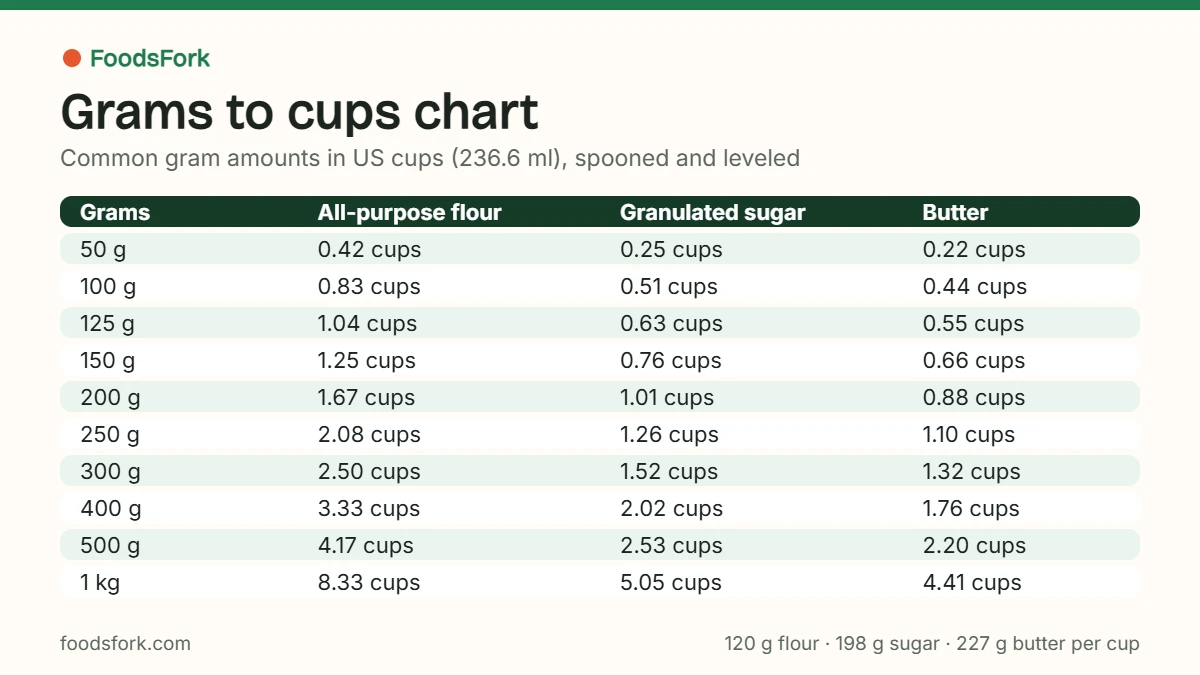
The chart below converts the most common gram amounts into US cups for every ingredient in our list. Each cell shows the nearest kitchen fraction, with the exact decimal in brackets. Choose a group to see its ingredients.
| Ingredient | 50 g | 100 g | 125 g | 200 g | 250 g | 500 g |
|---|---|---|---|---|---|---|
| All-purpose flour | ⅜ (0.42) | ⅞ (0.83) | 1 (1.04) | 1⅔ (1.67) | 2⅛ (2.08) | 4⅛ (4.17) |
| Bread flour | ⅜ (0.42) | ⅞ (0.83) | 1 (1.04) | 1⅔ (1.67) | 2⅛ (2.08) | 4⅛ (4.17) |
| Cake flour | ⅜ (0.42) | ⅞ (0.83) | 1 (1.04) | 1⅔ (1.67) | 2⅛ (2.08) | 4⅛ (4.17) |
| Whole wheat flour | ½ (0.44) | ⅞ (0.88) | 1⅛ (1.11) | 1¾ (1.77) | 2¼ (2.21) | 4⅜ (4.42) |
| Self-rising flour | ½ (0.44) | ⅞ (0.88) | 1⅛ (1.11) | 1¾ (1.77) | 2¼ (2.21) | 4⅜ (4.42) |
| '00' pizza flour | ⅜ (0.43) | ⅞ (0.86) | 1⅛ (1.08) | 1¾ (1.72) | 2⅛ (2.16) | 4⅓ (4.31) |
| Almond flour | ½ (0.52) | 1 (1.04) | 1⅓ (1.30) | 2⅛ (2.08) | 2⅝ (2.60) | 5¼ (5.21) |
| Coconut flour | ⅜ (0.39) | ¾ (0.78) | 1 (0.98) | 1½ (1.56) | 2 (1.95) | 3⅞ (3.91) |
| Oat flour | ½ (0.54) | 1⅛ (1.09) | 1⅜ (1.36) | 2⅛ (2.17) | 2¾ (2.72) | 5⅜ (5.43) |
| Rye flour | ½ (0.47) | 1 (0.94) | 1⅛ (1.18) | 1⅞ (1.89) | 2⅜ (2.36) | 4¾ (4.72) |
| White rice flour | ⅓ (0.35) | ⅔ (0.70) | ⅞ (0.88) | 1⅜ (1.41) | 1¾ (1.76) | 3½ (3.52) |
| Semolina | ⅓ (0.31) | ⅝ (0.61) | ¾ (0.77) | 1¼ (1.23) | 1½ (1.53) | 3⅛ (3.07) |
| Cornmeal | ⅜ (0.36) | ¾ (0.72) | ⅞ (0.91) | 1½ (1.45) | 1¾ (1.81) | 3⅝ (3.62) |
| Cornstarch | ½ (0.45) | ⅞ (0.89) | 1⅛ (1.12) | 1¾ (1.79) | 2¼ (2.23) | 4½ (4.46) |
| Ingredient | 50 g | 100 g | 125 g | 200 g | 250 g | 500 g |
|---|---|---|---|---|---|---|
| Granulated sugar | ¼ (0.25) | ½ (0.51) | ⅝ (0.63) | 1 (1.01) | 1¼ (1.26) | 2½ (2.53) |
| Brown sugar (packed) | ¼ (0.23) | ½ (0.47) | ⅝ (0.59) | 1 (0.94) | 1⅛ (1.17) | 2⅓ (2.35) |
| Powdered sugar | ½ (0.44) | ⅞ (0.88) | 1⅛ (1.11) | 1¾ (1.77) | 2¼ (2.21) | 4⅜ (4.42) |
| Caster (superfine) sugar | ¼ (0.26) | ½ (0.53) | ⅔ (0.66) | 1 (1.05) | 1⅓ (1.32) | 2⅝ (2.63) |
| Honey | ⅛ (0.15) | ⅓ (0.30) | ⅜ (0.37) | ⅝ (0.60) | ¾ (0.74) | 1½ (1.49) |
| Maple syrup | ⅛ (0.16) | ⅓ (0.32) | ⅜ (0.40) | ⅝ (0.64) | ¾ (0.80) | 1⅝ (1.60) |
| Molasses | ⅛ (0.15) | ⅓ (0.29) | ⅜ (0.37) | ⅝ (0.59) | ¾ (0.74) | 1½ (1.47) |
| Corn syrup | ⅛ (0.16) | ⅓ (0.32) | ⅜ (0.40) | ⅝ (0.64) | ¾ (0.80) | 1⅝ (1.60) |
| Agave syrup | ⅛ (0.15) | ⅓ (0.30) | ⅜ (0.37) | ⅝ (0.60) | ¾ (0.74) | 1½ (1.49) |
| Ingredient | 50 g | 100 g | 125 g | 200 g | 250 g | 500 g |
|---|---|---|---|---|---|---|
| Butter | ¼ (0.22) | ½ (0.44) | ½ (0.55) | ⅞ (0.88) | 1⅛ (1.10) | 2¼ (2.20) |
| Vegetable oil | ¼ (0.23) | ½ (0.46) | ⅝ (0.57) | ⅞ (0.92) | 1⅛ (1.15) | 2⅓ (2.29) |
| Olive oil | ¼ (0.23) | ½ (0.46) | ⅝ (0.58) | ⅞ (0.93) | 1⅛ (1.16) | 2⅓ (2.31) |
| Coconut oil | ¼ (0.22) | ½ (0.44) | ½ (0.55) | ⅞ (0.88) | 1⅛ (1.11) | 2¼ (2.21) |
| Vegetable shortening | ¼ (0.27) | ½ (0.54) | ⅔ (0.68) | 1⅛ (1.09) | 1⅜ (1.36) | 2¾ (2.72) |
| Ingredient | 50 g | 100 g | 125 g | 200 g | 250 g | 500 g |
|---|---|---|---|---|---|---|
| Water | ¼ (0.21) | ⅜ (0.42) | ½ (0.53) | ⅞ (0.84) | 1 (1.05) | 2⅛ (2.11) |
| Milk | ¼ (0.20) | ⅜ (0.41) | ½ (0.51) | ⅞ (0.82) | 1 (1.02) | 2 (2.05) |
| Buttermilk | ¼ (0.20) | ⅜ (0.41) | ½ (0.51) | ⅞ (0.82) | 1 (1.02) | 2 (2.04) |
| Heavy cream | ¼ (0.21) | ⅜ (0.42) | ½ (0.53) | ⅞ (0.84) | 1 (1.05) | 2⅛ (2.10) |
| Sour cream | ¼ (0.22) | ⅜ (0.43) | ½ (0.54) | ⅞ (0.87) | 1⅛ (1.09) | 2⅛ (2.17) |
| Plain yogurt | ¼ (0.20) | ⅜ (0.41) | ½ (0.51) | ⅞ (0.82) | 1 (1.02) | 2 (2.04) |
| Cream cheese | ¼ (0.22) | ⅜ (0.43) | ½ (0.54) | ⅞ (0.86) | 1⅛ (1.08) | 2⅛ (2.16) |
| Ingredient | 50 g | 100 g | 125 g | 200 g | 250 g | 500 g |
|---|---|---|---|---|---|---|
| Rolled oats | ½ (0.56) | 1⅛ (1.12) | 1⅜ (1.40) | 2¼ (2.25) | 2¾ (2.81) | 5⅝ (5.62) |
| White rice (uncooked) | ¼ (0.25) | ½ (0.51) | ⅝ (0.63) | 1 (1.01) | 1¼ (1.26) | 2½ (2.53) |
| Quinoa (uncooked) | ¼ (0.28) | ⅝ (0.56) | ⅔ (0.71) | 1⅛ (1.13) | 1⅜ (1.41) | 2⅞ (2.82) |
| Cocoa powder | ⅝ (0.60) | 1¼ (1.19) | 1½ (1.49) | 2⅜ (2.38) | 3 (2.98) | 6 (5.95) |
| Chocolate chips | ⅓ (0.29) | ⅝ (0.59) | ¾ (0.74) | 1⅛ (1.18) | 1½ (1.47) | 3 (2.94) |
| Peanut butter | ⅛ (0.19) | ⅜ (0.37) | ½ (0.46) | ¾ (0.74) | ⅞ (0.93) | 1⅞ (1.85) |
| Walnuts (chopped) | ½ (0.44) | ⅞ (0.88) | 1⅛ (1.11) | 1¾ (1.77) | 2¼ (2.21) | 4⅜ (4.42) |
| Pecans (diced) | ½ (0.44) | ⅞ (0.88) | 1⅛ (1.10) | 1¾ (1.75) | 2¼ (2.19) | 4⅜ (4.39) |
| Almonds (whole) | ⅓ (0.35) | ⅔ (0.70) | ⅞ (0.88) | 1⅜ (1.41) | 1¾ (1.76) | 3½ (3.52) |
| Raisins | ⅓ (0.34) | ⅔ (0.67) | ⅞ (0.84) | 1⅓ (1.34) | 1⅔ (1.68) | 3⅜ (3.36) |
| Shredded coconut (sweetened) | ⅝ (0.59) | 1⅛ (1.18) | 1½ (1.47) | 2⅓ (2.35) | 3 (2.94) | 5⅞ (5.88) |
| Breadcrumbs (dried) | ½ (0.45) | ⅞ (0.89) | 1⅛ (1.12) | 1¾ (1.79) | 2¼ (2.23) | 4½ (4.46) |
| Parmesan (grated) | ½ (0.50) | 1 (1.00) | 1¼ (1.25) | 2 (2.00) | 2½ (2.50) | 5 (5.00) |
| Cheddar (grated) | ½ (0.44) | ⅞ (0.88) | 1⅛ (1.11) | 1¾ (1.77) | 2¼ (2.21) | 4⅜ (4.42) |
| Ingredient | 50 g | 100 g | 125 g | 200 g | 250 g | 500 g |
|---|---|---|---|---|---|---|
| Mashed banana | ¼ (0.22) | ½ (0.44) | ½ (0.55) | ⅞ (0.88) | 1⅛ (1.10) | 2¼ (2.20) |
| Pumpkin purée | ¼ (0.22) | ½ (0.44) | ½ (0.55) | ⅞ (0.88) | 1⅛ (1.10) | 2¼ (2.20) |
| Applesauce | ¼ (0.20) | ⅜ (0.39) | ½ (0.49) | ¾ (0.78) | 1 (0.98) | 2 (1.96) |
If your amount is not listed, enter it in the converter at the top of the page for an exact answer.
Turning odd fractions into real measuring cups
Most US measuring sets contain 1, ½, ⅓ and ¼ cup measures, and sometimes ⅔ and ¾. When a conversion gives you something like 0.83 or 1.4 cups, the trick is to fill the biggest cup that fits and top up with spoons. These equivalents make it easy:
| Cup amount | Tablespoons | Teaspoons |
|---|---|---|
| 1 cup | 16 tbsp | 48 tsp |
| ¾ cup | 12 tbsp | 36 tsp |
| ⅔ cup | 10 tbsp + 2 tsp | 32 tsp |
| ½ cup | 8 tbsp | 24 tsp |
| ⅓ cup | 5 tbsp + 1 tsp | 16 tsp |
| ¼ cup | 4 tbsp | 12 tsp |
| ⅛ cup | 2 tbsp | 6 tsp |
| 1 tablespoon | 1 tbsp | 3 tsp |
For example, 0.83 cups is 13.3 tablespoons. Fill a ¾ cup measure (12 tablespoons) and add about 1½ tablespoons more. For 1.4 cups, use 1 cup plus ⅓ cup and a teaspoon. The converter does this arithmetic for you in the Measure it as box, rounding to the nearest half tablespoon, which is as precise as most home measuring gets.
Converting a whole recipe from grams to cups
When you convert an entire recipe, work through it one ingredient at a time and write the cup amounts beside the grams before you start. A classic sponge cake from a British cookbook makes a good example:
| Ingredient | Recipe amount | In US cups | Measure it as |
|---|---|---|---|
| Self-rising flour | 225 g | 1.99 cups | 2 cups |
| Caster sugar | 225 g | 1.18 cups | 1 cup + 3 tbsp |
| Butter, softened | 225 g | 0.99 cups | 1 cup (2 sticks) |
| Milk | 30 g | 0.12 cups | 2 tbsp |
| Eggs | 4 large | Not converted | 4 large eggs |
A few rules keep whole-recipe conversions on track:
- Leave eggs as a count. Recipes give eggs by number, so there is nothing to convert unless the recipe weighs them.
- Convert small amounts to spoons, not cups. Anything under about 30 g is easier to measure with tablespoons and teaspoons.
- Liquids can be converted by volume. For water and milk, 1 g is roughly 1 ml, so you can use the milliliter lines on a measuring jug.
- Keep the ratios. If you round one ingredient up, consider rounding similar ingredients the same way so the balance of the recipe stays the same.
Why 100 g fills a different cup every time
It helps to see how much the answer changes from one ingredient to the next. Here is what 100 grams looks like in US cups for some everyday ingredients:
- Rolled oats: about 1⅛ cups. Oats are light and full of air pockets, so 100 g takes up more than a full cup.
- Cocoa powder: about 1¼ cups. Cocoa is one of the lightest baking ingredients by volume.
- All-purpose flour: about ⅞ cup, or ¾ cup plus 1½ tablespoons.
- Granulated sugar: about ½ cup. Sugar crystals pack tightly, so the same weight takes up much less room.
- Butter: 7 tablespoons, just under ½ cup.
- Honey: about ⅓ cup. Honey is so dense that 100 g fills less than a third of a cup.
That is a fourfold difference between oats and honey for exactly the same weight. It is the reason this converter asks for the ingredient first, and why any chart that offers a single “grams per cup” figure should be used with caution.
Flour
Flour causes the most confusion because recipes are written with different assumptions. We use 120 g per US cup for all-purpose, bread and cake flour, which matches flour that is spooned into the cup and leveled. If a recipe says its cups were scooped, use about 140 g per cup instead, and your cup amounts will come out slightly smaller.
Sugar
White sugar is easy: 200 g is essentially 1 cup. Brown sugar is heavier only because it is packed, so make sure you press it down. Powdered sugar is very light, and 100 g fills almost a full cup.
Butter
American butter is sold in 113 g sticks, each ½ cup. A 250 g European block is a little over 1 cup, or 2 sticks plus about 2 tablespoons. Butter weighs the same whether it is soft, cold or melted, so the conversion never changes.
Which cup should you use?
Grams are the same everywhere, but cups are not. Before you convert, check which cups you will be measuring with, because the converter needs to know how big your cup is.
| Cup | Volume | Flour per cup | 100 g of flour is |
|---|---|---|---|
| US cup | 236.6 ml | 120 g | 0.83 cups |
| Metric cup | 250 ml | 127 g | 0.79 cups |
| UK imperial cup | 284 ml | 144 g | 0.69 cups |
| Japanese cup | 200 ml | 101 g | 0.99 cups |
American measuring sets use US cups. Sets sold in Australia, New Zealand, Canada and South Africa are usually 250 ml metric cups, and the size is often printed on the handle. If you are not sure, fill your 1-cup measure with water and pour it into a jug: if it reads about 240 ml it is a US cup, and if it reads 250 ml it is metric.
When to keep grams instead
Converting grams to cups always loses a little accuracy, because cups depend on how you fill them. For forgiving recipes like soups, stews, pancakes, muffins and most cookies, that small difference does not matter. For some recipes it does:
If you bake these often, a digital kitchen scale pays for itself quickly. For everything else, the cup amounts from this converter will serve you well.
Tips for accurate grams to cups results
- Spoon and level dry ingredients. Our flour weights assume the flour is spooned into the cup and leveled, not scooped from the bag.
- Pack brown sugar. Brown sugar converts correctly only when pressed firmly into the cup.
- Check what the recipe means by “flour”. European recipes often use plain flour (all-purpose) or self-raising flour, and the two convert slightly differently.
- Use the right butter conversion. In the US, 1 stick of butter is 113 g, ½ cup or 8 tablespoons.
- Round sensibly. Rounding 0.83 cups to ¾ cup leaves out about 10 g of flour; adding the 1½ tablespoons keeps the recipe accurate.
Grams to cups when you scale or change a recipe
Most people convert grams to cups for a single recipe. Things get trickier when you also change the size of the batch or the pan. The order of the steps matters.
Scale the grams first, then convert
Do the maths in grams, and convert to cups only at the end. Every cup conversion rounds to a fraction. If you round, scale and round again, small errors stack up.
For example, halve a recipe with 300 g of flour. Half is 150 g, which is exactly 1¼ cups. If you had first rounded 300 g to 2½ cups and then halved it, you would get the same answer here, but odd amounts like 275 g drift fast. The recipe scaler keeps everything in the original units for you.
Changing the pan size
A metric cake recipe written for a 20 cm tin may need more or less batter in your 9-inch pan. Work out the new amount in grams with the cake pan size calculator, then convert the new gram amounts to cups.
Butter in grams
US butter sticks weigh 113 g and are marked in tablespoons, so 113 g is ½ cup. You rarely need a cup for butter at all. Cut it by the wrapper lines or weigh it.
Butter blocks outside the US
European and Australian butter often comes in 250 g blocks. One block is about 1.1 US cups, or 1 cup plus 1½ tablespoons. The butter converter handles sticks, blocks, cups and grams.
Liquids are the easy part
Water weighs about 1 g per ml, so 250 g of water is 250 ml, a little over 1 US cup. Milk is close behind. For liquids, the ml to cups converter gives you cups and spoons in one step.
Frequently asked questions
How many cups is 100 grams of flour?
100 grams of all-purpose flour is about 0.83 US cups. In measuring cups, that is ¾ cup plus about 1½ tablespoons, with the flour spooned in and leveled.
How many cups is 250 grams of flour?
250 grams of all-purpose flour is about 2.08 US cups, or 2 cups plus about 1½ tablespoons. Many cooks simply use 2 cups, but adding the extra spoonfuls keeps the recipe accurate.
How many cups is 200 grams of sugar?
200 grams of granulated sugar is almost exactly 1 US cup, because a cup of sugar weighs about 198 grams.
How many cups is 100 grams of butter?
100 grams of butter is about 0.44 US cups, which is 7 tablespoons, or ½ cup minus 1 tablespoon.
How many cups is 500 grams of flour?
500 grams of all-purpose flour is about 4.17 US cups, or 4 cups plus about 2½ tablespoons.
How many cups is 1 kg of flour?
1 kilogram (1,000 grams) of all-purpose flour is about 8⅓ US cups, based on 120 grams per cup.
Is 1 cup equal to 250 grams?
Only for some liquids in a metric cup. A metric cup holds 250 ml, and 250 ml of water weighs 250 grams. A US cup holds 236.6 ml, and dry ingredients weigh much less: a cup of flour is only about 120 grams.
How can I convert grams to cups without a scale?
Divide the grams by the weight of one cup of that ingredient, then measure the result with cups and spoons. This converter does it for you and also shows the amount as a measuring-cup combination, such as ¾ cup plus 2 tablespoons.
How many cups is 125 grams of flour?
125 g of all-purpose flour is just over 1 US cup: 1 cup plus about 2 teaspoons, using 120 g per cup. If your recipe was written with 125 g per cup, it is exactly 1 cup.
How many cups is 100 grams of sugar?
100 g of granulated sugar is about ½ US cup, because 1 cup of granulated sugar weighs about 198 g.
How many cups is 150 grams of flour?
150 g of all-purpose flour is 1¼ US cups, using 120 g per cup spooned and leveled.
How many cups is 250 grams of milk?
250 g of milk is about 1 US cup plus 1 teaspoon, because 1 cup of milk weighs about 244 g. For everyday cooking, 1 cup is close enough.
Related tools
Sources: King Arthur Baking ingredient weight chart (dry ingredients, butter and purées); USDA FoodData Central (milk, cream, yogurt and oils). Weights are averages for typical home measuring; brands and technique can change them slightly. See our disclaimer.