
Grams to Ounces Converter
Convert grams to ounces and ounces to grams instantly, with pounds, kilograms and the nearest kitchen fraction. Works the same for every ingredient, because both are units of weight.
This converts weight ounces (oz), the kind on a kitchen scale. For liquid measures in fluid ounces, use our ml to cups converter.
Based on the international avoirdupois ounce (1 oz = 28.349523125 g)
Common gram amounts in ounces
Quick answer
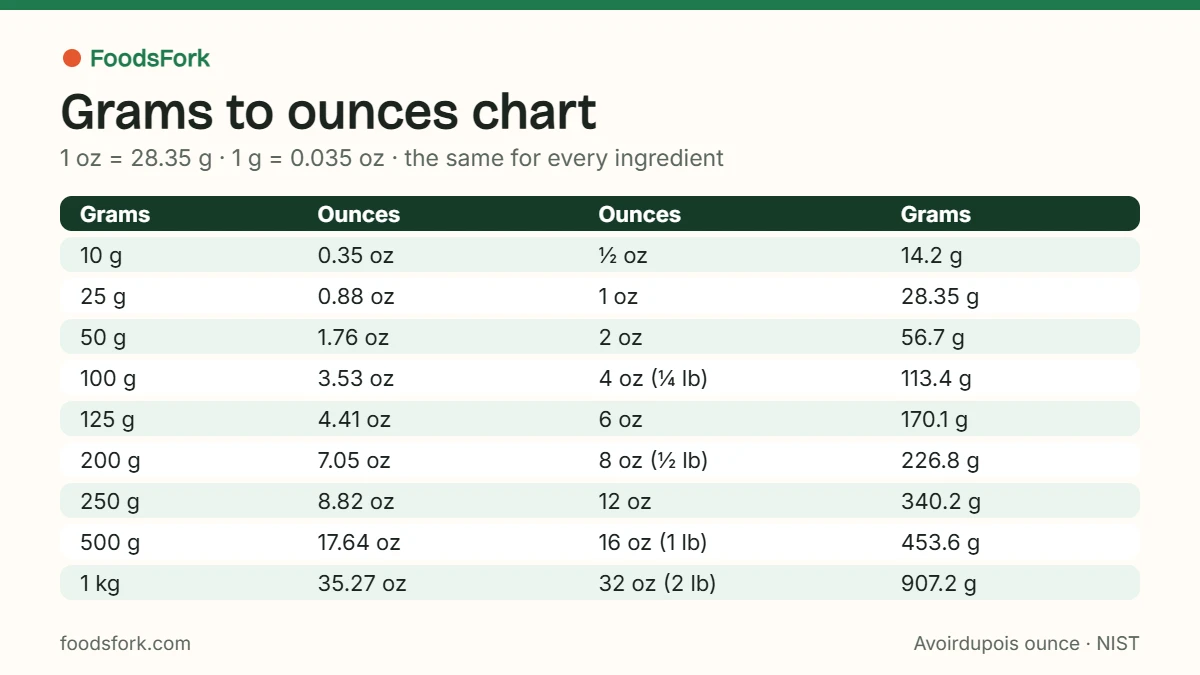
1 ounce = 28.35 grams, and 1 gram = 0.035 ounces. So 100 g is 3.53 oz, 250 g is 8.82 oz, 1 pound (16 oz) is 454 g and 1 kilogram is 35.27 oz. Unlike cups, ounces and grams both measure weight, so the conversion is the same for every ingredient.
Key facts
- 1 ounce = 28.35 g (28.349523125 g exactly).
- 1 gram = 0.035 oz.
- 100 g = 3.53 oz; 250 g = 8.82 oz.
- 1 pound = 16 oz = 453.6 g; 1 kg = 35.27 oz.
- Weight ounces are not fluid ounces: 1 US fl oz = 29.57 ml.
How to use the grams to ounces converter
Grams and ounces both measure weight, so this converter does not need to know what you are weighing. That makes it one of the simplest conversions in the kitchen, and one of the most useful when you are following a recipe from another country.
Below the converter, a list shows the amounts you are most likely to need, from 10 g to 1 kg, or from ½ oz to 2 lb when you switch direction. If you are working with a large amount, the Pounds and ounces box splits the result the way an American recipe would write it, for example 1 lb 1.64 oz instead of 17.64 oz.
How to convert grams to ounces
Since 1959, the ounce used for food has been defined as exactly 28.349523125 grams. That fixed number means the maths is always the same:
A few worked examples:
- 125 g of butter: 125 ÷ 28.35 = 4.41 oz, just over one US stick.
- 200 g of chocolate: 200 ÷ 28.35 = 7.05 oz, about 7 oz.
- 12 oz of pasta: 12 × 28.35 = 340 g.
- 1½ lb of chicken: 24 oz × 28.35 = 680 g.
For quick mental maths, multiply ounces by 28 and add a little, or divide grams by 30 and add a little. To go from grams to ounces in your head, divide by 30 and then add about 6 percent: 300 g ÷ 30 = 10, plus 6 percent gives 10.6 oz, very close to the exact 10.58 oz.
Grams to ounces chart
Use this chart for the gram amounts that appear most often in metric recipes. The fraction column rounds to the nearest eighth of an ounce, which matches the markings on most kitchen scales set to imperial units.
| Grams | Ounces | Nearest fraction | Pounds & ounces |
|---|---|---|---|
| 1 g | 0.04 oz | 0 oz | 0.04 oz |
| 5 g | 0.18 oz | ⅛ oz | 0.18 oz |
| 10 g | 0.35 oz | ⅓ oz | 0.35 oz |
| 15 g | 0.53 oz | ½ oz | 0.53 oz |
| 20 g | 0.71 oz | ⅔ oz | 0.71 oz |
| 25 g | 0.88 oz | ⅞ oz | 0.88 oz |
| 30 g | 1.06 oz | 1 oz | 1.06 oz |
| 40 g | 1.41 oz | 1⅜ oz | 1.41 oz |
| 50 g | 1.76 oz | 1¾ oz | 1.76 oz |
| 60 g | 2.12 oz | 2⅛ oz | 2.12 oz |
| 75 g | 2.65 oz | 2⅝ oz | 2.65 oz |
| 80 g | 2.82 oz | 2⅞ oz | 2.82 oz |
| 100 g | 3.53 oz | 3½ oz | 3.53 oz |
| 125 g | 4.41 oz | 4⅜ oz | 4.41 oz |
| 150 g | 5.29 oz | 5¼ oz | 5.29 oz |
| 175 g | 6.17 oz | 6⅛ oz | 6.17 oz |
| 200 g | 7.05 oz | 7 oz | 7.05 oz |
| 225 g | 7.94 oz | 7⅞ oz | 7.94 oz |
| 250 g | 8.82 oz | 8⅞ oz | 8.82 oz |
| 300 g | 10.58 oz | 10⅝ oz | 10.58 oz |
| 350 g | 12.35 oz | 12⅓ oz | 12.35 oz |
| 400 g | 14.11 oz | 14⅛ oz | 14.11 oz |
| 450 g | 15.87 oz | 15⅞ oz | 15.87 oz |
| 500 g | 17.64 oz | 17⅝ oz | 1 lb 1.64 oz |
| 600 g | 21.16 oz | 21⅛ oz | 1 lb 5.16 oz |
| 750 g | 26.46 oz | 26½ oz | 1 lb 10.46 oz |
| 800 g | 28.22 oz | 28¼ oz | 1 lb 12.22 oz |
| 900 g | 31.75 oz | 31¾ oz | 1 lb 15.75 oz |
| 1,000 g | 35.27 oz | 35¼ oz | 2 lb 3.27 oz |
Ounces to grams chart
Going the other way, here are common ounce amounts from American recipes and packaging. The rounded column is what most cooks would actually weigh out.
| Ounces | Grams | Rounded |
|---|---|---|
| ⅛ oz | 3.54 g | 4 g |
| ¼ oz | 7.09 g | 7 g |
| ½ oz | 14.17 g | 14 g |
| ¾ oz | 21.26 g | 21 g |
| 1 oz | 28.35 g | 28 g |
| 1½ oz | 42.52 g | 43 g |
| 2 oz | 56.70 g | 57 g |
| 3 oz | 85.05 g | 85 g |
| 4 oz | 113.40 g | 113 g |
| 5 oz | 141.75 g | 142 g |
| 6 oz | 170.10 g | 170 g |
| 7 oz | 198.45 g | 198 g |
| 8 oz | 226.80 g | 227 g |
| 9 oz | 255.15 g | 255 g |
| 10 oz | 283.50 g | 283 g |
| 12 oz | 340.19 g | 340 g |
| 14 oz | 396.89 g | 397 g |
| 16 (1 lb) oz | 453.59 g | 454 g |
| 20 oz | 566.99 g | 567 g |
| 24 oz | 680.39 g | 680 g |
| 32 (2 lb) oz | 907.18 g | 907 g |
Pounds and kilograms
American recipes and supermarkets often use pounds for larger amounts of meat, vegetables and flour. One pound is 16 ounces, or 453.59 grams. One kilogram is 1,000 grams, or about 2.2 pounds.
| Pounds | Ounces | Metric |
|---|---|---|
| ¼ lb | 4 oz | 113 g |
| ½ lb | 8 oz | 227 g |
| ¾ lb | 12 oz | 340 g |
| 1 lb | 16 oz | 454 g |
| 1½ lb | 24 oz | 680 g |
| 2 lb | 32 oz | 907 g |
| 2.2 lb | 35.27 oz | 1 kg |
| 3 lb | 48 oz | 1.36 kg |
| 5 lb | 80 oz | 2.27 kg |
| 10 lb | 160 oz | 4.54 kg |
A handy rule: a kilogram is a little more than 2 pounds, and half a kilogram (500 g) is a little more than 1 pound. So when a British recipe asks for 500 g of minced beef, a 1 lb pack from a US store is about 46 g short.
Weight ounces vs fluid ounces
The word “ounce” is used for two different things, and mixing them up is one of the most common conversion mistakes.
If a recipe lists a liquid in ounces, it almost always means fluid ounces. If it lists a dry ingredient such as flour, sugar or chocolate in ounces, it means weight. When in doubt, look at the rest of the recipe: if it also uses cups and spoons, liquids are probably fluid ounces. Our ml to cups converter handles liquid volumes.
Common package sizes in grams
American packaging is labeled in ounces and pounds, which can be confusing when a recipe from elsewhere gives grams. These are the sizes you will see most often:
| Product | US size | Metric |
|---|---|---|
| Stick of butter (US) | 4 oz | 113 g |
| Block of cream cheese | 8 oz | 227 g |
| Bag of chocolate chips | 12 oz | 340 g |
| Can of diced tomatoes | 14.5 oz | 411 g |
| Can of beans | 15 oz | 425 g |
| Box of pasta | 16 oz (1 lb) | 454 g |
| Box of brown sugar | 32 oz (2 lb) | 907 g |
| Bag of flour | 5 lb | 2.27 kg |
Most US labels also print the metric weight in small type next to the ounces, so check the front of the pack before you convert. Package sizes vary by brand and can change over time.
Why recipes use both ounces and grams
The United States uses the US customary system, so American recipes measure dry ingredients in cups and ounces and sell food by the pound. Almost every other country uses the metric system, where recipes are written in grams and kilograms. The United Kingdom officially moved to metric decades ago, but many British cooks still think in ounces and pounds, and older family recipes are often written that way. Australia, New Zealand, Canada and South Africa use grams for weight, though Canadian packaging often shows both.
The good news is that weight converts cleanly between the two systems. Unlike cups, which depend on the ingredient, an ounce of flour and an ounce of chocolate both weigh 28.35 grams. Once you know that single number, any recipe written by weight can be followed anywhere in the world.
Converting a whole recipe from ounces to grams
Older British baking recipes are a common reason to convert. Take a classic Victoria sponge written in ounces:
| Ingredient | Recipe | Exact grams | Weigh out |
|---|---|---|---|
| Self-raising flour | 8 oz | 226.8 g | 227 g |
| Caster sugar | 8 oz | 226.8 g | 227 g |
| Butter, softened | 8 oz | 226.8 g | 227 g |
| Eggs | 4 large | Not converted | 4 large |
| Strawberry jam | 4 oz | 113.4 g | 113 g |
Notice that the flour, sugar and butter are all the same weight. That equal-weights balance is what makes the cake work, and it survives the conversion perfectly as long as you use the same rounding for each ingredient. If you prefer round numbers, 225 g of each is fine, because all three move by the same amount. What you should avoid is rounding the flour to 225 g and the butter to 250 g, which changes the recipe.
- Convert every ingredient with the same factor before you start weighing.
- Keep eggs as a count unless the recipe gives them by weight.
- Leave liquids in fluid measures if the recipe gives them in pints or fluid ounces, and convert those to milliliters separately.
Ounces and grams for everyday portions
Nutrition labels and diet plans often use ounces for portions. These quick equivalents help when you are reading labels or planning meals:
- 1 oz of cheese is 28 g, about the size of two dice.
- 1 oz of nuts is 28 g, roughly a small handful or about 23 almonds.
- 3 oz of cooked meat or fish is 85 g, about the size of a deck of cards.
- 4 oz of raw meat is 113 g, a typical burger patty before cooking.
- 6 oz of yogurt is 170 g, a common single-serve pot in the US.
These visual guides are approximate, so use a scale when you need an exact amount.
Should you round an ounce to 28 g or 30 g?
The exact figure is 28.35 g, but cookbooks and websites round it differently. Older British cookbooks often used 25 g for 1 oz to keep recipes in neat multiples, which is about 12 percent light. Some modern books use 30 g, which is about 6 percent heavy.
For soups, stews and roasts these differences do not matter. For baking, they can. If a recipe was written in ounces, convert it with 28.35 g per ounce. If it was written in grams and lists ounces in brackets, trust the grams, because the ounces were probably rounded. When both are given and they do not agree, always stick to one system for the whole recipe so the proportions stay consistent.
Tip: never mix systems in one recipe. Weighing the flour in grams and the butter in ounces can shift the ratios enough to change the texture.
Grams or ounces: which is better for cooking?
Both work, but grams have a practical edge. A gram is a much smaller unit than an ounce, so recipes written in grams can be precise without fractions: 7 g of yeast is clearer than ¼ oz. Grams also scale more easily, because halving 350 g is simpler than halving 12⅓ oz. That is why most professional bakers and pastry chefs, including many in the United States, now write their recipes in grams.
Ounces still make sense for American recipes, packaged foods and anyone whose scale or habits are set up that way. The important thing is to choose one unit for each recipe and stick with it. If you switch your scale to grams for a new recipe, give it a week and you will probably find it faster than working in ounces.
Kitchen scale tips
- Switch units instead of converting. Most digital scales have a unit button that switches between grams and ounces, so you can weigh in whichever unit the recipe uses.
- Use grams for small amounts. Scales show grams in whole steps but ounces only in tenths or eighths, so grams are more precise for yeast, salt and spices.
- Tare between ingredients. Put the bowl on, press tare to zero it, add the first ingredient, then tare again before the next.
- Check your scale. A US nickel weighs 5 grams, which makes a quick accuracy check.
- Mind the maximum. Many kitchen scales top out at 5 kg (11 lb); weigh heavy items in batches.
Grams and ounces for meat and turkey
Meat is where grams and ounces meet most often. US stores sell by the pound and ounce, while many recipes and nutrition apps use grams.
Raw weight vs cooked weight
Meat loses water as it cooks, so it weighs less on the plate. A common rule of thumb is that 4 oz (113 g) of raw boneless meat cooks down to about 3 oz (85 g). Always check whether a recipe or nutrition label means raw or cooked weight.
Planning turkey by the pound
Turkey charts use pounds. Plan about 1 pound (454 g) of whole bird per person. That covers the bones and leaves a little for leftovers. The turkey per person calculator does this for any group size.
Once you know the weight, the turkey cooking time calculator gives you roasting, thawing and resting times. A 12 lb bird is 5.44 kg if your scale or oven guide uses kilograms.
Reading package labels
US food labels show net weight in both ounces and grams, for example “16 oz (454 g)”. When a recipe asks for a can or pack by weight, read the gram figure and skip the maths.
Common meat pack sizes
- 1 lb ground beef = 16 oz = 454 g.
- A quarter-pound burger patty = 4 oz = 113 g raw.
- A 6 oz salmon fillet = 170 g.
- A 2 lb pork tenderloin pack = 32 oz = 907 g.
Ounces of meat vs fluid ounces of stock
Stock, milk and wine are measured in fluid ounces, which are volume. One US fluid ounce is 29.57 ml. For liquids, use the ml to cups converter instead of a weight converter.
Frequently asked questions
How many grams are in an ounce?
There are 28.35 grams in one ounce. The exact figure is 28.349523125 grams, which is how the international avoirdupois ounce is defined. For everyday cooking, rounding to 28 grams is accurate enough.
How many ounces is 100 grams?
100 grams is 3.53 ounces, or about 3½ ounces.
How many grams is 8 ounces?
8 ounces is 226.8 grams, usually rounded to 227 grams. That is the weight of a standard block of cream cheese or two sticks of US butter.
How many grams are in a pound?
One pound is 16 ounces, which equals 453.59 grams. Most recipes round it to 454 grams, or 450 grams for convenience.
How many ounces are in a kilogram?
One kilogram is 35.27 ounces, or about 2 pounds 3¼ ounces.
Is an ounce 28 grams or 30 grams?
An ounce is 28.35 grams. Some cookbooks round it to 30 grams, and older British books often use 25 grams, to make the numbers easier. Those rounded figures are fine for forgiving recipes but can throw off baking.
Are weight ounces and fluid ounces the same?
No. Weight ounces (oz) measure how heavy something is, while fluid ounces (fl oz) measure how much space a liquid takes up. They only line up for water and similar liquids; 8 fluid ounces of flour weighs only about 4.2 ounces.
Is a troy ounce the same as a regular ounce?
No. Troy ounces are used for precious metals such as gold and silver and weigh 31.1 grams. Food is always measured in regular avoirdupois ounces of 28.35 grams.
How many ounces is 250 grams?
250 grams is 8.82 ounces, a little under 9 ounces. It is a common European butter block size and slightly more than two US sticks of butter.
How many grams is a quarter pound?
A quarter pound is 4 ounces, which is 113.4 grams, usually rounded to 113 grams. It is the size of a classic burger patty before cooking and one US stick of butter.
How many grams is 2 ounces?
2 ounces is 56.7 grams, which most cooks round to 57 grams.
How many grams is half an ounce?
Half an ounce is 14.2 g, because 1 ounce is 28.35 g.
How many grams is 4 ounces?
4 ounces is 113.4 g, usually rounded to 113 g. That is a quarter pound, and the weight of one US stick of butter.
Is 30 grams equal to 1 ounce?
Not quite. 30 g is 1.06 ounces, and 1 ounce is 28.35 g. Some recipes and labels round 1 ounce up to 30 g to keep numbers simple, which is fine for cooking but not for baking with small amounts.
How many ounces is 1 cup?
A US cup holds 8 fluid ounces of volume. Its weight in ounces depends on the ingredient: about 4.2 oz of all-purpose flour, 7 oz of granulated sugar and 8 oz of butter.
Related tools
Sources: NIST Office of Weights and Measures (US definitions of the pound and ounce). Package sizes are typical US retail sizes and vary by brand. See our disclaimer.