
Tablespoons to Cups Converter
Convert tablespoons to cups, cups to tablespoons and teaspoons to tablespoons. Get an easy cups-and-spoons measurement, plus milliliters and fluid ounces.
In the US system there are exactly 16 tablespoons in a cup and 3 teaspoons in a tablespoon. Spoon conversions are volume, so they work for any ingredient.
US customary definitions (NIST): 1 cup = 16 tbsp = 48 tsp
Tablespoons in common cup measures
Quick answer
There are 16 tablespoons in 1 cup, so to convert tablespoons to cups, divide by 16. 4 tbsp = ¼ cup, 5 tbsp + 1 tsp = ⅓ cup, 8 tbsp = ½ cup and 12 tbsp = ¾ cup. Each tablespoon holds 3 teaspoons, or about 14.8 ml.
Key facts
- 1 US cup = 16 tablespoons = 48 teaspoons.
- 1 tablespoon = 3 teaspoons = ½ fluid ounce = 14.8 ml.
- ⅓ cup is 5 tbsp + 1 tsp and ⅔ cup is 10 tbsp + 2 tsp.
- Metric tablespoons are 15 ml. Australian tablespoons are 20 ml.
- Tablespoons measure volume, so their weight in grams depends on the ingredient.
How to use the tablespoons to cups converter
This tool converts in three directions: tablespoons to cups, cups to tablespoons and teaspoons to tablespoons. Every result also shows teaspoons, milliliters and fluid ounces.
The “Measure it as” answer is the useful part when you’re halfway through a recipe. Ten tablespoons becomes ½ cup + 2 tbsp, and that’s much faster to measure than scooping ten times. The grid under the converter lists the tablespoons in every common cup measure.
How many tablespoons are in a cup?
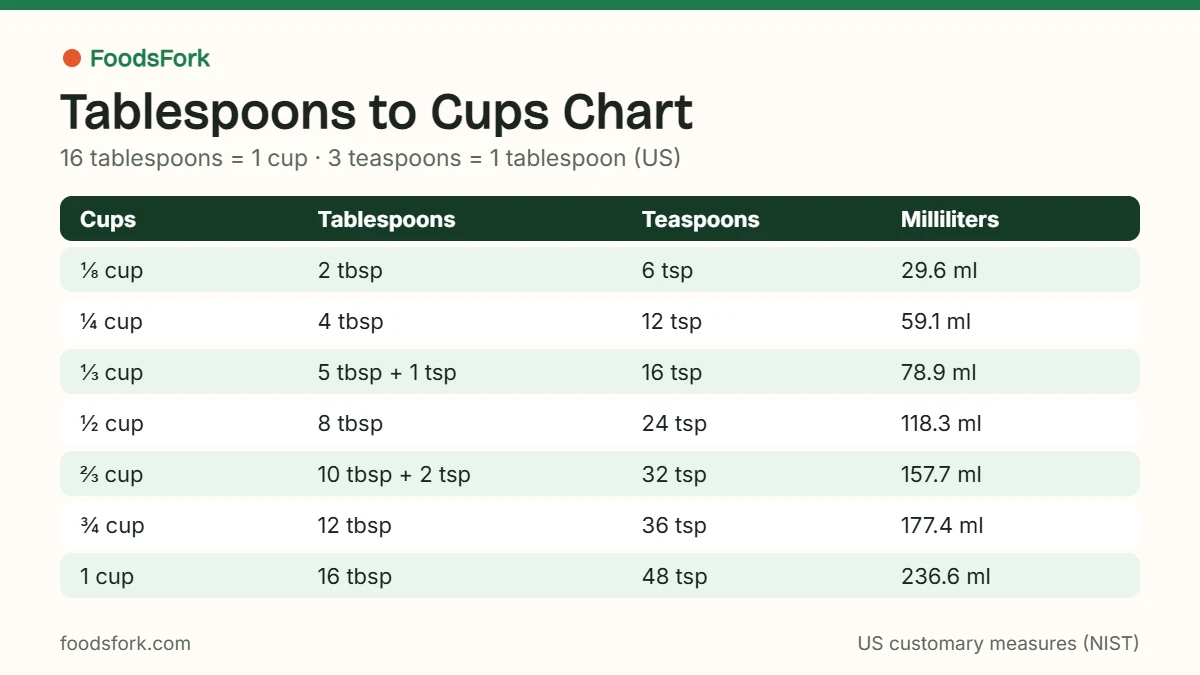
A US cup holds exactly 16 tablespoons. From there, every cup fraction has a matching number of tablespoons. This is the table most cooks end up memorizing:
| Cup measure | Tablespoons | Teaspoons | Milliliters |
|---|---|---|---|
| 1⁄16 cup | 1 tbsp | 3 tsp | 14.8 ml |
| ⅛ cup | 2 tbsp | 6 tsp | 29.6 ml |
| ¼ cup | 4 tbsp | 12 tsp | 59.1 ml |
| ⅓ cup | 5 tbsp + 1 tsp | 16 tsp | 78.9 ml |
| ⅜ cup | 6 tbsp | 18 tsp | 88.7 ml |
| ½ cup | 8 tbsp | 24 tsp | 118.3 ml |
| ⅔ cup | 10 tbsp + 2 tsp | 32 tsp | 157.7 ml |
| ¾ cup | 12 tbsp | 36 tsp | 177.4 ml |
| 1 cup | 16 tbsp | 48 tsp | 236.6 ml |
| 2 cups | 32 tbsp | 96 tsp | 473.2 ml |
Thirds are the awkward ones. Because 16 doesn’t divide evenly by 3, ⅓ cup is 5⅓ tablespoons. In practice you measure it as 5 tablespoons plus 1 teaspoon. Likewise, ⅔ cup is 10 tablespoons plus 2 teaspoons.
Why it’s 16
US kitchen units are built in halves. A cup is 8 fluid ounces. A fluid ounce is 2 tablespoons. That makes 16 tablespoons per cup. A tablespoon then splits into 3 teaspoons, which is why teaspoons don’t line up as neatly: there are 48 of them in a cup.
The tablespoons to cups formula
Worked examples
- 6 tablespoons of melted butter: 6 ÷ 16 = 0.375 cups, which is ⅜ cup or ¼ cup + 2 tbsp.
- 14 tablespoons of oil: 14 ÷ 16 = 0.875 cups, or ¾ cup + 2 tbsp.
- ⅔ cup of sugar in tablespoons: ⅔ × 16 = 10⅔ tbsp, or 10 tbsp + 2 tsp.
- Halving ⅓ cup: 5⅓ tbsp ÷ 2 = 2⅔ tbsp, which is 2 tbsp + 2 tsp.
That last example is the real reason to know tablespoons: they make halving and thirding recipes much easier. Our recipe scaler does this for whole recipes.
Tablespoons to cups chart
Use this chart to turn any number of tablespoons from 1 to 32 into cups. The “measure it as” column gives the simplest combination of US cups and spoons.
| Tablespoons | Cups (decimal) | Nearest fraction | Measure it as | Milliliters |
|---|---|---|---|---|
| 1 tbsp | 0.062 | 1⁄16 cup | 1 tbsp | 14.8 ml |
| 2 tbsp | 0.125 | ⅛ cup | 2 tbsp | 29.6 ml |
| 3 tbsp | 0.188 | 3⁄16 cup | 3 tbsp | 44.4 ml |
| 4 tbsp | 0.25 | ¼ cup | ¼ cup | 59.1 ml |
| 5 tbsp | 0.312 | 5⁄16 cup | ¼ cup + 1 tbsp | 73.9 ml |
| 6 tbsp | 0.375 | ⅜ cup | ¼ cup + 2 tbsp | 88.7 ml |
| 7 tbsp | 0.438 | 7⁄16 cup | ¼ cup + 3 tbsp | 103.5 ml |
| 8 tbsp | 0.5 | ½ cup | ½ cup | 118.3 ml |
| 9 tbsp | 0.562 | 9⁄16 cup | ½ cup + 1 tbsp | 133.1 ml |
| 10 tbsp | 0.625 | ⅝ cup | ½ cup + 2 tbsp | 147.9 ml |
| 11 tbsp | 0.688 | 11⁄16 cup | ⅔ cup + 1 tsp | 162.7 ml |
| 12 tbsp | 0.75 | ¾ cup | ¾ cup | 177.4 ml |
| 13 tbsp | 0.812 | 13⁄16 cup | ¾ cup + 1 tbsp | 192.2 ml |
| 14 tbsp | 0.875 | ⅞ cup | ¾ cup + 2 tbsp | 207.0 ml |
| 15 tbsp | 0.938 | 15⁄16 cup | ¾ cup + 3 tbsp | 221.8 ml |
| 16 tbsp | 1 | 1 cup | 1 cup | 236.6 ml |
| 18 tbsp | 1.125 | 1⅛ cups | 1 cup + 2 tbsp | 266.2 ml |
| 20 tbsp | 1.25 | 1¼ cups | 1¼ cups | 295.7 ml |
| 24 tbsp | 1.5 | 1½ cups | 1½ cups | 354.9 ml |
| 32 tbsp | 2 | 2 cups | 2 cups | 473.2 ml |
Teaspoons to tablespoons
A tablespoon is three teaspoons in both US and metric systems. For small amounts, such as spices, baking powder, extracts and salt, this is the conversion you need most.
| Teaspoons | Tablespoons | Milliliters |
|---|---|---|
| ½ tsp | ⅙ tbsp | 2.5 ml |
| 1 tsp | ⅓ tbsp | 4.9 ml |
| 1½ tsp | ½ tbsp | 7.4 ml |
| 2 tsp | ⅔ tbsp | 9.9 ml |
| 3 tsp | 1 tbsp | 14.8 ml |
| 4 tsp | 1⅓ tbsp | 19.7 ml |
| 6 tsp | 2 tbsp (⅛ cup) | 29.6 ml |
| 12 tsp | 4 tbsp (¼ cup) | 59.1 ml |
If you’ve lost your tablespoon, three level teaspoons do the same job. If you’ve lost your ⅛ cup measure, 2 tablespoons fill it exactly.
Tablespoon sizes around the world
Not every tablespoon is the same. If a recipe comes from another country, its tablespoon may hold a different amount:
| Tablespoon | Volume | Equals | Per cup |
|---|---|---|---|
| US tablespoon | 14.8 ml | 3 US teaspoons | 16 per US cup |
| Metric tablespoon | 15 ml | 3 metric teaspoons | 16⅔ per metric cup |
| Australian tablespoon | 20 ml | 4 metric teaspoons | 12½ per metric cup |
| Old UK tablespoon | about 17.7 ml | varies | about 16 per imperial cup |
| Dessert spoon (UK) | 10 ml | 2 teaspoons | — |
The difference between US (14.8 ml) and metric (15 ml) tablespoons is tiny, so you can use them interchangeably. The Australian tablespoon is a different story. At 20 ml it’s a third bigger. For a teaspoon of baking soda or a tablespoon of salt, that difference changes the result. When following an Australian recipe with US spoons, measure 1 tablespoon plus 1 teaspoon for every tablespoon listed.
How much does a tablespoon weigh?
Tablespoons measure volume, not weight. A tablespoon of flour and a tablespoon of honey take up the same space, but the honey weighs nearly three times as much. These are typical weights per level US tablespoon:
| Ingredient | Per tablespoon | Per teaspoon |
|---|---|---|
| Water | 14.8 g | 4.9 g |
| Milk | 15.3 g | 5.1 g |
| Butter | 14.2 g | 4.7 g |
| Vegetable oil | 13.6 g | 4.5 g |
| Honey | 21 g | 7 g |
| Granulated sugar | 12.4 g | 4.1 g |
| Brown sugar (packed) | 13.3 g | 4.4 g |
| All-purpose flour | 7.5 g | 2.5 g |
The figures come from King Arthur Baking’s ingredient weight chart and USDA FoodData Central, divided down from their cup weights. Flour varies most, because it packs down. For ingredient-specific conversions, use our cups to grams converter, and for butter, the butter conversion page.
Tablespoons of butter
US butter sticks are printed with tablespoon marks. One stick is 8 tablespoons, which is ½ cup or 113 g. So 2 tablespoons of butter is a quarter of a stick, and 4 tablespoons is half a stick. Just slice along the lines on the wrapper.
Halving and scaling cup measures with tablespoons
Tablespoons are the secret to cutting a recipe in half or making a third of it. Odd cup amounts are hard to split with measuring cups, but easy to split once you think in tablespoons.
| Recipe amount | In tablespoons | Half of it | A third of it |
|---|---|---|---|
| ¼ cup | 4 tbsp | 2 tbsp | 1 tbsp + 1 tsp |
| ⅓ cup | 5 tbsp + 1 tsp | 2 tbsp + 2 tsp | 1 tbsp + 2⅓ tsp |
| ½ cup | 8 tbsp | 4 tbsp (¼ cup) | 2 tbsp + 2 tsp |
| ⅔ cup | 10 tbsp + 2 tsp | 5 tbsp + 1 tsp (⅓ cup) | 3 tbsp + 1⅔ tsp |
| ¾ cup | 12 tbsp | 6 tbsp | 4 tbsp (¼ cup) |
| 1 cup | 16 tbsp | 8 tbsp (½ cup) | 5 tbsp + 1 tsp (⅓ cup) |
Write the converted amounts on the recipe before you start. It’s easy to halve the flour and forget to halve the butter halfway through. For bigger changes, such as turning a 12-serving cake into 5 servings, use our recipe scaler, which converts every ingredient at once.
Dry vs liquid tablespoons
A tablespoon is the same size whether you fill it with flour or milk, so there’s no separate “dry tablespoon”. But the way you fill it matters. Dry ingredients should be leveled flat. Liquids should be filled until the surface reaches the rim without spilling. Sticky ingredients like peanut butter and honey need to be scraped out fully with a small spatula or your finger.
Cups are different. In the US, dry measuring cups are meant to be filled and leveled, and liquid measuring cups have a pour spout and lines below the rim. Using a liquid cup for flour usually gives you too much, because you can’t level it.
Tablespoons in drinks and cocktails
Bartenders work in fluid ounces, and tablespoons convert neatly: 1 US fluid ounce = 2 tablespoons. So a standard 1½ oz jigger holds 3 tablespoons, a ¾ oz pour of lime juice is 1½ tablespoons, and ½ oz of simple syrup is 1 tablespoon. No jigger? A tablespoon makes a perfectly good substitute for home drinks.
Coffee is another common use. The National Coffee Association suggests 1 to 2 tablespoons of ground coffee per 6 fluid ounces of water as a starting point, then adjusting to taste. For the most consistent coffee, though, weigh the beans, because grind size changes how much fits in a spoon.
When to use a scale instead of spoons
Spoons are perfect for small amounts of liquid, spices and leaveners. They’re less reliable for flour, cocoa powder and powdered sugar, which pack down or fluff up depending on how you scoop. If a recipe gives grams, weigh those ingredients. A digital scale that reads in 1-gram steps is accurate enough for almost every home recipe, and it means one less spoon to wash.
How to measure with spoons accurately
- Level dry ingredients. Scoop, then sweep the back of a knife across the top. A heaped tablespoon of flour can hold twice the level amount.
- Fill liquids to the brim. Hold the spoon over a small bowl, not over your mixing bowl, so spills don’t end up in the recipe.
- Use real measuring spoons. Table spoons from your cutlery drawer vary a lot in size. A “tablespoon” for soup might hold anywhere from 7 to 20 ml.
- Grease the spoon for sticky things. A drop of oil helps honey, molasses and syrup slide out completely.
- Use a cup when you can. Measuring 12 tablespoons is slow and error-prone. Use a ¾ cup measure instead.
Heaping, rounded and scant
Older recipes sometimes describe spoonfuls instead of exact amounts. A heaping tablespoon is piled as high as it will go, often close to double. A rounded tablespoon has a gentle dome, roughly 1½ level spoons. A scant tablespoon is filled just short of the top. When a recipe says only “tablespoon”, assume level.
Tablespoon and teaspoon abbreviations
Recipes abbreviate spoons in different ways, and confusing them is a classic mistake:
- Tablespoon: tbsp, Tbsp, tbs, tbl, T (capital T).
- Teaspoon: tsp, t (lowercase t).
- Cup: c, C.
- Fluid ounce: fl oz.
The capital T versus lowercase t is the one to watch. Mixing them up means three times too much or too little. If a handwritten recipe is unclear, think about the ingredient: “1 T salt” in a small batch of cookies is far more likely to be a teaspoon.
Common tablespoons to cups mistakes
- Using 15 tablespoons per cup. It’s 16. The error is small per cup but adds up when scaling.
- Forgetting the extra teaspoon in ⅓ cup. Five tablespoons alone is only 0.31 cups.
- Mixing US and Australian spoons. An Australian tablespoon holds 20 ml, a third more than a US one.
- Counting cutlery spoons as tablespoons. Dinner spoons aren’t standard measures.
- Converting weight to spoons without the ingredient. “30 g = 2 tablespoons” is only true for water and similar liquids.
Tablespoons to cups FAQ
How many tablespoons are in a cup?
There are 16 tablespoons in 1 US cup. Half a cup is 8 tablespoons, a quarter cup is 4 tablespoons and three-quarters of a cup is 12 tablespoons.
How many tablespoons are in ¼ cup?
There are 4 tablespoons in ¼ cup.
How many tablespoons are in ⅓ cup?
There are 5⅓ tablespoons in ⅓ cup. Measure it as 5 tablespoons plus 1 teaspoon.
How many tablespoons are in ½ cup?
There are 8 tablespoons in ½ cup. That is also the amount in one US stick of butter.
How many tablespoons are in ⅔ cup?
There are 10⅔ tablespoons in ⅔ cup, which is 10 tablespoons plus 2 teaspoons.
How many tablespoons are in ¾ cup?
There are 12 tablespoons in ¾ cup.
How many cups is 8 tablespoons?
8 tablespoons is ½ cup.
How many cups is 6 tablespoons?
6 tablespoons is ⅜ cup, or ¼ cup plus 2 tablespoons.
How many teaspoons are in a tablespoon?
There are 3 teaspoons in 1 tablespoon in both the US and metric systems. An Australian tablespoon is bigger and holds 4 teaspoons.
How many teaspoons are in a cup?
There are 48 teaspoons in 1 US cup, because a cup has 16 tablespoons and each tablespoon has 3 teaspoons.
Is a tablespoon 15 ml?
A metric tablespoon is exactly 15 ml. A US tablespoon is slightly smaller at 14.8 ml, and an Australian tablespoon is 20 ml.
What does tbsp mean?
Tbsp is the abbreviation for tablespoon. Recipes may also write T, Tbs or tbl. A lowercase t or tsp means teaspoon.
Is a tablespoon of flour the same weight as a tablespoon of sugar?
No. Tablespoons measure volume, so the weight depends on the ingredient. A tablespoon of all-purpose flour weighs about 7.5 g, while a tablespoon of granulated sugar weighs about 12.4 g.
Related tools
Sources: NIST Office of Weights and Measures (US customary volume units); King Arthur Baking ingredient weight chart and USDA FoodData Central (ingredient weights). See our disclaimer.