
Calories to Foot-Pounds Converter (cal and kcal to ft·lbf)
Convert calories to foot-pounds of energy, or foot-pounds back to calories. Works with small calories, food Calories (kcal), joules, BTU and watt-hours, and shows how high that energy could lift a weight.
Food labels use Calories (kcal). 1 food Calorie = 1,000 small calories = about 3,086 foot-pounds.
| Unit | Same energy |
|---|
1 ft·lbf = 1.3558179483 J (exact) · 1 cal = 4.184 J · 1 food Calorie = 4,184 J = 3,085.96 ft·lbf
Quick answer
1 calorie = 3.08596 foot-pounds (ft·lbf), and 1 food Calorie (kcal) = 3,085.96 foot-pounds. To convert calories to foot-pounds, multiply small calories by 3.08596 or food Calories by 3,085.96. For example, a 95-Calorie apple holds about 293,166 foot-pounds of energy. To go the other way, multiply foot-pounds by 0.32405 to get small calories.
Key facts
- 1 cal = 4.184 J = 3.08596 ft·lbf.
- 1 food Calorie (kcal) = 4,184 J = 3,085.96 ft·lbf.
- 1 ft·lbf = 1.3558179483 J exactly = 0.32405 cal.
- Food labels use Calories (kcal), not small calories.
- The international table calorie (4.1868 J) gives 3.08803 ft·lbf.
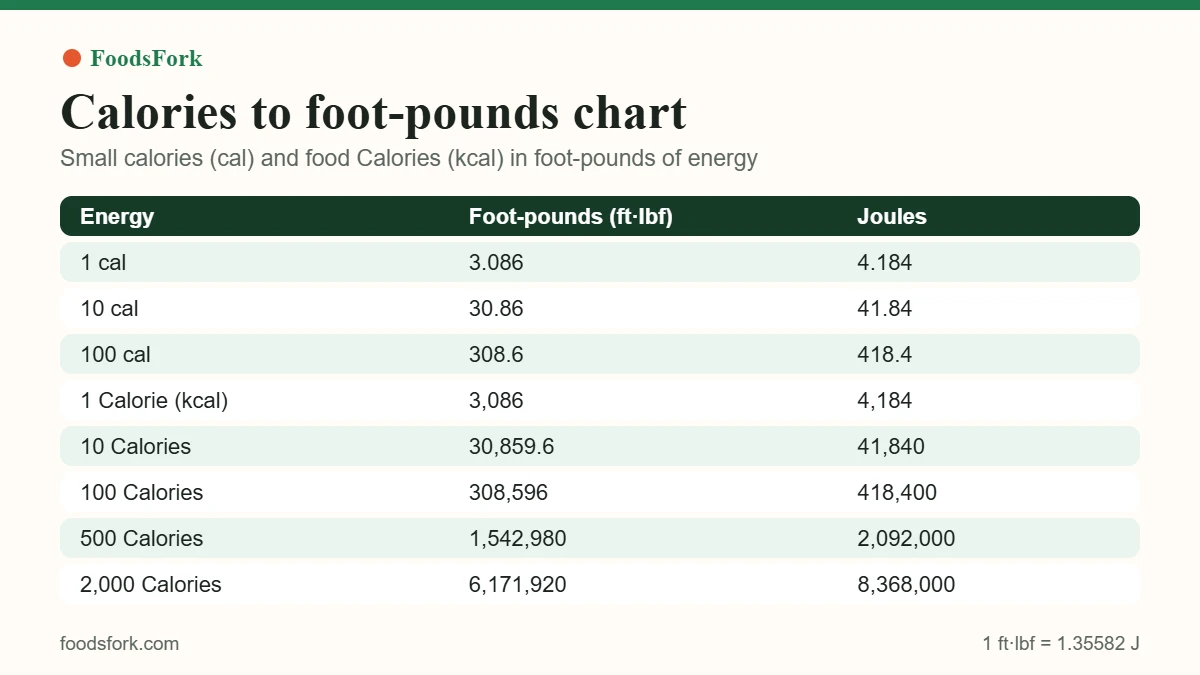
How to use the calories to foot-pounds converter
Calories vs Calories: the 1,000× trap
The word “calorie” means two different sizes of energy, and mixing them up gives answers that are 1,000 times off.
- Small calorie (cal): the energy to warm 1 gram of water by 1 °C. Used in chemistry and physics.
- Food Calorie (Cal or kcal): 1,000 small calories. This is the number on food labels and in our calories burned per day calculator.
| You see | It means | In foot-pounds |
|---|---|---|
| 1 cal | 1 small calorie | 3.086 ft·lbf |
| 1 Cal or 1 kcal | 1 food Calorie = 1,000 cal | 3,086 ft·lbf |
| “100 calories” on a snack | 100 food Calories | 308,596 ft·lbf |
If you are converting the energy in food, you almost always want food Calories (kcal). If you are working from a physics or chemistry problem, it is usually small calories.
A quick check helps. If your answer for a snack comes out in the hundreds of foot-pounds, you probably used small calories by mistake. A typical snack holds hundreds of thousands of foot-pounds. If a physics answer for warming a cup of water comes out in the millions, you probably used food Calories instead of small calories.
Which calorie? Thermochemical vs international
There are also a few slightly different definitions of the calorie itself:
| Calorie type | Joules | Foot-pounds per calorie | Used for |
|---|---|---|---|
| Thermochemical (cal) | 4.184 exactly | 3.08596 | Chemistry, nutrition science (default here) |
| International table (cal IT) | 4.1868 exactly | 3.08803 | Steam tables, engineering |
| 15 °C calorie | about 4.1855 | 3.08707 | Older physics texts |
The difference between them is under 0.1%, so for food it does not matter. For a homework problem, use the one your textbook names.
What is a foot-pound-force?
A foot-pound-force (ft·lbf), often shortened to foot-pound, is a U.S. customary unit of work or energy. It is the work done when a force of one pound pushes or lifts something one foot. Lift a 1 lb bag of sugar from the counter to a shelf 1 foot higher and you have done 1 foot-pound of work.
In metric terms, one foot-pound is exactly 1.3558179483314004 joules. It is used in engineering, in physics classes and for the muzzle energy of bullets in the United States.
Foot-pounds of energy vs pound-feet of torque
The same units also measure torque, the twisting force on a bolt or a wrench. Many engineers write torque as pound-feet (lb·ft) to keep the two apart. This page is about energy, so the answer is always foot-pounds of energy.
Calories to foot-pounds formulas
Where 3.08596 comes from
Both units can be written in joules. A calorie is 4.184 J and a foot-pound is 1.35582 J. So 1 calorie = 4.184 ÷ 1.35582 = 3.08596 foot-pounds. Multiply by 1,000 for a food Calorie: 3,085.96 foot-pounds.
Worked example: a slice of bread
A slice of bread has about 80 Calories. 80 × 3,085.96 = 246,877 foot-pounds. That much energy could, in theory, lift a 180 lb person about 1,372 feet straight up.
Calories to foot-pounds conversion tables
Small calories (cal) to foot-pounds
| Calories (cal) | Foot-pounds (ft·lbf) |
|---|---|
| 1 | 3.086 |
| 2 | 6.172 |
| 5 | 15.43 |
| 10 | 30.86 |
| 25 | 77.15 |
| 50 | 154.3 |
| 100 | 308.6 |
| 250 | 771.5 |
| 500 | 1,543 |
| 1,000 | 3,086 |
Food Calories (kcal) to foot-pounds
| Food Calories (kcal) | Foot-pounds (ft·lbf) |
|---|---|
| 1 | 3,086 |
| 5 | 15,429.8 |
| 10 | 30,859.6 |
| 50 | 154,298 |
| 100 | 308,596 |
| 200 | 617,192 |
| 500 | 1,542,980 |
| 1,000 | 3,085,960 |
| 2,000 | 6,171,920 |
| 2,500 | 7,714,900 |
Foot-pounds to calories
| Foot-pounds | Small calories (cal) | Food Calories (kcal) |
|---|---|---|
| 1 | 0.324 | 0.000324 |
| 10 | 3.24 | 0.00324 |
| 100 | 32.4 | 0.0324 |
| 1,000 | 324 | 0.324 |
| 10,000 | 3,240.5 | 3.24 |
| 100,000 | 32,404.8 | 32.4 |
| 1,000,000 | 324,048 | 324 |
Food energy as mechanical work
Converting food Calories to foot-pounds shows how much energy is packed into food. One food Calorie could lift about 3,086 lb one foot. That sounds like a lot, but your body cannot turn all food energy into movement.
Human muscles are only about 20% to 25% efficient at turning food energy into mechanical work. The rest becomes heat, which is why you warm up when you exercise. So to do 3,086 foot-pounds of real work, such as climbing stairs, your body burns about 4 to 5 food Calories, not 1.
Example: climbing stairs
A 180 lb person climbs 10 floors, about 100 feet. The work against gravity is 180 × 100 = 18,000 foot-pounds, or about 5.8 food Calories. At around 22% efficiency, the body burns roughly 27 Calories, plus a little more for resting metabolism and moving the arms and legs.
This is why exercise burns fewer Calories than many people hope, and why food choices matter so much for weight. The 4-4-9 rule shows where those Calories come from: carbs, protein and fat.
Common foods in foot-pounds
Approximate Calories for everyday foods, converted to foot-pounds, and how high that energy could lift a 180 lb person at 100% efficiency.
| Food | Calories (kcal) | Foot-pounds | Lift a 180 lb person |
|---|---|---|---|
| Large egg | 72 | 222,189 | 1,234 feet |
| Slice of bread | 80 | 246,877 | 1,372 feet |
| Medium apple | 95 | 293,166 | 1,629 feet |
| Medium banana | 105 | 324,026 | 1,800 feet |
| 12 oz can of cola | 140 | 432,034 | 2,400 feet |
| Candy bar | 250 | 771,490 | 4,286 feet |
| Fast-food burger | 550 | 1,697,278 | 1.8 miles |
| 2,000-Calorie day | 2,000 | 6,171,920 | 6.5 miles |
A whole day of food, 2,000 Calories, holds over 6 million foot-pounds of energy. Most of it keeps your heart, brain and organs running rather than moving you around.
Weightlifting in foot-pounds and Calories
Lifting weights is a neat way to see foot-pounds in action. The work in one rep is the weight times the distance it moves up. Here is how a few common lifts add up. The Calorie figures include the 20% to 25% muscle efficiency, so they show roughly what your body burns for the lifting itself.
| Lift | Weight × distance | Work per rep | Work for 3 sets of 10 | Food Calories burned |
|---|---|---|---|---|
| Bench press | 185 lb × 1.5 ft | 278 ft·lbf | 8,340 ft·lbf | about 12 |
| Squat | 225 lb × 2 ft | 450 ft·lbf | 13,500 ft·lbf | about 20 |
| Deadlift | 275 lb × 2 ft | 550 ft·lbf | 16,500 ft·lbf | about 24 |
| Dumbbell curl | 30 lb × 1.5 ft | 45 ft·lbf | 1,350 ft·lbf | about 2.0 |
These numbers count only the work of raising the weight. A real workout burns many more Calories, because your heart rate climbs, you breathe harder, and you also spend energy lowering the weight under control and rebuilding muscle afterwards. Still, the table shows why a single set of lifting does not undo a slice of cake.
Quick mental math for calories in foot-pounds-force
When you need calories in foot pounds-force without a calculator, these shortcuts get you close:
- Small calories: multiply by 3, then add about 3%. 50 cal × 3 = 150, plus 3% ≈ 154 ft·lbf (exact: 154.3).
- Food Calories: multiply by 3,000, then add about 3%. 200 kcal × 3,000 = 600,000, plus 3% ≈ 618,000 ft·lbf (exact: 617,192).
- Foot-pounds to calories: divide by 3, then take away about 3%. 300 ft·lbf ÷ 3 = 100, minus 3% ≈ 97 cal (exact: 97.2).
- Joules to foot-pounds: multiply by about ¾. 100 J ≈ 74 ft·lbf (exact: 73.76).
For homework or engineering, always use the full factors: 3.08596 for the thermochemical calorie or 3.08803 for the international table calorie.
Joule’s 772 foot-pounds
The link between heat and work was first measured in the 1840s by James Prescott Joule. He let a falling weight spin a paddle wheel in water and measured how much the water warmed. He found that about 772 foot-pounds of work raised 1 pound of water by 1 °F, the amount of heat called a British thermal unit (BTU).
Today we know 1 BTU is about 778 foot-pounds, very close to Joule’s result. His work showed that heat, food energy and mechanical work are all the same thing, energy, measured in different units.
Calories and other energy units
| Unit | Equals in joules | 1 food Calorie equals |
|---|---|---|
| Joule (J) | 1 | 4,184 J |
| Kilojoule (kJ) | 1,000 | 4.184 kJ |
| Foot-pound (ft·lbf) | 1.35582 | 3,086.0 ft·lbf |
| BTU (IT) | 1,055.06 | 3.966 BTU |
| Watt-hour (Wh) | 3,600 | 1.162 Wh |
Many countries print kilojoules on food labels instead of Calories. To convert, multiply kilocalories by 4.184. Need other kitchen conversions? Try the Fahrenheit to Celsius converter or the kg to pounds converter.
Common mistakes
| Mistake | What happens | Fix |
|---|---|---|
| Using small calories for food | Answer 1,000 times too small | Food labels are kcal; multiply by 3,085.96 |
| Using food Calories for a physics problem | Answer 1,000 times too big | Physics usually means cal; multiply by 3.08596 |
| Mixing up torque and energy | Wrong kind of answer | Energy is ft·lbf; torque is often lb·ft |
| Forgetting body efficiency | Exercise Calories look tiny | Multiply work by about 4 to 5 |
| Rounding too early | Small errors grow | Round only at the end |
Frequently asked questions
How many foot-pounds are in a calorie?
One small calorie (the thermochemical calorie, 4.184 joules) equals about 3.0860 foot-pounds of energy. If you use the international table calorie (4.1868 joules), it is about 3.0880 foot-pounds.
How many foot-pounds are in a food Calorie?
One food Calorie, the kilocalorie on a nutrition label, equals about 3,086.0 foot-pounds. That is 1,000 small calories.
How do you convert calories to foot-pounds?
Multiply calories by 3.08596 to get foot-pounds. For food Calories (kcal), multiply by 3,085.96. Both factors come from 4.184 joules per calorie divided by 1.3558 joules per foot-pound.
How many calories are in a foot-pound?
One foot-pound of energy equals about 0.3240 small calories, or 0.0003240 food Calories (kcal).
What does calories in foot pounds-force mean?
It means expressing an amount of energy measured in calories as foot-pounds-force (ft·lbf), the U.S. customary unit of work. A foot-pound-force is the work done by a force of one pound acting over one foot.
Is a foot-pound the same as a pound-foot?
For energy, foot-pound (ft·lbf) is the usual name. Pound-foot (lb·ft) is often preferred for torque, the twisting force on a bolt or engine. They use the same units, but energy and torque are different things, so check which one you need.
Which calorie do food labels use?
Food labels in the United States list kilocalories, usually written as Calories. Nutrition science normally uses the thermochemical value of 4.184 kilojoules per kilocalorie, which this converter uses by default.
How many calories does it take to lift 100 lb one foot?
Lifting 100 lb one foot takes 100 foot-pounds of work, about 32.4 small calories or 0.032 food Calories. Because muscles are only about 20% to 25% efficient, your body would actually burn about 0.13 to 0.16 food Calories.
How many joules are in a foot-pound?
Exactly 1.3558179483314004 joules. One joule is about 0.7376 foot-pounds.
Why are there different calories?
Scientists defined the calorie in slightly different ways over the years: the thermochemical calorie (4.184 J), the international steam table calorie (4.1868 J) and the 15 °C calorie (about 4.1855 J). The differences are less than 0.1%, so they rarely matter for food.
Related tools and guides
How we checked this page: conversion factors (1 ft·lbf = 1.3558179483 J; thermochemical calorie = 4.184 J; international table calorie = 4.1868 J) follow NIST Special Publication 811. Food Calorie values are approximate figures from USDA FoodData Central. Checked November 2026.