
Cake Pan Size Calculator
Swap one cake pan for another without guesswork. Compare round, square and rectangular pans in inches or centimeters, and find out how much to scale the recipe.
Measure across the inside top edge of the pan. For rectangles, enter the length and width. Leave depth at 2 inches unless your pans are noticeably deeper or shallower.
Area: round = π × radius² · square = side² · rectangle = length × width
Quick answer
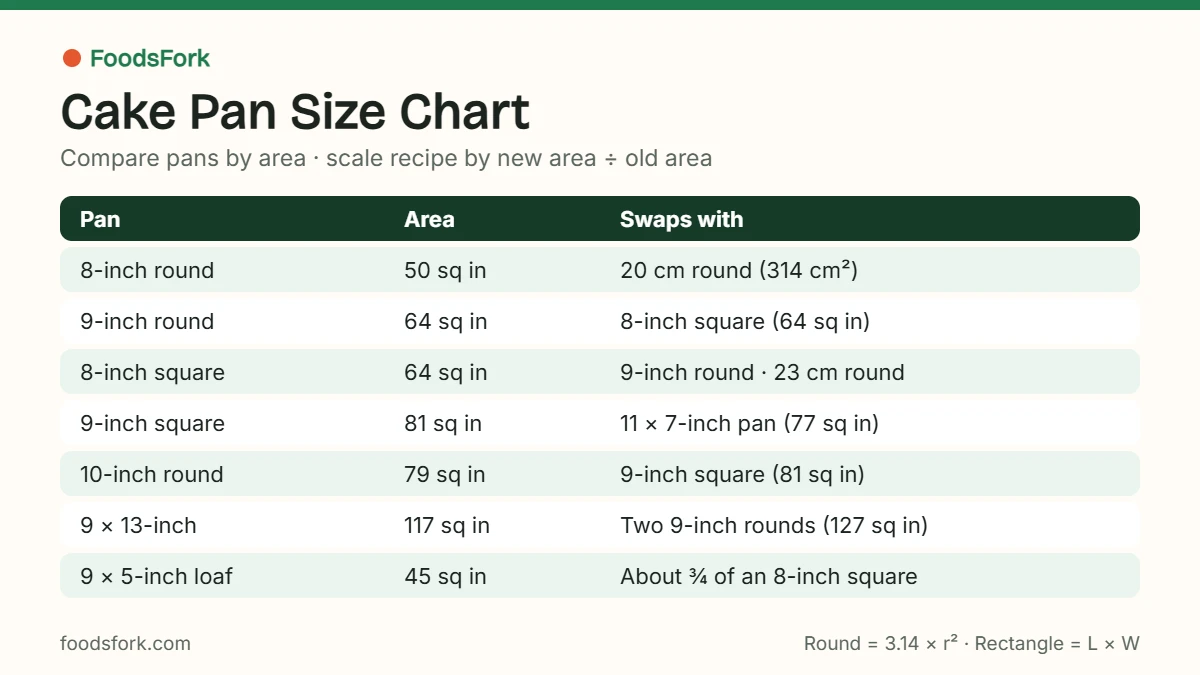
To switch cake pan sizes, compare the pans by area and scale the recipe by new area ÷ old area. An 8-inch round is 50 sq in, a 9-inch round is 64, an 8-inch square is 64, a 9-inch square is 81 and a 9 × 13 pan is 117. So a 9-inch round recipe needs about 1.8× the batter for a 9 × 13, and an 8-inch square swaps 1:1 with a 9-inch round.
Key facts
- Round pan area = 3.14 × radius². Square = side². Rectangle = length × width.
- Scaling factor = new pan area ÷ recipe pan area (when the depths match).
- 8-inch square = 9-inch round: both about 64 sq in.
- A 9 × 13 pan (117 sq in) ≈ two 9-inch rounds or 2⅓ 8-inch rounds.
- Shallower batter bakes faster. Deeper batter needs longer and a slightly cooler oven.
How to use the cake pan size calculator
This calculator tells you how much to scale a recipe when you switch to a different pan. It also shows how deep the batter will be if you don’t scale it, which tells you how the baking time will change.
If your pans are a different depth from the recipe’s pan, enter both depths. The calculator then compares volume instead of area. Most cake pans are 2 inches deep, so you can usually leave the depth alone.
How to compare cake pan sizes
A cake turns out right when the batter sits at the same depth it was designed for. Because most pans are the same depth, the easiest way to compare them is by the area of the base.
Then divide one area by the other. Going from a 9-inch round (64) to a 9 × 13 (117) gives 117 ÷ 64 = 1.83. Make 1.83 times the recipe, or simply double it and fill a few cupcakes with the extra.
Why diameter is misleading
A 10-inch round pan sounds only a little bigger than an 8-inch one. But area grows with the square of the radius, so the 10-inch pan holds about 56% more batter. That’s why swapping round pans by eye so often leads to flat or overflowing cakes.
Cake pan size chart
This chart lists the area of the most common baking pans, plus their approximate brim-full volume at 2 inches deep. Real pans have slightly sloped sides, so they hold a little less, and you’ll only fill them half to two-thirds full.
| Pan | Area | Volume at 2 in deep | Area (metric) |
|---|---|---|---|
| 6-inch round | 28 sq in | 3.9 cups | 182 cm² |
| 8-inch round | 50 sq in | 7.0 cups | 324 cm² |
| 9-inch round | 64 sq in | 8.8 cups | 410 cm² |
| 10-inch round | 79 sq in | 10.9 cups | 507 cm² |
| 12-inch round | 113 sq in | 15.7 cups | 730 cm² |
| 8-inch square | 64 sq in | 8.9 cups | 413 cm² |
| 9-inch square | 81 sq in | 11.2 cups | 523 cm² |
| 10-inch square | 100 sq in | 13.9 cups | 645 cm² |
| 11 × 7-inch | 77 sq in | 10.7 cups | 497 cm² |
| 9 × 13-inch | 117 sq in | 16.2 cups | 755 cm² |
| 10 × 15-inch jelly roll | 150 sq in | 20.8 cups | 968 cm² |
| 13 × 18-inch half sheet | 234 sq in | 32.4 cups | 1510 cm² |
| 8 × 4-inch loaf | 32 sq in | 4.4 cups | 206 cm² |
| 8½ × 4½-inch loaf | 38 sq in | 5.3 cups | 247 cm² |
| 9 × 5-inch loaf | 45 sq in | 6.2 cups | 290 cm² |
Loaf pan volumes in the chart assume a 2-inch depth for comparison. Most loaf pans are 2½ to 3 inches deep and hold more.
Cake pan substitution chart
These are the swaps bakers ask about most. The factor tells you how much to multiply the recipe by to keep the same batter depth.
| Recipe pan | Your pan | Factor | What to make |
|---|---|---|---|
| 8-inch round | 9-inch round | × 1.27 | About 1¼× the recipe |
| 9-inch round | 8-inch round | × 0.79 | About ¾ of the recipe |
| 9-inch round | 8-inch square | × 1.01 | About the same amount |
| 8-inch square | 9 × 13-inch | × 1.83 | About 1¾× the recipe |
| 9-inch round | 9 × 13-inch | × 1.84 | About 1¾× the recipe |
| Two 9-inch rounds | 9 × 13-inch | × 0.92 | About the same amount |
| Two 8-inch rounds | 9 × 13-inch | × 1.16 | About 1¼× the recipe |
| 9 × 13-inch | Two 8-inch squares | × 1.09 | About the same amount |
| 9 × 13-inch | 10 × 15-inch | × 1.28 | About 1¼× the recipe |
| 9 × 5-inch loaf | 8-inch square | × 1.42 | About 1½× the recipe |
| 9 × 5-inch loaf | 8 × 4-inch loaf | × 0.71 | About ¾ of the recipe |
| 9 × 13-inch | Half sheet (13 × 18) | × 2.00 | About 2× the recipe |
When the factor lands on an awkward number, round to something easy, like 1½ or 2, and bake the extra batter as cupcakes. Our recipe scaler multiplies the whole ingredient list for you.
Metric cake pan sizes
Recipes from the UK, Europe and Australia give pan sizes in centimeters. Here are the common ones in square centimeters and square inches, so you can match them to American pans:
| Pan | Area | In square inches |
|---|---|---|
| 18 cm round | 254 cm² | 39 sq in |
| 20 cm round | 314 cm² | 49 sq in |
| 23 cm round | 415 cm² | 64 sq in |
| 25 cm round | 491 cm² | 76 sq in |
| 20 cm square | 400 cm² | 62 sq in |
| 23 cm square | 529 cm² | 82 sq in |
| 23 × 33 cm | 759 cm² | 118 sq in |
| 900 g (2 lb) loaf | 242 cm² | 38 sq in |
A 20 cm round pan is close to an 8-inch round, and a 23 cm round pan matches a 9-inch round. Switch the calculator to Centimeters to compare metric pans directly.
Depth, filling and volume
Area is the best comparison when both pans have the same depth, which is true for most cake pans. When depths differ, such as a 3-inch-deep springform versus a 2-inch layer pan, compare volume instead: area × depth. Enter both depths in the calculator and it switches to volume automatically.
- Fill pans half to two-thirds full. Cakes need room to rise.
- Deeper isn’t always better. Very deep batter can sink in the middle or overbake at the edges before the center sets.
- Springform pans are usually 2½ to 3 inches deep, so they suit cheesecakes and tall cakes.
How to find a pan’s volume with water
For odd shapes, measure volume directly. Fill the pan to the brim with water, one cup at a time, and count the cups. Do the same with the pan you want to swap in, and compare the numbers.
Adjusting baking time and temperature
When you scale the recipe to match the new pan, the batter depth stays the same and the baking time stays about the same. Start checking about 5 minutes early anyway, because ovens vary.
If you don’t scale the recipe and pour the same batter into a different pan, the depth changes:
- Bigger pan, shallower batter: the cake bakes faster and can dry out. Start checking 10 minutes early.
- Smaller pan, deeper batter: the cake takes longer. Lower the oven by about 25 °F so the center cooks before the edges overbake, and allow extra time.
- Dark or nonstick pans bake faster than light aluminum. Many bakers reduce the temperature by 25 °F.
Always test with a toothpick or cake tester in the center. It should come out clean or with a few moist crumbs. Our Fahrenheit to Celsius converter helps if your oven uses Celsius.
Bundt pans, loaf pans and cupcakes
Bundt and tube pans
Bundt and tube pans have a center tube, so their area is hard to calculate. Measure their volume with water instead and fill them about two-thirds full. A standard 10-inch Bundt pan usually takes the batter of a two-layer 9-inch cake. Grease every crevice well so the cake releases cleanly.
Loaf pans
Loaf pans vary more than you’d expect. A 9 × 5-inch pan holds about 40% more than an 8 × 4-inch pan, which is why a quick bread recipe can overflow one and look flat in the other. Use the calculator’s rectangle setting to compare them.
Cupcakes
Cupcakes are the easiest way to use extra batter. A recipe for two 9-inch layers makes about 24 standard cupcakes. Fill liners about two-thirds full and bake for roughly half the layer-cake time, starting to check early.
How to measure a cake pan
- Measure the inside. Place the ruler across the top of the pan from one inside wall to the other. Pans are sold by their top inside measurement.
- Ignore the rim. Don’t include any lip or handles.
- Measure depth inside. Stand the ruler on the bottom and read the height at the rim.
- Check the label. Many pans have their size stamped on the base, sometimes in both inches and centimeters.
Using the calculator to choose your cake pan size before you start baking saves a lot of guesswork, and a lot of overflowing batter on the oven floor.
Common cake pan size mistakes
- Comparing diameters instead of areas. A 10-inch round holds over 50% more than an 8-inch round.
- Overfilling. More than two-thirds full risks overflow and a sunken middle.
- Keeping the original time. A shallower layer can be done 10 minutes early.
- Forgetting the depth. A deep springform and a shallow layer pan of the same diameter hold very different amounts.
- Skipping the pan prep. Grease and line new or unusual pans, especially Bundt and loaf pans.
Cake pan size FAQ
How do I convert a recipe to a different pan size?
Work out the area of both pans. Divide the new pan's area by the original pan's area, then multiply every ingredient by that number. A round pan's area is 3.14 × radius², a square is side × side and a rectangle is length × width.
Can I use a 9-inch round pan instead of an 8-inch round?
Yes. A 9-inch round pan has about 27% more area than an 8-inch round, so the cake will be a little thinner and bake a few minutes faster. To keep the same thickness, make about 1.25 times the recipe.
Is an 8-inch square pan the same as a 9-inch round?
Almost exactly. An 8-inch square pan has an area of 64 square inches and a 9-inch round pan has about 64 square inches, so you can swap them without changing the recipe.
How many 8-inch round pans equal a 9 × 13 pan?
A 9 × 13 pan (117 sq in) holds about the same batter as 2⅓ 8-inch round pans (50 sq in each). Two 8-inch rounds plus a few cupcakes is a good match.
Can I bake a 9 × 13 cake in two 9-inch round pans?
Yes. Two 9-inch rounds (about 127 sq in together) hold slightly more than a 9 × 13 pan (117 sq in), so the layers will be a little thinner. Start checking for doneness about 5 to 10 minutes early.
How do I change the baking time for a different pan?
Baking time depends on how deep the batter is. Shallower batter in a bigger pan bakes faster, so check early. Deeper batter in a smaller pan needs longer, and lowering the oven by about 25 °F helps the middle cook before the edges overbake.
How full should a cake pan be?
Fill cake pans about half to two-thirds full. That leaves room for the cake to rise without overflowing.
How do I measure a cake pan?
Measure across the inside of the pan at the top edge, from one inner wall to the other. Measure depth on the inside from the bottom to the rim. Don't include the pan's lip or handles.
How many cupcakes does a cake recipe make?
A recipe for two 9-inch layers usually makes about 24 standard cupcakes. Fill each liner about two-thirds full and bake for roughly half the time of the layer cake, checking early.
How do I find the volume of a Bundt or tube pan?
Fill it with water using a measuring cup and count the cups. Then fill it about two-thirds full of batter. A recipe that fills two 9-inch round pans usually suits a standard 10-inch Bundt pan.
Does pan material affect baking time?
Yes. Dark metal pans absorb more heat and bake faster, so many bakers lower the oven by about 25 °F. Glass pans also heat up more slowly but hold heat longer; follow the recipe or lower the temperature slightly and check early.
What size is a quarter sheet pan?
A quarter sheet pan is about 9 × 13 inches, and a half sheet pan is about 13 × 18 inches. Exact sizes vary a little by brand.
Related tools
Sources: King Arthur Baking: alternative baking pan sizes; pan areas and volumes calculated from standard dimensions (1 US cup = 14.44 cubic inches, per NIST definitions). See our disclaimer.