
Brine Calculator: Salt to Water Ratio for Any Brine
Use this brine calculator to get the exact salt for turkey, chicken, pork, seafood or pickles. Enter your water and salt type to get grams and easy cup and spoon measurements.
Strength is salt as a percentage of the water’s weight. Picking a food fills in a typical strength; you can change it.
Salt = water weight × strength. Table salt 6 g, Morton kosher 4.8 g, Diamond Crystal 2.8 g per teaspoon.
Quick answer
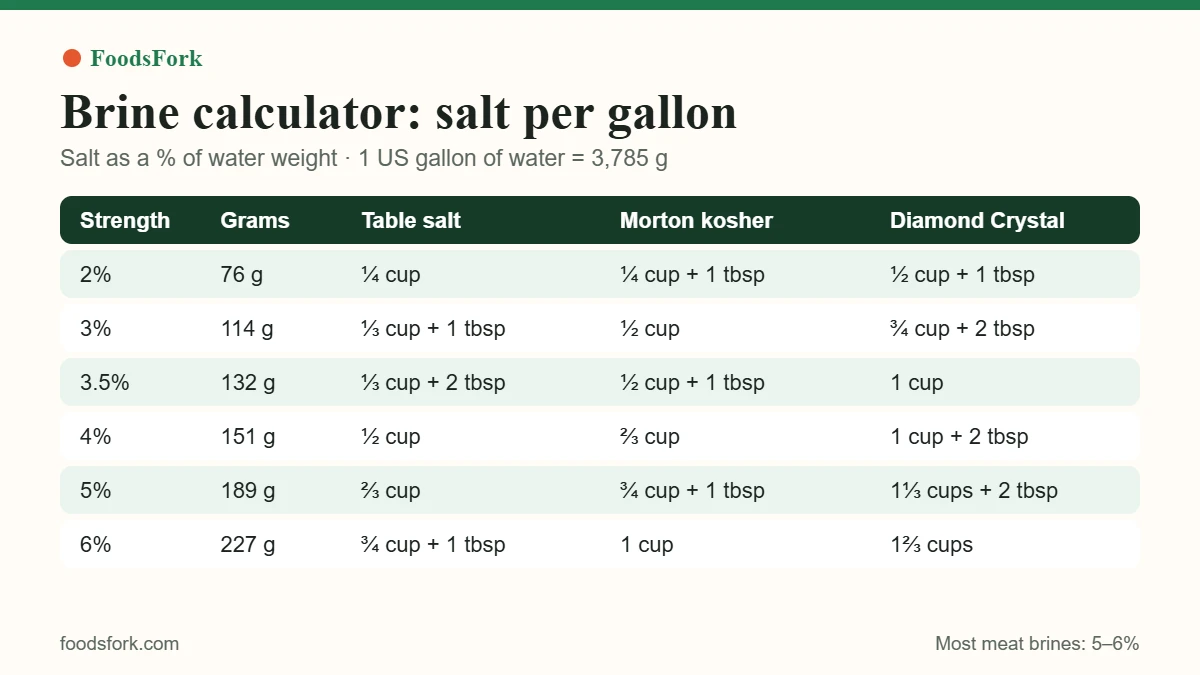
A standard meat brine is 5% salt by weight of the water: 50 g of salt per liter, or 189 g per gallon. In cups, that is about ⅔ cup of table salt, ¾ cup + 1 tbsp of Morton kosher salt or 1⅓ cups + 2 tbsp of Diamond Crystal kosher salt per gallon. The USDA poultry brine is ¾ cup of salt per gallon (3 tbsp per quart). Fermented pickles use 3.5% to 5%.
Key facts
- Salt (g) = water (g) × strength ÷ 100. One liter of water weighs 1,000 g.
- Meat and poultry: 5% to 6%. Pickles: 3.5% to 5%. Other ferments: 2% to 3%.
- Kosher salts weigh much less per cup: Diamond Crystal needs about twice the volume of table salt.
- Keep brining food at 40 °F or below and brine no longer than 2 days (USDA).
- Never reuse a brine that held raw meat.
How the brine calculator works
A brine is just salt dissolved in water. Its strength is the salt’s weight as a percentage of the water’s weight. That is the standard way cooks and food scientists describe a brine, and it is what this calculator uses.
Why weigh the salt?
A cup of salt can weigh anywhere from about 135 g to 290 g, depending on the crystals. Weight never changes. If you have a kitchen scale, weigh the grams and ignore the cups. Our grams to ounces converter helps if your scale only shows ounces.
Percent of water or percent of brine?
Some recipes measure salt as a percentage of the finished brine (salt plus water) instead of the water alone. At normal strengths the difference is tiny. A 5% brine by water weight is about 4.8% by total weight, which makes no real difference in the kitchen.
Brine ratio charts
These charts show the salt for common strengths. Cup and spoon amounts are rounded to measures you can actually use.
Salt per gallon of water
| Strength | Salt (grams) | Table salt | Morton kosher | Diamond Crystal |
|---|---|---|---|---|
| 2% | 76 g | ¼ cup | ¼ cup + 1 tbsp | ½ cup + 1 tbsp |
| 3% | 114 g | ⅓ cup + 1 tbsp | ½ cup | ¾ cup + 2 tbsp |
| 3.5% | 132 g | ⅓ cup + 2 tbsp | ½ cup + 1 tbsp | 1 cup |
| 4% | 151 g | ½ cup | ⅔ cup | 1 cup + 2 tbsp |
| 5% | 189 g | ⅔ cup | ¾ cup + 1 tbsp | 1⅓ cups + 2 tbsp |
| 6% | 227 g | ¾ cup + 1 tbsp | 1 cup | 1⅔ cups |
Salt per quart of water
| Strength | Salt (grams) | Table salt | Morton kosher | Diamond Crystal |
|---|---|---|---|---|
| 2% | 19 g | 1 tbsp | 1 tbsp + 1 tsp | 2 tbsp + 1 tsp |
| 3% | 28 g | 1 tbsp + 1½ tsp | 2 tbsp | 3 tbsp + 1 tsp |
| 3.5% | 33 g | 1 tbsp + 2½ tsp | 2 tbsp + 1 tsp | 4 tbsp |
| 4% | 38 g | 2 tbsp + ½ tsp | 2 tbsp + 2 tsp | ¼ cup + 1 tbsp |
| 5% | 47 g | 2 tbsp + 2 tsp | 3 tbsp + 1 tsp | ⅓ cup + 1 tbsp |
| 6% | 57 g | 3 tbsp + ½ tsp | 4 tbsp | ⅓ cup + 2 tbsp |
Salt per liter of water
| Strength | Salt (grams) | Table salt | Morton kosher | Diamond Crystal |
|---|---|---|---|---|
| 2% | 20 g | 1 tbsp + ½ tsp | 1 tbsp + 1 tsp | 2 tbsp + 1 tsp |
| 3% | 30 g | 1 tbsp + 2 tsp | 2 tbsp | 3 tbsp + 1½ tsp |
| 3.5% | 35 g | 2 tbsp | 2 tbsp + 1½ tsp | ¼ cup |
| 4% | 40 g | 2 tbsp + ½ tsp | 2 tbsp + 2½ tsp | ¼ cup + 1 tbsp |
| 5% | 50 g | 2 tbsp + 2½ tsp | 3 tbsp + 1½ tsp | ⅓ cup + 1 tbsp |
| 6% | 60 g | 3 tbsp + 1 tsp | ¼ cup | ⅓ cup + 2 tbsp |
For smaller amounts, 1 cup of water is a quarter of a quart. The tablespoons to cups converter helps you split these measures, and the ml to cups converter turns metric water amounts into cups.
Table salt vs kosher salt in a brine
This is the biggest source of brining mistakes. Different salts have different crystal shapes, so a cup of one weighs far more than a cup of another.
| Salt | Weight per teaspoon | Weight per cup | Compared with table salt |
|---|---|---|---|
| Table salt or fine sea salt | About 6 g | About 290 g | Same |
| Pickling or canning salt | About 6 g | About 290 g | Same |
| Morton kosher salt | About 4.8 g | About 230 g | Use about 1¼ times the volume |
| Diamond Crystal kosher salt | About 2.8 g | About 135 g | Use about twice the volume |
Weights per teaspoon are worked out from the serving sizes printed on US salt packages. Exact weights vary a little by batch.
So when a recipe says “1 cup of kosher salt,” it matters which brand the writer used. One cup of Morton kosher salt holds about 70% more salt than one cup of Diamond Crystal. If you are not sure, go by weight.
Iodized salt
Iodized table salt works for meat brines. For fermented pickles and vegetables, choose non-iodized salt, such as pickling salt, kosher salt or pure sea salt. Some cooks find iodine and anti-caking agents cloud the brine or slow fermentation.
Comparing salt in recipes more generally? See our guide to salted vs unsalted butter, which converts between the same three salts.
How long to brine
Time depends on the size of the food and the strength of the brine. Thin, small pieces take on salt quickly; a whole turkey needs much longer. These times are for a 5% to 6% brine in the fridge.
| Food | Typical strength | Brining time |
|---|---|---|
| Whole turkey (12–16 lb) | 5–6% | 12–24 hours |
| Turkey breast, bone-in | 5–6% | 6–12 hours |
| Whole chicken | 5–6% | 4–12 hours |
| Chicken pieces, bone-in | 5% | 2–4 hours |
| Boneless chicken breasts | 5% | 30 minutes–2 hours |
| Pork chops (1 inch thick) | 5% | 1–4 hours |
| Pork loin or roast | 5% | 8–12 hours |
| Shrimp | 5% | 15–30 minutes |
| Fish fillets | 5% | 15–30 minutes |
Weaker brine, longer time
A milder brine of 2% to 3% can run longer without making the meat too salty. A stronger brine of 8% to 10% works faster but is easy to overdo. If you change the strength, change the time in the opposite direction.
Signs you brined too long
The meat tastes salty all the way through and the texture turns spongy or ham-like. Next time, shorten the time or lower the strength. Remember that drippings from brined meat are salty too, so taste your gravy before you season it.
How to brine a turkey
- Check the label. Do not brine a kosher, self-basting or “enhanced” turkey. They are already salted.
- Thaw it first. The turkey must be fully thawed. Our turkey thawing guide has times by weight.
- Make the brine. For a 5% brine, dissolve 189 g of salt per gallon of water. Dissolve it in a little warm water, then add the rest cold.
- Chill and submerge. Place the turkey breast down in a food-safe bucket, stainless pot or brining bag. Pour in the cold brine until the bird is covered.
- Refrigerate. Brine for 12 to 24 hours at 40 °F or below.
- Dry and roast. Remove the turkey, pat it very dry and roast it. Throw the brine away.
Brined turkeys often cook a little faster, so start checking early. Plan the roast with our turkey cooking time calculator and check doneness with a thermometer: see where to put the thermometer in a turkey. The turkey is done at 165 °F.
No room in the fridge?
Use a large cooler. Put the turkey and brine in a brining bag inside the cooler, and add sealed bags of ice to keep everything at 40 °F or below. Check the temperature with a thermometer and add ice as needed.
How much brine do you need?
You need enough brine to cover the food completely. The exact amount depends on the shape of your container more than the food itself.
- Whole turkey (12–16 lb): usually 2 to 3 gallons in a bucket, or less in a brining bag that hugs the bird.
- Whole chicken: about 2 to 3 quarts in a large bowl or pot.
- Chicken pieces or pork chops: about 1 to 2 quarts in a zip-top bag.
- Shrimp or fish: about 1 quart per pound.
A quick way to measure
Put the food in its container and add plain water until it is covered. Lift the food out and measure the water. That is how much brine to make.
Brine for pickles and fermented vegetables
Fermented vegetables use a lower-salt brine. The salt keeps harmful bacteria out while friendly lactic acid bacteria sour the vegetables.
| Ferment | Brine strength | Salt per liter of water |
|---|---|---|
| Cucumber pickles (half-sour) | 2.5–3% | 25–30 g |
| Cucumber pickles (full sour) | 3.5–5% | 35–50 g |
| Carrots, green beans, cauliflower | 2–3% | 20–30 g |
| Peppers and hot sauce mash | 3–5% | 30–50 g |
| Garlic | 3% | 30 g |
Sauerkraut and kimchi are usually salted by the weight of the vegetables, about 2% to 2.5%, rather than covered in a separate brine. Vinegar pickles are a different method again and follow their own tested recipes.
Tips for crisp fermented pickles
- Use fresh, firm cucumbers and trim the blossom end.
- Keep the vegetables fully under the brine with a weight.
- Ferment somewhere cool, ideally 60 to 75 °F.
- Taste after a week, and move the jar to the fridge when you like the sourness.
Sugar and flavorings in a brine
Salt does the real work in a brine. Sugar is optional. It balances the saltiness and helps the skin brown. A common amount is half as much sugar as salt by weight, or the same weight for a sweeter brine.
- Brown sugar, honey or maple syrup add flavor as well as sweetness.
- Aromatics: garlic, bay leaves, peppercorns, thyme, rosemary and citrus peel are classics.
- Liquids: apple cider or a little vinegar can replace some water. Avoid strongly acidic brines for long times; they can turn meat mushy.
Heat the aromatics in part of the water to release their flavor, then cool the brine completely before adding the food.
Wet brine vs dry brine
| Wet brine | Dry brine | |
|---|---|---|
| What it is | Food soaks in salted water | Salt is rubbed onto the meat |
| Space needed | Large container in the fridge | Just a tray |
| Skin | Can be softer | Crisper and browner |
| Moisture | Adds some water | Keeps the meat’s own juices |
| Typical salt | 5% brine | About ½ to 1% of the meat’s weight |
For a dry brine, use roughly ½ teaspoon of table salt or 1 teaspoon of Diamond Crystal kosher salt per pound of meat. Rub it all over, then refrigerate uncovered on a rack for 12 to 48 hours. Many cooks prefer dry brining for turkey because the skin crisps better.
Brining safely
- Keep it cold. Food and brine must stay at 40 °F or below the whole time. Never brine on the counter, in a garage or on a porch.
- Use a food-safe container. Food-grade plastic, stainless steel, glass or a brining bag. Avoid aluminum, which reacts with salt.
- Do not brine too long. The USDA advises no longer than 2 days for turkey.
- Do not reuse brine. Throw it away after one use.
- Cook to a safe temperature. Poultry is done at 165 °F; pork chops and roasts at 145 °F with a 3-minute rest. See our chicken internal temperature guide.
Brined food is saltier. If you are watching your sodium, use a milder brine or a shorter time, and do not add salt to the rub.
Common brining mistakes
| Mistake | What happens | Fix |
|---|---|---|
| Swapping salts by the cup | Brine far too strong or weak | Weigh the salt, or use the calculator |
| Brining an enhanced turkey | Very salty meat | Check the label first |
| Adding food to warm brine | Food safety risk | Chill the brine below 40 °F first |
| Brining too long | Spongy, salty meat | Follow the time chart |
| Not drying the meat | Pale, soft skin | Pat dry; rest uncovered in the fridge |
| Salting the gravy as usual | Salty gravy | Taste the drippings first |
Frequently asked questions
How much salt do I need for 1 gallon of brine?
For a standard 5% meat brine, add 189 g of salt to 1 gallon of water. That is about ⅔ cup of table salt, ¾ cup plus 1 tbsp of Morton kosher salt, or about 1⅓ cups plus 2 tbsp of Diamond Crystal kosher salt. The USDA's poultry brine uses ¾ cup of table salt per gallon, about 5.7%.
What is the ratio of salt to water for a brine?
Most meat brines use 5% to 6% salt by weight of the water, or 50 to 60 g of salt per liter. In cups, that is about 3 tablespoons of table salt per quart, or ¾ cup per gallon. Fermented pickles use 3% to 5%, and sauerkraut-style ferments about 2% to 2.5%.
How much kosher salt do I use for a turkey brine?
For 1 gallon of water at 5%, use about ¾ cup plus 1 tbsp of Morton kosher salt or about 1⅓ cups plus 2 tbsp of Diamond Crystal kosher salt. Diamond Crystal is much lighter, so you need almost twice the volume. Weighing the salt avoids the problem: 189 g per gallon for 5%.
How long should I brine a turkey?
In a 5% brine, brine a whole turkey for 12 to 24 hours in the fridge. Use the shorter time for smaller birds or stronger brines. The USDA advises keeping the turkey and brine at 40 °F or below and not brining longer than 2 days.
How long do you brine chicken?
Brine a whole chicken for 4 to 12 hours, bone-in pieces for 2 to 4 hours, and boneless breasts for 30 minutes to 2 hours in a 5% brine. Thin cuts take on salt fast, so longer is not better.
Can I use table salt instead of kosher salt in a brine?
Yes. Salt is salt by weight, so 189 g of table salt and 189 g of kosher salt make the same brine. By volume they are very different, so use the calculator to convert, or weigh the salt.
Do I rinse meat after brining?
A quick rinse removes surface salt, but it can splash bacteria around the sink. Most cooks simply pat the meat very dry with paper towels instead. Either way, dry it well so the skin browns.
What percentage brine should I use for pickles?
Fermented cucumber pickles usually use a 3.5% to 5% brine, which is about 35 to 50 g of salt per liter of water. Lower amounts ferment faster but can turn soft. Use non-iodized salt.
Can I reuse a brine?
Do not reuse a brine that has held raw meat or poultry. It contains raw juices. Throw it away and make a fresh batch next time.
Should I brine a kosher or self-basting turkey?
No. Kosher turkeys are already salted, and self-basting or “enhanced” turkeys are injected with a salt solution. Brining them again makes them too salty. Check the label for words like “contains up to X% solution.”
What is the difference between a wet brine and a dry brine?
A wet brine soaks the food in salted water. A dry brine rubs salt straight onto the meat and lets it rest in the fridge. Dry brining needs no container and gives crisper skin; wet brining adds a little more moisture.
Related tools and guides
How we checked this page: brine strength is salt as a percentage of water weight, using 1 ml of water = 1 g. Salt weights per teaspoon come from US package serving sizes. Poultry brine guidance (¾ cup salt per gallon, 40 °F or below, no longer than 2 days) is from the USDA Food Safety and Inspection Service. Brining times are typical ranges used by cooking schools and test kitchens. Checked November 2026.