
Coffee to Water Ratio Calculator for Every Brew Method
Find the perfect coffee to water ratio for drip, pour-over, French press, AeroPress, moka pot, cold brew and espresso. Enter your water or coffee to get grams and tablespoons.
Ratios are by weight: 1:16 means 1 g of coffee for every 16 g (16 ml) of water. For espresso, the second number is the drink weight, not the water.
SCA Golden Cup: 55 g coffee per liter of water (about 1:18) · 1 level tbsp of ground coffee ≈ 5 g
Quick answer
A good everyday coffee to water ratio is 1:16: 1 gram of coffee for every 16 grams (ml) of water. That is about 22 g of coffee for a 12 oz mug, or roughly 4½ level tablespoons. The SCA Golden Cup guideline is 55 g per liter (about 1:18). Use 1:12 to 1:15 for French press, 1:7 to 1:9 for a moka pot and 1:2 for espresso.
Key facts
- Ratios are by weight: 1:16 = 1 g coffee to 16 g water.
- SCA Golden Cup: 55 g per liter, ±10% (about 1:16 to 1:20).
- Without a scale: 2 level tablespoons per 6 fl oz of water.
- Grounds keep about 2 g of water per gram of coffee, so you pour more than you drink.
- Too sour → grind finer. Too bitter → grind coarser.
How to use the coffee ratio calculator
The tablespoon figure assumes about 5 g of medium-ground coffee per level tablespoon. Dark roasts and coarse grinds weigh less per spoon, so a scale is always more accurate.
What does a coffee to water ratio mean?
A brew ratio compares the weight of ground coffee with the weight of water. A 1:16 ratio means 1 gram of coffee for every 16 grams of water. Because 1 ml of water weighs 1 g, you can measure the water in milliliters and the answer is the same.
Lower number = stronger coffee
A 1:12 ratio uses more coffee per gram of water than 1:18, so it brews a stronger, heavier cup. A 1:18 ratio is lighter and brighter. Most people enjoy filter coffee somewhere between 1:15 and 1:18.
Why weight, not scoops?
Coffee beans vary in size and density. A tablespoon of finely ground dark roast and a tablespoon of coarse light roast can differ by a gram or more. A cheap kitchen scale that reads to 1 g removes the guesswork and makes every cup taste the same.
The golden ratio for coffee
The Specialty Coffee Association (SCA) set its Golden Cup guideline at 55 g of coffee per liter of water, give or take 10%. That works out to about 1:18, with a range from roughly 1:16 to 1:20. It was designed for batch drip brewers.
The full Golden Cup standard also targets how much of the coffee dissolves into the drink (extraction) and how concentrated the result is (strength). At home, you only need the ratio as a starting point. Many home brewers find 1:16 or 1:17 tastes richer than 1:18, especially for small batches.
Coffee to water ratio by brew method
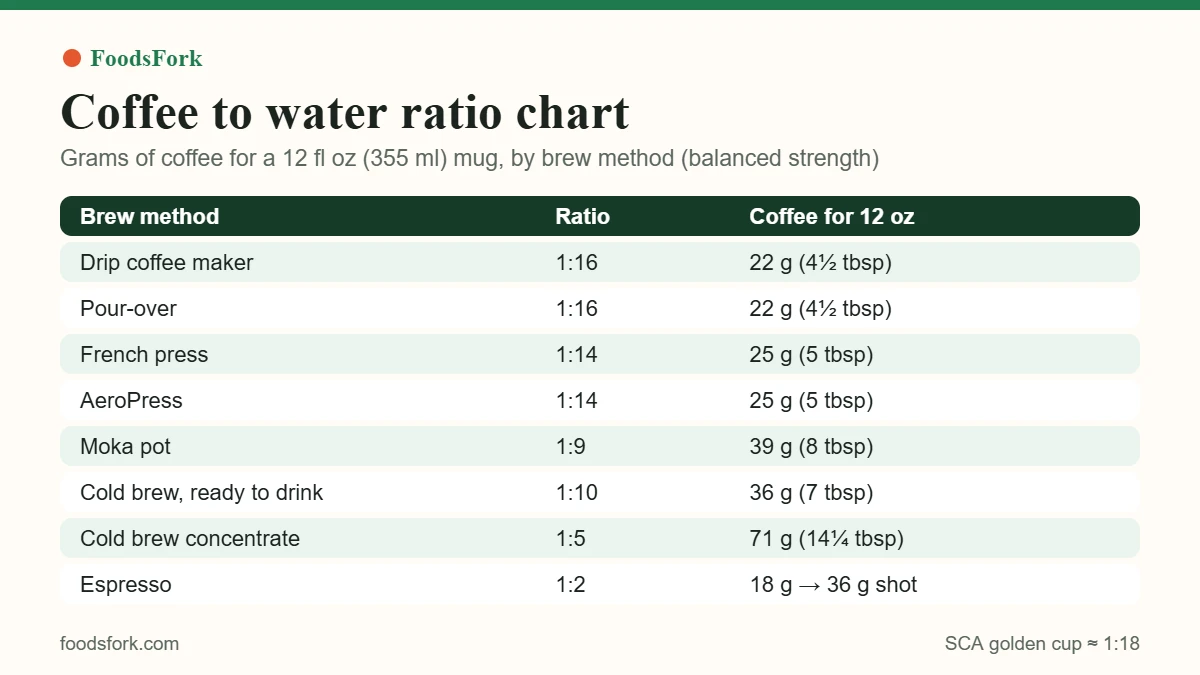
Each brewing method extracts coffee differently, so each has its own sweet spot. The last column shows the coffee for a 12 fl oz (355 ml) mug at the balanced ratio.
| Brew method | Balanced ratio | Usual range | Coffee for 12 oz water |
|---|---|---|---|
| Drip coffee maker | 1:16 | 1:15–1:18 | 22 g |
| Pour-over (V60, Kalita) | 1:16 | 1:15–1:17 | 22 g |
| Chemex | 1:16 | 1:15–1:17 | 22 g |
| French press | 1:14 | 1:12–1:16 | 25 g |
| AeroPress | 1:14 | 1:11–1:16 | 25 g |
| Moka pot | 1:9 | 1:7–1:10 | 39 g |
| Cold brew, ready to drink | 1:10 | 1:8–1:12 | 36 g |
| Cold brew concentrate | 1:5 | 1:4–1:8 | 71 g |
| Espresso | 1:2 | 1:1.5–1:3 | 18 g in → 36 g out |
Drip coffee maker
Start at 1:16. If the coffee tastes weak, go to 1:15; if it is too strong, go to 1:17 or 1:18. Use a medium grind and fill the water to the line you plan to drink.
Pour-over and Chemex
Pour-over gives you control over every pour, and 1:15 to 1:17 is the usual range. A Chemex uses a thick paper filter, so many people grind slightly coarser and keep the ratio near 1:16.
French press
The French press is a full-immersion brew with a metal filter. It tastes best a little stronger, around 1:12 to 1:15. Use a coarse grind and steep for about 4 minutes.
AeroPress
The AeroPress is very flexible. At 1:14 to 1:16 it makes a filter-style cup; at 1:10 or stronger it makes a concentrate you can top up with hot water.
Moka pot
A stovetop moka pot brews strong, espresso-like coffee at about 1:7 to 1:10. The pot’s basket and water chamber largely set the ratio, so fill the basket level and the water to just below the safety valve.
How much coffee per cup?
This table shows grams and level tablespoons for common cup sizes at mild (1:18), balanced (1:16) and strong (1:15) ratios.
| Serving | Water | Mild 1:18 | Balanced 1:16 | Strong 1:15 |
|---|---|---|---|---|
| 1 small cup (6 fl oz) | 177 ml | 9.9 g (2 tbsp) | 11 g (2¼ tbsp) | 12 g (2¼ tbsp) |
| 1 US cup (8 fl oz) | 237 ml | 13 g (2¾ tbsp) | 15 g (3 tbsp) | 16 g (3¼ tbsp) |
| 1 mug (12 fl oz) | 355 ml | 20 g (4 tbsp) | 22 g (4½ tbsp) | 24 g (4¾ tbsp) |
| 1 large mug (16 fl oz) | 473 ml | 26 g (5¼ tbsp) | 30 g (6 tbsp) | 32 g (6¼ tbsp) |
| 2 mugs (24 fl oz) | 710 ml | 39 g (8 tbsp) | 44 g (8¾ tbsp) | 47 g (9½ tbsp) |
| 1 liter (34 fl oz) | 1000 ml | 56 g (11 tbsp) | 62 g (12½ tbsp) | 67 g (13¼ tbsp) |
How much coffee for one cup?
For a standard 8 fl oz cup at 1:16, use about 15 g of coffee, or 3 level tablespoons. For a 12 oz mug, use about 22 g, or 4½ tablespoons.
How much coffee for a full pot
Coffee makers count “cups” of 5 or 6 fl oz, not 8 oz US cups. A typical “12-cup” maker brews about 60 fl oz. This table uses 5 fl oz cups and a 1:16 ratio; adjust to taste.
| Coffee maker | Water | Coffee at 1:16 | Level tablespoons |
|---|---|---|---|
| 4-cup (fill line) | 20 fl oz (591 ml) | 37 g | 7½ tbsp |
| 6-cup (fill line) | 30 fl oz (887 ml) | 55 g | 11 tbsp |
| 8-cup (fill line) | 40 fl oz (1183 ml) | 74 g | 14¾ tbsp |
| 10-cup (fill line) | 50 fl oz (1479 ml) | 92 g | 18½ tbsp |
| 12-cup (fill line) | 60 fl oz (1774 ml) | 111 g | 22¼ tbsp |
Check your own machine: the fill lines on the water tank tell you how many of its cups it brews. If yours uses 6 fl oz cups, add about 20% more coffee.
Measuring coffee without a scale
No scale? Tablespoons work if you are consistent.
- 1 level tablespoon of medium-ground coffee weighs about 5 g.
- 2 level tablespoons per 6 fl oz of water is a classic guideline, about 1:18.
- A standard coffee scoop usually holds 2 tablespoons, about 10 g.
- Measure water in a measuring cup: 1 US cup = 8 fl oz = 237 ml. Our cups to ml converter helps with other amounts.
Use the same scoop and the same grind each time. Once you find a scoop count you like, the ratio stays steady even without weighing.
Adjusting strength and taste
Ratio controls strength, how concentrated the coffee is. Grind and brew time control extraction, how much flavor you pull from the grounds. Fix the right one.
| What you taste | Likely cause | Try this |
|---|---|---|
| Weak, watery | Too much water for the coffee | Use a lower ratio, e.g. 1:15 |
| Too strong, heavy | Too much coffee | Use a higher ratio, e.g. 1:17 |
| Sour, sharp, thin | Under-extracted | Grind finer or brew longer |
| Bitter, harsh, dry | Over-extracted | Grind coarser or brew shorter |
| Flat, dull | Old or stale beans | Use beans within a month of roasting |
Change one thing at a time. If you change the ratio and the grind together, you will not know which one helped.
Cold brew coffee to water ratios
Cold brew steeps coarse coffee in cold water for 12 to 24 hours. Cold water extracts more slowly, so cold brew uses much more coffee than hot brewing.
| Cold brew style | Ratio | Coffee per liter of water | How to serve |
|---|---|---|---|
| Concentrate | 1:4 to 1:5 | 200–250 g | Dilute about 1:1 with water or milk |
| Strong ready-to-drink | 1:8 | 125 g | Over ice |
| Light ready-to-drink | 1:10 to 1:12 | 85–100 g | Over ice, no dilution |
Steep in the fridge, then strain through a fine sieve and a paper filter. Cold brew concentrate keeps about a week to 10 days in a sealed jar in the fridge.
Espresso brew ratios
Espresso ratios work differently. They compare the dry coffee dose with the weight of liquid espresso in the cup, not the water used.
| Style | Ratio (dose : drink) | Example |
|---|---|---|
| Ristretto | 1:1 to 1:1.5 | 18 g in, 18–27 g out |
| Normale (standard) | 1:2 | 18 g in, 36 g out |
| Lungo | 1:3 | 18 g in, 54 g out |
A double shot usually uses 16 to 20 g of finely ground coffee and takes about 25 to 30 seconds. An Americano adds hot water to espresso; a long black pours espresso over hot water.
Water, grind and temperature
- Water: coffee is about 98% water, so use clean, good-tasting water. Filtered tap water works well; distilled water makes flat coffee.
- Temperature: brew hot coffee with water just off the boil, about 195 to 205 °F (90 to 96 °C). Our Fahrenheit to Celsius converter helps with kettle settings.
- Grind: coarse for French press and cold brew, medium for drip, medium-fine for pour-over, fine for espresso.
- Freshness: grind just before brewing. Ground coffee loses aroma within minutes.
Common coffee ratio mistakes
| Mistake | What happens | Fix |
|---|---|---|
| Using coffee-maker cups as 8 oz cups | Too much water per scoop | Check the machine’s cup size |
| Heaped scoops one day, level the next | Strength changes daily | Weigh, or level every scoop |
| Fixing sourness with more coffee | Strong but still sour | Grind finer instead |
| Using the drip ratio for French press | Thin, weak cup | Go stronger, 1:12–1:15 |
| Forgetting cold brew is a concentrate | Very strong coffee | Dilute about 1:1 |
Frequently asked questions
What is the best coffee to water ratio?
For drip and pour-over coffee, 1:16 is a good starting point: 1 gram of coffee for every 16 grams of water. The Specialty Coffee Association's Golden Cup guideline is 55 g of coffee per liter of water, about 1:18. Go stronger, around 1:12 to 1:15, for French press.
How much coffee do I use for 12 oz of water?
For 12 fl oz (355 ml) of water at 1:16, use about 22 g of ground coffee, or 4½ level tablespoons. At the milder 1:18 ratio, use about 20 g.
How many tablespoons of coffee per cup?
The classic guideline is 2 level tablespoons (about 10 g) of ground coffee for every 6 fl oz of water. For an 8 oz cup, use about 2½ to 3 tablespoons.
What is the golden ratio for coffee?
The golden ratio usually means the SCA Golden Cup guideline of 55 g of coffee per liter of water, give or take 10%. That is about 1:18, with a range of roughly 1:16 to 1:20.
What ratio should I use for a French press?
Use 1:12 to 1:15. A 1:14 ratio, about 71 g of coffee per liter, is a good middle. For a 34 oz (1 liter) press, that is roughly 70 g of coarse coffee.
What is the ratio for cold brew?
For a concentrate, use about 1:4 to 1:5 and dilute it 1:1 with water or milk. For ready-to-drink cold brew, use about 1:8 to 1:12. Steep 12 to 24 hours in the fridge.
What is the espresso brew ratio?
Espresso is usually brewed at 1:2: for example, 18 g of ground coffee in and 36 g of espresso out. A ristretto is about 1:1 to 1:1.5 and a lungo about 1:3.
How much coffee for a 12-cup coffee maker?
A 12-cup coffee maker brews about 60 fl oz (1.8 liters), because its cups are 5 fl oz. At 1:16 that needs about 110 g of coffee, about 22 level tablespoons. Many people use slightly less, around 90 to 100 g.
Why does my coffee taste sour or bitter?
Sour or thin coffee is usually under-extracted: grind finer, or use a little less coffee. Bitter or harsh coffee is usually over-extracted: grind coarser or shorten the brew time. Change one thing at a time.
Is the ratio by weight or by volume?
By weight. 1:16 means 1 gram of coffee to 16 grams of water. Because 1 ml of water weighs 1 g, you can measure the water in ml. Coffee should be weighed, since a tablespoon can hold 4 to 7 g depending on the grind.
Related tools and guides
How we checked this page: the Golden Cup guideline of 55 g of coffee per liter of water (±10%) is from the Specialty Coffee Association. Method ranges reflect common brewing guidance from coffee roasters and equipment makers. The tablespoon weight (about 5 g of medium-ground coffee per level tablespoon) and the water held by grounds (about 2 g per gram) are typical values. Checked November 2026.