
Cups to Ml Converter: How Many Ml in a Cup?
Convert cups to ml for US, metric, UK and Japanese cups. Type any amount, including fractions like 1 1/2 or ¾, and get milliliters, liters, fluid ounces and an easy jug reading.
Cups and milliliters both measure volume, so the answer is the same for water, milk, oil or flour. To weigh dry ingredients, use our cups to grams converter.
1 US cup = 236.5882365 ml (NIST) · US legal cup = 240 ml (FDA 21 CFR 101.9)
Common cup amounts in ml
Quick answer
1 US cup = 236.6 ml, usually rounded to 240 ml. A metric cup = 250 ml. To convert cups to ml, multiply the cups by 236.6 for a US recipe or by 250 for a metric recipe. So ½ cup = 118.3 ml, ⅓ cup = 78.9 ml, ¼ cup = 59.1 ml and 2 cups = 473.2 ml.
Key facts
- US cup: 236.6 ml (NIST). US nutrition label cup: 240 ml (FDA).
- Metric cup: 250 ml. UK imperial cup: 284 ml. Japanese cup: 200 ml.
- 1 liter ≈ 4¼ US cups, or exactly 4 metric cups.
- Cups to ml is the same for every ingredient; only the weight changes.
- Round to the nearest 5 or 10 ml to read a measuring jug.
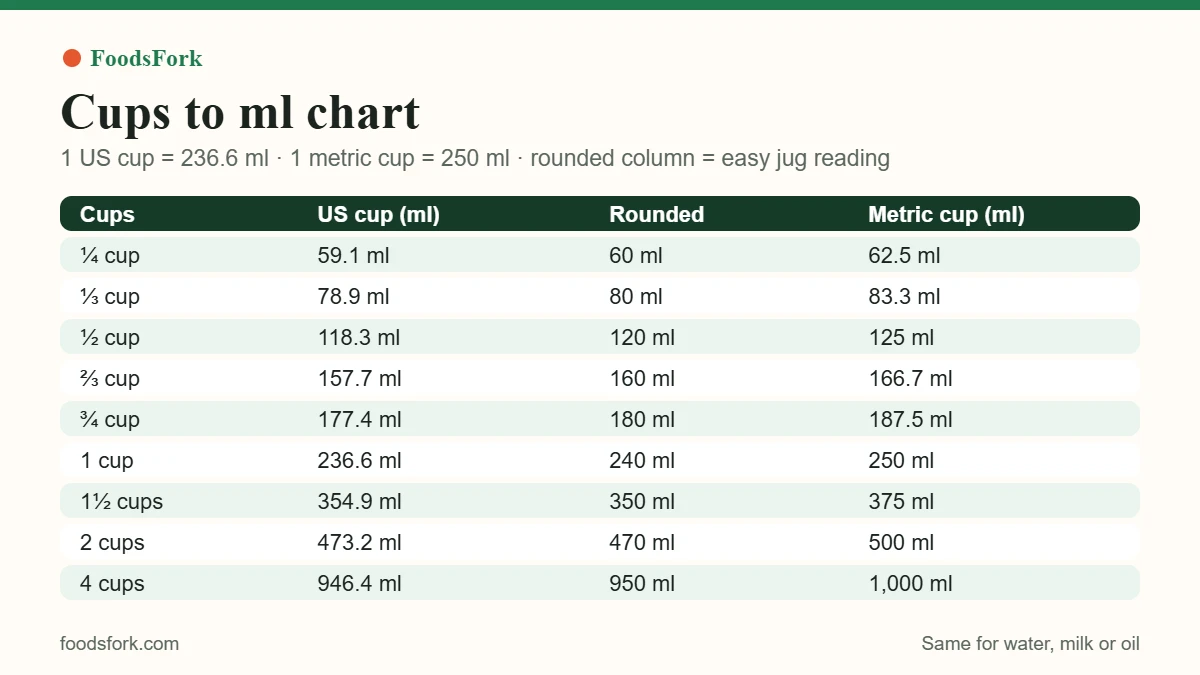
How many ml are in a cup?
It depends on where the recipe comes from. “Cup” is not one fixed size around the world. Here are the cups you are likely to meet.
| Cup | Milliliters | Where it is used |
|---|---|---|
| US customary cup | 236.6 ml | Most American recipes and US measuring cups |
| US legal cup | 240 ml | US nutrition facts labels |
| Metric cup | 250 ml | Australia, New Zealand, Canada, South Africa and many modern UK recipes |
| UK imperial cup | 284 ml | Older British cookbooks |
| Japanese measuring cup | 200 ml | Japanese recipes |
| Japanese rice cup (1 gō) | 180 ml | Rice cookers and rice packaging in Japan |
For a US recipe, use 236.6 ml. Many cooks and cookbooks round it to 240 ml, and that tiny difference does not change a recipe. For a recipe from Australia or New Zealand, use 250 ml.
Why are there different cups?
The US kept its customary units, so its cup is based on the US fluid ounce: 8 fl oz = 236.6 ml. Countries that went metric rounded the cup to a neat 250 ml. Older British recipes used half an imperial pint, which is larger, about 284 ml.
How to use the cups to ml converter
Going the other way? Our ml to cups converter turns milliliters back into cups, with an easy cups and spoons measure for any amount.
The cups to ml formula
The exact US value is 236.5882365 ml. It comes from the US fluid ounce: 1 cup is 8 fluid ounces, and 1 fluid ounce is 29.5735 ml. For cooking, 236.6 ml is more than precise enough.
Worked examples
- ¾ cup of milk: 0.75 × 236.6 = 177.4 ml. Measure 180 ml on a jug, or 175 ml if your jug is marked in 5s.
- 1⅓ cups of water: 1.333 × 236.6 = 315.5 ml. Measure 315 to 320 ml.
- 2½ metric cups of stock: 2.5 × 250 = 625 ml.
Cups to ml conversion chart
The “rounded” column is the closest amount you can read on a typical measuring jug.
| Cups | US cup (ml) | Rounded for a jug | Metric cup (ml) | UK imperial cup (ml) |
|---|---|---|---|---|
| ⅛ cup | 29.6 ml | 30 ml | 31.2 ml | 35.5 ml |
| ¼ cup | 59.1 ml | 60 ml | 62.5 ml | 71 ml |
| ⅓ cup | 78.9 ml | 80 ml | 83.3 ml | 94.7 ml |
| ⅜ cup | 88.7 ml | 90 ml | 93.8 ml | 106.5 ml |
| ½ cup | 118.3 ml | 120 ml | 125 ml | 142.1 ml |
| ⅝ cup | 147.9 ml | 150 ml | 156.2 ml | 177.6 ml |
| ⅔ cup | 157.7 ml | 160 ml | 166.7 ml | 189.4 ml |
| ¾ cup | 177.4 ml | 180 ml | 187.5 ml | 213.1 ml |
| ⅞ cup | 207 ml | 210 ml | 218.8 ml | 248.6 ml |
| 1 cup | 236.6 ml | 240 ml | 250 ml | 284.1 ml |
| 1¼ cups | 295.7 ml | 300 ml | 312.5 ml | 355.2 ml |
| 1½ cups | 354.9 ml | 350 ml | 375 ml | 426.2 ml |
| 1¾ cups | 414 ml | 410 ml | 437.5 ml | 497.2 ml |
| 2 cups | 473.2 ml | 470 ml | 500 ml | 568.3 ml |
| 2½ cups | 591.5 ml | 590 ml | 625 ml | 710.3 ml |
| 3 cups | 709.8 ml | 710 ml | 750 ml | 852.4 ml |
| 4 cups | 946.4 ml | 950 ml | 1,000 ml | 1,137 ml |
| 5 cups | 1,183 ml | 1,175 ml | 1,250 ml | 1,421 ml |
| 6 cups | 1,420 ml | 1,425 ml | 1,500 ml | 1,705 ml |
| 8 cups | 1,893 ml | 1,900 ml | 2,000 ml | 2,273 ml |
Cup fractions in ml
These are the amounts people search for most. All use the US cup unless noted.
How many ml is ½ cup?
Half a cup is 118.3 ml, about 120 ml. In a metric recipe, ½ cup is 125 ml. Half a cup is also 8 tablespoons, or 4 fluid ounces.
How many ml is ⅓ cup?
One-third of a cup is 78.9 ml, about 80 ml. With a metric cup it is 83 ml. In spoons, ⅓ cup is 5 tablespoons plus 1 teaspoon.
How many ml is ¼ cup?
A quarter cup is 59.1 ml, about 60 ml. That is the same as 4 tablespoons. A metric quarter cup is 62.5 ml.
How many ml is ⅔ cup?
Two-thirds of a cup is 157.7 ml, about 160 ml. With a metric cup it is 167 ml.
How many ml is ¾ cup?
Three-quarters of a cup is 177.4 ml. Round it to 175 or 180 ml. A metric ¾ cup is 187.5 ml.
How many ml is 2 cups?
Two cups is 473.2 ml, just under half a liter. Two metric cups make exactly 500 ml. A US pint is the same as 2 cups.
How many ml is ⅛ cup?
One-eighth of a cup is 29.6 ml, about 30 ml, which is 2 tablespoons or 1 fluid ounce.
Cups to liters
For big batches of soup, stock or punch, liters are easier. One liter is about 4¼ US cups.
| Cups | US cups in liters | Metric cups in liters |
|---|---|---|
| 1 cup | 0.237 L | 0.250 L |
| 2 cups | 0.473 L | 0.500 L |
| 3 cups | 0.710 L | 0.750 L |
| 4 cups | 0.946 L | 1.000 L |
| 5 cups | 1.183 L | 1.250 L |
| 6 cups | 1.420 L | 1.500 L |
| 8 cups | 1.893 L | 2.000 L |
| 10 cups | 2.366 L | 2.500 L |
| 12 cups | 2.839 L | 3.000 L |
| 16 cups | 3.785 L | 4.000 L |
Need larger units? 4 US cups make 1 US quart (0.95 L), and 16 cups make 1 US gallon (3.79 L). Our brine calculator uses these amounts for large batches.
Cups to fluid ounces and spoons
| US cups | Fluid ounces | Tablespoons | Teaspoons | Milliliters |
|---|---|---|---|---|
| ⅛ cup | 1 fl oz | 2 tbsp | 6 tsp | 29.6 ml |
| ¼ cup | 2 fl oz | 4 tbsp | 12 tsp | 59.1 ml |
| ½ cup | 4 fl oz | 8 tbsp | 24 tsp | 118.3 ml |
| 1 cup | 8 fl oz | 16 tbsp | 48 tsp | 236.6 ml |
| 2 cups | 16 fl oz | 32 tbsp | 96 tsp | 473.2 ml |
For any spoon amount, try the tablespoons to cups converter.
Which cup does your recipe use?
If a recipe does not say, look for clues.
- American websites and cookbooks, or recipes with Fahrenheit temperatures and ounces: US cup, 236.6 ml.
- Australian, New Zealand or Canadian recipes, especially with Celsius and grams: metric cup, 250 ml.
- Older British cookbooks that mention pints and ounces: possibly the imperial cup, 284 ml. Modern UK recipes usually use grams.
- Japanese recipes: 200 ml for most ingredients, but 180 ml when measuring rice for a rice cooker.
Does the difference matter?
For soups, stews, sauces and drinks, no. The 5% gap between a US and a metric cup is less than the error of most home measuring. For baking, it can add up across several cups of flour and liquid. If the recipe gives grams, use those. Otherwise, use the cup the recipe was written for.
Cups to ml for dry ingredients
A cup of flour, sugar or rice takes up the same space as a cup of water, so it is also 236.6 ml. The weight is what changes. A cup of all-purpose flour weighs about 120 g, while a cup of water weighs about 237 g.
That is why metric recipes usually give dry ingredients in grams, not milliliters. To turn cups of a dry ingredient into grams, use the cups to grams converter. It has weights for more than 50 ingredients. For how to fill each kind of cup, see our guide to dry vs liquid measuring cups.
| 1 US cup of… | Volume | Approximate weight |
|---|---|---|
| Water | 236.6 ml | 237 g |
| Milk | 236.6 ml | 242 g |
| Vegetable oil | 236.6 ml | 218 g |
| Honey | 236.6 ml | 340 g |
| All-purpose flour | 236.6 ml | 120 g |
| Granulated sugar | 236.6 ml | 198 g |
Converting a US recipe to metric
- Liquids to ml. Convert water, milk, juice, oil and stock with the converter, then round to the nearest 5 ml.
- Dry ingredients to grams. Convert flour, sugar, cocoa and similar to grams with the cups to grams converter.
- Butter to grams. One US stick is 113 g; see the butter converter.
- Small amounts. Keep teaspoons and tablespoons, or use 5 ml and 15 ml.
- Oven temperature. Convert °F to °C with the Fahrenheit to Celsius converter.
Worked example: a simple pancake recipe
| US recipe | Metric | How |
|---|---|---|
| 1½ cups milk | 355 ml (about 350 ml) | 1.5 × 236.6 |
| ¼ cup melted butter | 60 ml or 57 g | 0.25 × 236.6 / butter chart |
| 1 cup flour | 120 g | Cups to grams |
| 2 tbsp sugar | 25 g | Cups to grams |
| 2 tsp baking powder | 2 tsp (10 ml) | Keep spoons |
| 1 egg | 1 egg | No change |
Measuring ml without a measuring jug
No jug? Spoons work well for amounts under about 120 ml.
- 1 US tablespoon = 14.8 ml (metric tablespoon = 15 ml).
- 1 US teaspoon = 4.9 ml (metric teaspoon = 5 ml).
- 60 ml = 4 tablespoons = ¼ cup.
- A standard mug often holds 300 to 350 ml, more than a cup, so do not use one as a measure.
A kitchen scale is another option for water-based liquids: 1 ml of water weighs 1 g, so 250 ml of water weighs 250 g. Milk and stock are close enough to weigh the same way.
How accurate are measuring cups?
Home measuring cups are less precise than most people think. Tests of everyday cup sets often find them a few percent off, and the way you fill them matters even more. A liquid cup read from above, rather than at eye level, can be off by 10 ml or more. A dry cup filled by scooping can pack in far more flour than one filled with a spoon.
For liquids, a clear jug with printed milliliter lines is the most reliable choice. Look for one marked in 10 ml or 25 ml steps for everyday cooking, and a small shot-glass style measure for amounts under 60 ml. Set it on a flat counter, pour, then bend down and read the bottom of the curved surface at eye level.
For anything where accuracy really matters, such as bread, cakes or cocktails, switch to weight. Water, milk and most stocks weigh almost exactly 1 g per ml, so a kitchen scale doubles as a perfect liquid measure.
Common cups to ml mistakes
| Mistake | What happens | Fix |
|---|---|---|
| Using 250 ml for a US recipe | About 6% too much liquid | Use 236.6 ml (or 240 ml) |
| Using a coffee mug as a cup | Far too much | Use a measuring cup or jug |
| Converting flour to ml | Unreliable weight | Convert dry ingredients to grams |
| Reading the jug from above | Over- or under-filling | Read at eye level on a flat counter |
| Mixing up rice cups | Wrong water ratio | A rice cooker cup is 180 ml |
Frequently asked questions
How many ml is 1 cup?
One US cup is 236.6 ml, which most cooks round to 240 ml. A metric cup, used in Australia, New Zealand, Canada and the UK, is exactly 250 ml.
How many ml is ½ cup?
Half a US cup is 118.3 ml, about 120 ml. Half a metric cup is 125 ml.
How many ml is ⅓ cup?
One-third of a US cup is 78.9 ml, about 80 ml. One-third of a metric cup is 83 ml.
How many ml is ¼ cup?
A quarter cup is 59.1 ml in the US, about 60 ml, or 62.5 ml with a metric cup.
How many ml is ¾ cup?
Three-quarters of a US cup is 177.4 ml, about 175 to 180 ml. With a metric cup it is 187.5 ml.
How many ml is 2 cups?
Two US cups are 473.2 ml, just under half a liter. Two metric cups are 500 ml.
Is a cup 250 ml or 240 ml?
Both, depending on the country. A metric cup is 250 ml. The US cup is 236.6 ml, and US nutrition labels round it to 240 ml. For everyday cooking the difference is small.
How many cups are in a liter?
One liter is about 4¼ US cups (4.23 cups), or exactly 4 metric cups.
Is a cup of flour also 236.6 ml?
Yes. A cup is a volume, so 1 cup of flour fills 236.6 ml, the same as 1 cup of water. The weight is very different, though: about 120 g of flour versus 237 g of water. For baking, weigh dry ingredients.
How do I measure ml without a measuring jug?
Use spoons. A US tablespoon holds about 14.8 ml and a teaspoon about 4.9 ml; metric spoons are 15 ml and 5 ml. So 60 ml is 4 tablespoons, or ¼ cup.
What size is a Japanese cup?
A Japanese measuring cup is 200 ml. The rice cup that comes with a rice cooker is smaller, 180 ml, called one gō.
Related tools and guides
How we checked this page: 1 US cup = 236.5882365 ml and 1 US fluid ounce = 29.5735 ml (NIST Handbook 44); the US legal cup of 240 ml is set by FDA 21 CFR 101.9 for nutrition labeling. Metric, imperial and Japanese cup sizes are standard definitions. Ingredient weights are averages from USDA FoodData Central and King Arthur Baking. Checked November 2026.