
Baker’s Percentage Calculator: Easy Baker’s Math for Bread
Use this baker’s percentage calculator to turn bread and pizza formulas into grams, or a recipe in grams into percentages. Scale by flour or total dough weight and check hydration.
Flour is always 100%. Every other ingredient is a percentage of the flour’s weight. Use instant yeast; for active dry use 1.25 times as much, for fresh yeast 3 times.
Baker’s % = ingredient weight ÷ flour weight × 100 · flour = dough weight ÷ (total % ÷ 100)
Quick answer
In baker’s percentage, flour is always 100% and every other ingredient is a percentage of the flour’s weight. To get grams, multiply the flour weight by each percentage. A basic loaf of 100% flour, 65% water, 2% salt and 1.2% instant yeast with 500 g of flour needs 325 g water, 10 g salt and 6 g yeast. To work backwards, divide each ingredient’s weight by the flour weight and multiply by 100.
Key facts
- Baker’s % = ingredient weight ÷ flour weight × 100.
- Weight = flour weight × baker’s % ÷ 100.
- Flour for a target dough = dough weight ÷ (total % ÷ 100).
- Typical bread: 60–75% water, 1.8–2.2% salt, 0.5–1.5% instant yeast.
- Percentages add up to more than 100%; that is normal.
How to use the baker’s percentage calculator
The yeast row assumes instant (rapid-rise) yeast. If you use active dry yeast, multiply the grams by 1.25; for fresh cake yeast, multiply by about 3.
What is baker’s percentage?
Baker’s percentage, also called baker’s math, is the way professional bakers write formulas. Instead of cups or a fixed batch size, every ingredient is written as a percentage of the flour weight. The flour is always 100%.
This makes recipes easy to compare and scale. You can see at a glance that one bread has 65% water and another 78%, and you can bake one loaf or fifty from the same numbers.
A simple example
| Ingredient | Weight | Baker’s % |
|---|---|---|
| Bread flour | 1,000 g | 100% |
| Water | 650 g | 65% |
| Salt | 20 g | 2% |
| Instant yeast | 10 g | 1% |
| Total | 1,680 g | 168% |
Notice the total is 168%. Each ingredient is compared with the flour, not with the whole dough, so the total is always more than 100%.
Baker’s percentage formulas
Worked example: scaling to a total dough weight
You want two loaves of 900 g each, 1,800 g of dough, using 100% flour, 65% water, 2% salt and 1.2% yeast. The total is 168.2%. Flour = 1,800 ÷ 1.682 = 1,070 g. Then water = 1,070 × 0.65 = 696 g, salt = 21 g and yeast = 13 g. Add a few percent extra to allow for dough left in the bowl.
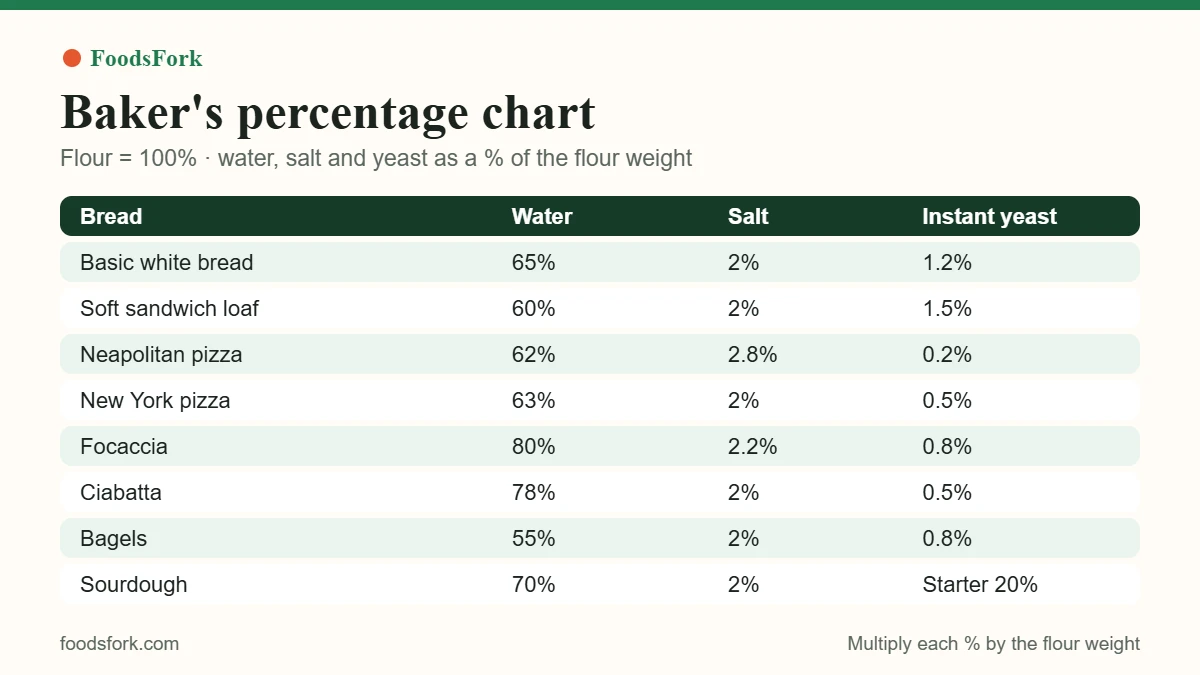
Baker’s percentages for common breads
These are typical starting formulas. Real recipes vary with flour, climate and taste.
| Bread | Water | Salt | Instant yeast | Other |
|---|---|---|---|---|
| Basic white bread | 65% | 2% | 1.2% | — |
| Soft sandwich loaf | 60% | 2% | 1.5% | sugar 6%, fat 8% |
| Neapolitan pizza | 62% | 2.8% | 0.2% | — |
| New York pizza | 63% | 2% | 0.5% | sugar 1%, fat 2% |
| Focaccia | 80% | 2.2% | 0.8% | fat 6% |
| Ciabatta | 78% | 2% | 0.5% | fat 1% |
| Bagels | 55% | 2% | 0.8% | sugar 3% |
| Brioche | — (milk and eggs) | 2% | 1.5% | sugar 12%, fat 50%, eggs and milk 70% |
| Sourdough (with starter) | 70% | 2% | — (starter) | starter 20% |
Choose any of these in the calculator, set your flour weight, and the grams appear instantly.
Dough hydration explained
Hydration is the water’s baker’s percentage. It is the biggest single factor in how a dough feels and how the bread turns out.
| Hydration | Dough feel | Typical breads |
|---|---|---|
| 50–58% | Stiff and smooth | Bagels, pretzels, some flatbreads |
| 58–65% | Soft, easy to knead | Sandwich bread, rolls, New York pizza |
| 65–72% | Soft, slightly tacky | Neapolitan pizza, French bread, everyday sourdough |
| 72–80% | Sticky, needs folds | Rustic loaves, open-crumb sourdough |
| 80% and up | Very wet, almost pourable | Ciabatta, focaccia |
Why the same hydration can feel different
Whole wheat and rye flours absorb more water than white flour, so a 75% whole wheat dough feels firmer than a 75% white dough. Fresh flour, humid weather and high-protein bread flour also change how much water a dough can take. Start at the low end and add water a little at a time.
Weighing makes hydration reliable. If your recipe lists flour in cups, convert it first with our cups to grams converter, because a cup of flour can weigh anywhere from 120 g to over 140 g depending on how you measure it.
Salt and yeast percentages
Salt
Most breads use 1.8% to 2.2% salt. Below about 1.5%, bread tastes flat and the dough can ferment too fast. Above about 2.5%, it tastes salty and slows the yeast. Neapolitan pizza dough often uses up to 2.8% to 3%. Use fine salt so it dissolves evenly; our brine calculator explains how table and kosher salts differ by volume.
Yeast
Yeast percentages depend on the type of yeast and how long the dough ferments.
| Yeast type | Typical % | Swap from instant yeast |
|---|---|---|
| Instant (rapid-rise) yeast | 0.5–1.5% | Same |
| Active dry yeast | 0.6–2% | × 1.25 |
| Fresh (cake) yeast | 1.5–4% | × 3 |
| Long cold fermentation (instant) | 0.1–0.3% | Use less, wait longer |
Less yeast and more time usually gives more flavor. A same-day loaf might use 1.2% instant yeast; a 48-hour cold-fermented pizza dough might use 0.2%.
Sugar, fat, milk and eggs
Enriched doughs add sugar, fat, milk or eggs. They follow the same rules: each is a percentage of the flour.
- Sugar: 0–5% for lean breads, 6–10% for soft sandwich bread, 10–20% for sweet rolls and brioche. Above about 10%, use a little more yeast or an osmotolerant yeast.
- Fat: 1–3% oil keeps pizza tender; 5–10% butter makes soft sandwich bread; brioche can use 50% butter or more.
- Milk: about 87% water, so 100 g of milk adds about 87 g of water.
- Eggs: about 75% water. A large egg without its shell weighs about 50 g.
Because milk and eggs add water, enriched doughs often list only a small amount of water, or none. When you compare doughs, count the water from milk and eggs too.
Using more than one flour
When a recipe uses several flours, all the flours together make 100%. For example:
| Ingredient | Baker’s % | For 1,000 g total flour |
|---|---|---|
| Bread flour | 70% | 700 g |
| Whole wheat flour | 30% | 300 g |
| Water | 75% | 750 g |
| Salt | 2% | 20 g |
| Instant yeast | 1% | 10 g |
Every other ingredient is a percentage of the combined 1,000 g. To use the calculator, enter the total flour weight, then split it between your flours yourself.
Sourdough and preferments
Sourdough starters, poolish and biga contain both flour and water. Bakers handle them in two ways.
- Formula percentage: list the starter as a percentage of the dough’s flour, often 15% to 25%. This is the simple method, and the one the calculator uses.
- Overall percentage: add the starter’s flour and water to the dough’s totals. A 100% hydration starter is half flour, half water. So 100 g of starter adds 50 g of flour and 50 g of water.
Example: overall hydration
A dough has 500 g flour, 350 g water and 100 g starter at 100% hydration. Formula hydration is 350 ÷ 500 = 70%. Overall, the flour is 550 g and the water 400 g, so the true hydration is 400 ÷ 550 = 72.7%. That explains why some sourdoughs feel wetter than their stated hydration.
Scaling pizza dough and dough balls
Baker’s percentage is perfect for pizza, because you usually know how many dough balls you want and how big each one should be.
- Total dough: number of balls × weight per ball. Six 260 g balls = 1,560 g.
- Add a margin: about 2% for dough lost in the bowl: 1,590 g.
- Enter it: choose “Total dough weight” in the calculator, type 1,590 and pick a pizza formula.
For a Neapolitan formula (100% flour, 62% water, 2.8% salt, 0.2% yeast, total 165%), that gives about 964 g flour, 598 g water, 27 g salt and 2 g yeast. Weigh the yeast carefully; a pocket scale that reads 0.1 g helps.
Need to feed a crowd? Our recipe scaler resizes other recipes, and the guide to doubling a recipe explains what to watch when you scale up.
Converting a cups recipe to baker’s percentage
- Convert everything to grams. Flour, water, sugar and butter with the cups to grams converter; small amounts of salt and yeast with a scale or the spoon weights on the package.
- Switch the calculator to Grams → percentages and type in the weights.
- Check the numbers. If salt comes out at 3% or yeast at 3%, the original recipe may have used heaped spoons or a different salt.
- Save the formula. Now you can bake any batch size without converting again.
Common baker’s percentage mistakes
| Mistake | What happens | Fix |
|---|---|---|
| Dividing by the total dough weight | Every percentage is too low | Always divide by the flour weight |
| Counting starter flour twice | Hydration looks wrong | Use formula % or overall %, not both |
| Swapping yeast types 1:1 | Too fast or too slow a rise | Active dry × 1.25, fresh × 3 |
| Measuring flour in cups | Hydration drifts | Weigh the flour |
| Forgetting water in milk and eggs | Dough wetter than expected | Count milk ≈ 87% water, eggs ≈ 75% |
Frequently asked questions
What is baker's percentage?
Baker's percentage is a way of writing a recipe where the flour always equals 100% and every other ingredient is shown as a percentage of the flour's weight. A dough with 1,000 g of flour and 650 g of water has 65% water.
How do you calculate baker's percentage?
Divide each ingredient's weight by the total flour weight, then multiply by 100. For example, 10 g of salt ÷ 500 g of flour × 100 = 2% salt.
How do I turn baker's percentages into grams?
Pick your flour weight, then multiply it by each percentage. For 500 g of flour at 65% water and 2% salt: 500 × 0.65 = 325 g of water and 500 × 0.02 = 10 g of salt.
Why do baker's percentages add up to more than 100%?
Because each ingredient is compared with the flour, not with the whole dough. Flour alone is 100%, so a dough with 65% water, 2% salt and 1% yeast totals 168%.
How do I scale a recipe to a total dough weight?
Add up all the percentages, then divide the dough weight you want by that total and multiply by 100. That gives the flour weight. For 1,000 g of dough at 168%, flour = 1,000 ÷ 1.68 = 595 g.
What is dough hydration?
Hydration is the water's baker's percentage: water weight ÷ flour weight × 100. Bagels are about 55%, sandwich bread 60–65%, rustic loaves 70–75% and ciabatta or focaccia 75–85%.
How much salt should bread have in baker's percentage?
Most breads use 1.8% to 2.2% salt. Neapolitan pizza often goes up to about 2.8% to 3%.
How much yeast should I use?
For instant yeast, 0.5% to 1.5% of the flour weight is typical; long, cold fermentations use as little as 0.1% to 0.3%. Use 1.25 times as much active dry yeast, or about 3 times as much fresh yeast.
How do I count more than one type of flour?
All the flours together make 100%. For example, 70% bread flour and 30% whole wheat flour. Every other ingredient is still a percentage of the combined flour weight.
How does sourdough starter fit into baker's percentage?
Most bakers list the starter as a percentage of the flour, often 15% to 25%. Because a 100% hydration starter is half flour and half water, some bakers also work out the overall hydration including the starter's water and flour.
Related tools and guides
How we checked this page: the baker’s percentage method (flour = 100%, each ingredient as a percentage of flour weight) follows King Arthur Baking’s professional reference and standard baking texts. Typical formulas, hydration ranges and yeast conversions reflect common professional practice; water content of milk and eggs is from USDA FoodData Central. Checked November 2026.