
How Many Calories in a Cup of Flour?
A cup of all-purpose flour has about 455 calories. Use the calculator to count calories, carbs, protein and fiber for any amount of all-purpose, bread, cake, whole wheat, almond or rice flour.
USDA weighs a cup of all-purpose flour at 125 g. Spooning and leveling gives about 120 g; scooping can pack in 140 g or more.
| Amount | Weight | Calories |
|---|
Source: USDA FoodData Central (almond flour: typical label values) · 1 cup = 16 tablespoons
Quick answer
There are about 455 calories in a cup of flour when it is all-purpose white flour weighed at the USDA standard of 125 g. If you spoon and level the flour, a cup weighs about 120 g and has about 437 calories. A cup of whole wheat flour has about 408 calories, bread flour about 495 and almond flour about 640.
Key facts
- All-purpose flour: about 455 calories per cup (125 g).
- Spooned and leveled cup (120 g): about 437 calories.
- All-purpose flour: about 364 calories per 100 g.
- 1 tablespoon of flour: about 28 calories.
- Whole wheat flour: about 408 calories per cup, with 4 times the fiber.
How to use the flour calorie calculator
How many calories in a cup of all-purpose flour?
A cup of all-purpose flour has about 455 calories, according to USDA FoodData Central. That cup weighs 125 g and gives 95.4 g of carbohydrate, 12.9 g of protein, 1.2 g of fat and 3.4 g of fiber.
The answer to how many calories in a cup of flour depends on how full the cup is. Many bakers, including King Arthur Baking, spoon flour into the cup and level it, which gives about 120 g and 437 calories. Scooping the cup straight into the bag packs the flour down to 140 g or more, about 510 calories.
| All-purpose flour | Weight | Calories |
|---|---|---|
| Spooned and leveled cup | 120 g | 437 |
| USDA standard cup | 125 g | 455 |
| Lightly scooped cup | 135 g | 491 |
| Packed or scooped cup | 145 g | 528 |
Bleached, unbleached and enriched all-purpose flours have almost identical calories. Enrichment adds back iron and B vitamins, not calories.
Calories in a cup of flour by type
| Flour, 1 cup | Weight | Calories | Carbs | Protein | Fiber |
|---|---|---|---|---|---|
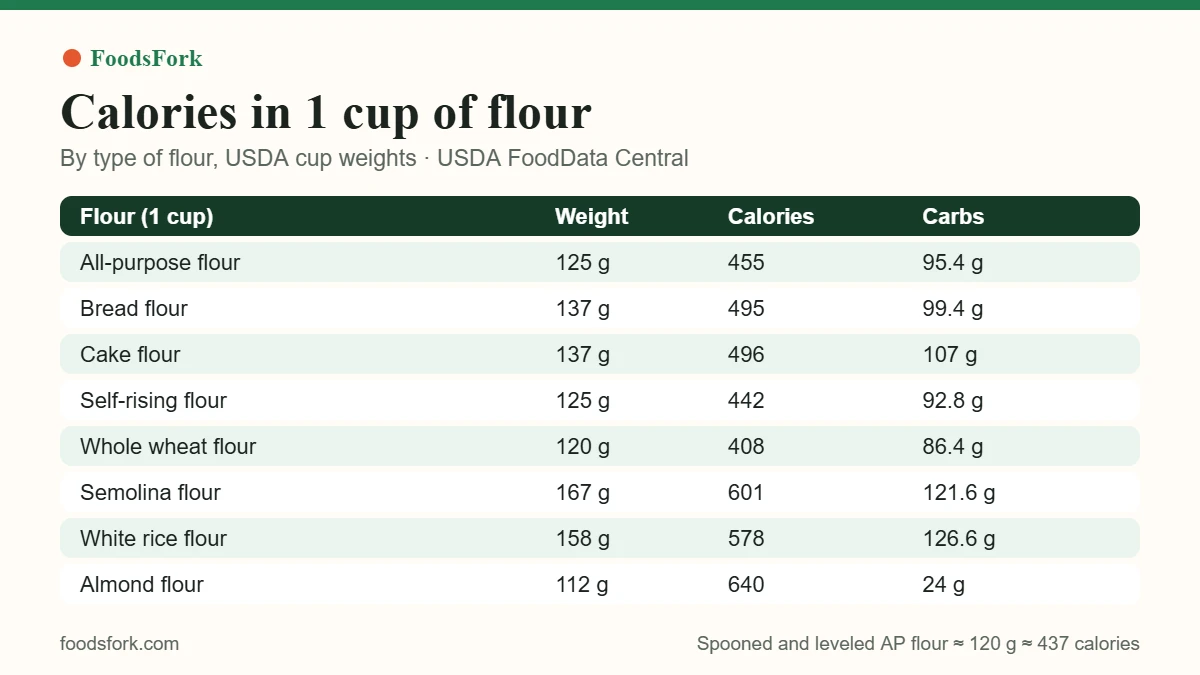
| All-purpose flour | 125 g | 455 | 95.4 g | 12.9 g | 3.4 g |
| Bread flour | 137 g | 495 | 99.4 g | 16.4 g | 3.3 g |
| Cake flour | 137 g | 496 | 107 g | 11 g | 2.3 g |
| Self-rising flour | 125 g | 442 | 92.8 g | 12.4 g | 3.4 g |
| Whole wheat flour | 120 g | 408 | 86.4 g | 15.9 g | 12.8 g |
| Semolina flour | 167 g | 601 | 121.6 g | 21.2 g | 6.5 g |
| White rice flour | 158 g | 578 | 126.6 g | 9.4 g | 3.8 g |
| Almond flour | 112 g | 640 | 24 g | 24 g | 12 g |
Wheat flours have similar calories per gram, about 340 to 365 per 100 g. Bread and cake flour show higher calories per cup only because USDA weighs their cup at 137 g. Almond flour is the outlier: it is ground almonds, so it is high in fat and much higher in calories.
Bread flour and cake flour
Bread flour has more protein, about 12 g per 100 g, which builds strong gluten for chewy loaves. Cake flour has less protein and is finely milled for tender cakes. Their calories per gram are almost the same as all-purpose flour.
Self-rising flour
Self-rising flour is all-purpose flour with baking powder and salt mixed in. It has slightly fewer calories per gram, about 354 per 100 g, because the leavening and salt take up some of the weight.
Calories in flour by portion size
Recipes rarely use exactly one cup. Here is how the calories in a cup of flour scale up and down for the most common types.
| Amount | All-purpose | Bread flour | Whole wheat | Almond flour |
|---|---|---|---|---|
| 1 tablespoon | 28 | 31 | 26 | 40 |
| ¼ cup | 114 | 124 | 102 | 160 |
| ⅓ cup | 152 | 165 | 136 | 213 |
| ½ cup | 228 | 247 | 204 | 320 |
| ¾ cup | 341 | 371 | 306 | 480 |
| 1 cup | 455 | 495 | 408 | 640 |
| 2 cups | 910 | 989 | 816 | 1,279 |
| 3 cups | 1,365 | 1,484 | 1,224 | 1,919 |
| 4 cups | 1,820 | 1,978 | 1,632 | 2,558 |
A 5 lb bag of all-purpose flour (2.27 kg) holds about 8,255 calories, or roughly 18 cups.
Why a cup of flour can have different calories
- Packing: flour settles in the bag. Scooping compresses it, so the same cup holds more flour and more calories.
- Sifting: sifted flour is airy. A cup of sifted all-purpose flour can weigh as little as 110 to 115 g.
- Flour type: fine cake flour and coarse whole wheat flour pack differently.
- Cup size: a US cup is 236.6 ml and a metric cup is 250 ml. The cups to ml converter shows the difference.
Humidity matters a little too. Flour stored in a damp kitchen can absorb a small amount of water, which adds weight but no calories, so a cup of it has slightly fewer calories than the same cup of dry flour. The effect is small next to the difference between spooning and scooping.
Because of these differences, weighing flour gives the most accurate calorie count. Our guide on how to measure flour explains the spoon-and-level method, and the cups to grams converter gives weights for 50+ ingredients.
Calories in flour per 100 g and per tablespoon
| Flour | Per 100 g | Per ounce (28 g) | Per tablespoon |
|---|---|---|---|
| All-purpose flour | 364 | 103 | 28 |
| Bread flour | 361 | 102 | 31 |
| Cake flour | 362 | 103 | 31 |
| Self-rising flour | 354 | 100 | 28 |
| Whole wheat flour | 340 | 96 | 26 |
| Semolina flour | 360 | 102 | 38 |
| White rice flour | 366 | 104 | 36 |
| Almond flour | 571 | 162 | 40 |
To count calories from grams, multiply the grams by the calories per 100 g and divide by 100. For example, 250 g of all-purpose flour × 364 ÷ 100 = 910 calories.
Carbs, protein and fiber in a cup of flour
Flour is mostly starch. In a cup of all-purpose flour, about 84% of the calories come from carbohydrate, 11% from protein and 2% from fat. You can check this with the 4-4-9 rule: 95.4 g carbs × 4 + 12.9 g protein × 4 + 1.2 g fat × 9 = about 444 calories, close to USDA’s 455.
- Carbohydrate: about 95 g per cup of all-purpose flour.
- Protein: about 13 g per cup, mostly the gluten-forming proteins.
- Fiber: about 3.4 g per cup in white flour and about 13 g in whole wheat flour.
- Fat: about 1 g per cup in white flour.
Enriched flour in the United States has thiamin, riboflavin, niacin, folic acid and iron added after milling.
Whole wheat flour vs white flour calories
Whole wheat flour is milled from the whole grain, including the bran and germ. That gives it:
- Slightly fewer calories per cup: about 408 versus 455, partly because the cup is lighter at 120 g.
- About 4 times the fiber: roughly 13 g per cup.
- More protein, magnesium and B vitamins from the bran and germ.
If you want fewer calories per slice of bread, the bigger lever is portion size and what you add, such as butter, sugar and oil, not the type of wheat flour.
Flour calories in baked goods
Flour is often a large share of a recipe’s calories, but fat and sugar can add even more. Here is a rough guide for one batch.
| Recipe | Flour used | Calories from the flour |
|---|---|---|
| Loaf of sandwich bread | 3½ cups | 1,592 |
| Batch of chocolate chip cookies | 2¼ cups | 1,024 |
| 9 × 13 inch cake | 2½ cups (cake flour) | 1,240 |
| Pizza dough (2 crusts) | 3 cups (bread flour) | 1,484 |
| Pancakes (8 to 10) | 1½ cups | 682 |
To get calories per serving, add up every ingredient and divide by the number of portions. Butter adds about 102 calories per tablespoon and sugar about 774 per cup.
Flour vs other baking staples
It helps to see how the calories in a cup of flour compare with the other ingredients in your pantry. Flour sits in the middle: higher than oats, lower than sugar and far lower than butter.
| Ingredient, 1 cup | Weight | About how many calories |
|---|---|---|
| Rolled oats | 81 g | 307 |
| Whole wheat flour | 120 g | 408 |
| All-purpose flour | 125 g | 455 |
| Bread flour | 137 g | 495 |
| Almond flour | 112 g | 640 |
| Granulated sugar | 200 g | 774 |
| Packed brown sugar | 220 g | 836 |
| Butter | 227 g | 1,628 |
Per cup, sugar has about 70% more calories than flour, mostly because a cup of sugar is heavier. Butter has more than three times the calories of flour per cup because it is about 80% fat.
Gluten-free flour calories
Gluten-free flours vary more than wheat flours. Grain and starch flours, such as white rice flour, are close to wheat flour per gram, about 360 to 370 calories per 100 g. A cup of white rice flour is heavier, though, at about 158 g and 578 calories.
Nut flours are the high end. Almond flour has about 570 calories per 100 g because about half of it is fat, and a cup has about 640 calories. Gluten-free baking blends usually mix rice flour, starches and gums, so check the label for the calories per serving and the gram weight of that serving.
How to count flour calories in a recipe
- Weigh the flour if you can. If not, use the USDA cup weight for your flour type.
- Multiply the grams by the calories per 100 g, then divide by 100.
- Add the other ingredients the same way.
- Divide by servings. Our recipe scaler helps if you change the batch size.
Baker’s percentages make this even easier because every ingredient is measured against the flour weight. See the baker’s percentage calculator for bread and pizza doughs.
Frequently asked questions
How many calories in a cup of flour?
One cup of all-purpose flour has about 455 calories, based on the USDA cup weight of 125 g. If you spoon and level the flour, a cup weighs about 120 g and has about 437 calories.
How many calories in a cup of all-purpose flour?
About 455 calories, with 95.4 g of carbohydrate, 12.9 g of protein, 1.2 g of fat and 3.4 g of fiber per 125 g cup.
How many calories in a cup of whole wheat flour?
About 408 calories per 120 g cup, with 15.9 g of protein and 12.8 g of fiber. It has slightly fewer calories than white flour per cup and about four times the fiber.
How many calories in a tablespoon of flour?
About 28 calories for all-purpose flour. A tablespoon is 1/16 of a cup, or about 7.8 g.
How many calories in 100 grams of flour?
About 364 calories for all-purpose flour, 361 for bread flour and 340 for whole wheat flour. Almond flour has about 571 calories per 100 g.
Does flour have more calories than sugar?
Per gram they are close. All-purpose flour has about 364 calories per 100 g and white sugar about 387. Per cup, sugar is higher because a cup of sugar weighs about 200 g while a cup of flour weighs about 125 g.
Does cooking or baking change the calories in flour?
No. Baking drives off water but does not remove calories. A loaf of bread has the calories of all its ingredients, so a slice is lower in calories per gram than the flour only because bread contains water.
Is almond flour lower in calories than regular flour?
No. Almond flour is much higher, about 640 calories per cup, because it is ground nuts and about half its weight is fat. It is lower in carbohydrate.
How many carbs are in a cup of flour?
About 95.4 g of carbohydrate in a cup of all-purpose flour, including about 3.4 g of fiber.
Why do different sites list different calories for a cup of flour?
Because a cup is a volume, and flour can be packed or fluffed. USDA uses 125 g, King Arthur Baking uses 120 g and a scooped cup can weigh 140 g or more. Weighing your flour gives the most accurate count.
Related tools and guides
How we checked this page: calories, nutrients and cup weights for wheat, semolina and rice flours are from USDA FoodData Central. The 120 g spooned cup follows the King Arthur Baking ingredient weight chart. Almond flour values are typical label figures. Checked November 2026.