
Fahrenheit to Celsius Converter
Convert oven and cooking temperatures between Fahrenheit and Celsius, with the right oven dial setting, fan-oven equivalent and gas mark. Includes safe cooking temperatures and candy stages.
Formula: °C = (°F − 32) × 5 ÷ 9
Common oven temperatures
Quick answer
°C = (°F − 32) × 5 ÷ 9. The most common oven temperature, 350 °F, is 177 °C, set as 180 °C (160 °C fan, gas mark 4). 375 °F is 190 °C, 400 °F is 200 °C and 425 °F is 220 °C. To go from Celsius to Fahrenheit, multiply by 9, divide by 5 and add 32.
Key facts
- °C = (°F − 32) × 5 ÷ 9, and °F = °C × 9 ÷ 5 + 32.
- 350 °F = 177 °C, set as 180 °C (160 °C fan, gas mark 4).
- 375 °F = 190 °C; 400 °F = 200 °C; 425 °F = 220 °C.
- Fan ovens: set about 20 °C lower.
- Chicken and turkey are safe at 165 °F = 74 °C.
How to use the Fahrenheit to Celsius converter
American recipes give oven temperatures in Fahrenheit, while recipes from almost everywhere else use Celsius, and many British recipes add a gas mark too. This converter handles all three, plus fan ovens:
In oven mode, the converter rounds to the nearest setting on a real oven dial, which goes in 10 °C or 25 °F steps, and shows the fan-oven equivalent, the nearest gas mark and the traditional description of the heat. In food mode, it shows the exact temperature to one decimal place, the value in Kelvin, and a note about where that temperature sits in food safety guidance, which is useful when you are reading a meat or sugar thermometer.
The Fahrenheit to Celsius formula
The two scales start at different points and use different-sized degrees. Water freezes at 32 °F or 0 °C and boils at 212 °F or 100 °C, so 180 Fahrenheit degrees cover the same range as 100 Celsius degrees. That gives the ratio of 5 to 9 in the formula.
Worked examples for everyday kitchen temperatures:
- 325 °F (low baking): (325 − 32) × 5 ÷ 9 = 162.8 °C, set as 160 °C.
- 425 °F (roasting vegetables): (425 − 32) × 5 ÷ 9 = 218.3 °C, set as 220 °C.
- 220 °C (bread): 220 × 9 ÷ 5 + 32 = 428 °F, set as 425 °F.
- 165 °F (cooked poultry): (165 − 32) × 5 ÷ 9 = 73.9 °C, rounded to 74 °C.
When should you use the exact figure and when the rounded one? For ovens, always round to the nearest setting on your dial, because home ovens cannot hold a temperature to the degree anyway. For food thermometers, sugar work, deep-frying oil and anything to do with food safety, use the exact conversion, since a few degrees can be the difference between soft-ball and firm-ball sugar, or between undercooked and safely cooked chicken. The converter shows both, so you can choose the right one for the job.
The two scales meet at −40, where −40 °F and −40 °C are the same temperature. It is a fun fact, and a handy check that you have the formula the right way round.
Oven temperature conversion chart
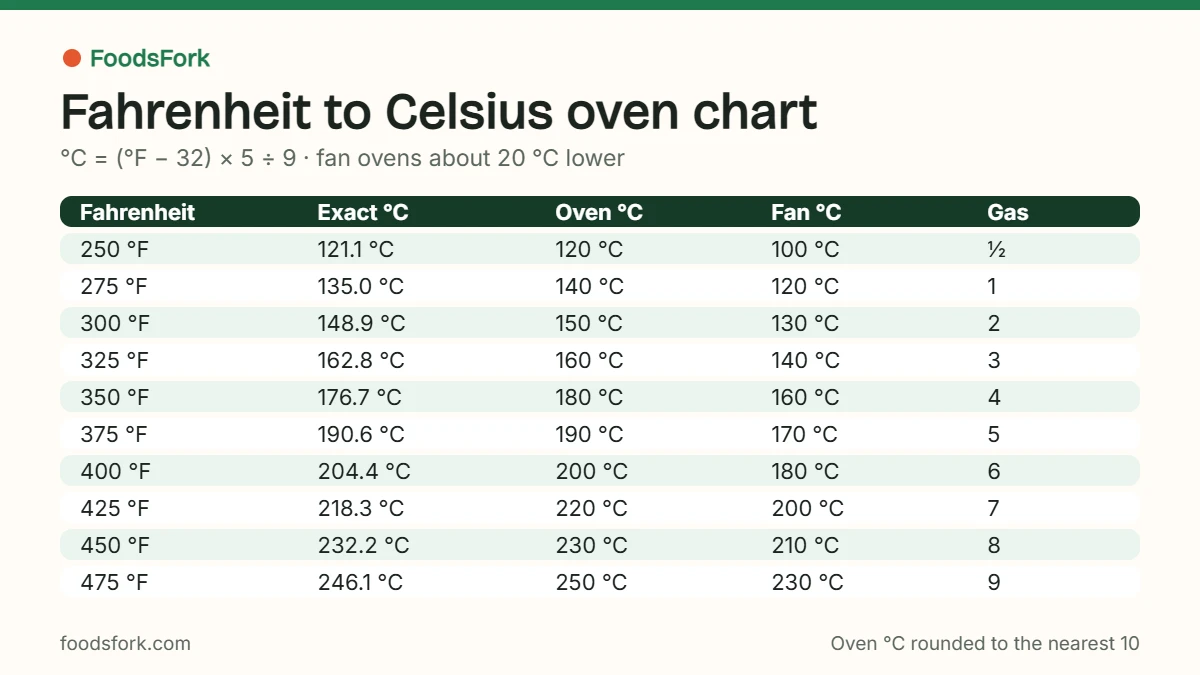
This chart lists every common oven temperature from very slow to very hot. The exact column is the mathematical conversion, and the oven column is what recipes and oven dials actually use.
| Fahrenheit | Exact Celsius | Oven °C | Fan °C | Gas mark | Heat |
|---|---|---|---|---|---|
| 225 °F | 107.2 °C | 110 °C | 90 °C | ¼ | Very slow |
| 250 °F | 121.1 °C | 120 °C | 100 °C | ½ | Slow |
| 275 °F | 135.0 °C | 140 °C | 120 °C | 1 | Slow |
| 300 °F | 148.9 °C | 150 °C | 130 °C | 2 | Moderately slow |
| 325 °F | 162.8 °C | 160 °C | 140 °C | 3 | Moderately slow |
| 350 °F | 176.7 °C | 180 °C | 160 °C | 4 | Moderate |
| 375 °F | 190.6 °C | 190 °C | 170 °C | 5 | Moderately hot |
| 400 °F | 204.4 °C | 200 °C | 180 °C | 6 | Hot |
| 425 °F | 218.3 °C | 220 °C | 200 °C | 7 | Hot |
| 450 °F | 232.2 °C | 230 °C | 210 °C | 8 | Very hot |
| 475 °F | 246.1 °C | 250 °C | 230 °C | 9 | Very hot |
| 500 °F | 260.0 °C | 260 °C | 240 °C | 10 | Very hot |
Recipes do not always round the same way. You may see 350 °F given as 175 °C or 180 °C, and 325 °F as 160 °C or 170 °C. A difference of 5 °C is well within how much most home ovens vary, so either is fine.
Celsius to Fahrenheit chart
If your recipe is in Celsius and your oven is in Fahrenheit, use this chart. The Fahrenheit column is rounded to the nearest degree; round it again to the nearest 25 °F for an oven dial.
| Celsius | Fahrenheit | Fan oven |
|---|---|---|
| 100 °C | 212 °F | 80 °C |
| 110 °C | 230 °F | 90 °C |
| 120 °C | 248 °F | 100 °C |
| 130 °C | 266 °F | 110 °C |
| 140 °C | 284 °F | 120 °C |
| 150 °C | 302 °F | 130 °C |
| 160 °C | 320 °F | 140 °C |
| 170 °C | 338 °F | 150 °C |
| 180 °C | 356 °F | 160 °C |
| 190 °C | 374 °F | 170 °C |
| 200 °C | 392 °F | 180 °C |
| 210 °C | 410 °F | 190 °C |
| 220 °C | 428 °F | 200 °C |
| 230 °C | 446 °F | 210 °C |
| 240 °C | 464 °F | 220 °C |
| 250 °C | 482 °F | 230 °C |
Typical oven temperatures by dish
When you are converting a recipe, it helps to know whether the result looks sensible. These are the usual temperature ranges for common dishes, so you can spot a conversion that has gone wrong:
- Meringues and pavlova: 225–250 °F (110–120 °C). Very low heat dries them out without browning.
- Slow-roasted meat and braises: 275–325 °F (140–160 °C). Low heat over several hours breaks down tough cuts.
- Cheesecake and custards: 300–325 °F (150–160 °C), often in a water bath, to set them gently without cracking.
- Cakes, brownies and cookies: 325–375 °F (160–190 °C), with 350 °F (180 °C) the most common setting.
- Muffins and quick breads: 350–400 °F (180–200 °C). Some recipes start hot for a better rise, then lower the heat.
- Roast chicken and vegetables: 400–425 °F (200–220 °C) for crisp skin and caramelized edges.
- Bread: 425–475 °F (220–240 °C) for a good crust.
- Pizza: as hot as your oven goes, usually 475–550 °F (240–290 °C).
If a conversion gives you 180 °F for a cake, the recipe was almost certainly in Celsius already. That kind of sense check catches most mix-ups before anything goes into the oven.
Why American recipes use Fahrenheit
The Fahrenheit scale was proposed by the physicist Daniel Gabriel Fahrenheit in the early 1700s, and the Celsius scale by the astronomer Anders Celsius a few decades later. Most of the world switched to Celsius as part of adopting the metric system during the twentieth century. The United States kept Fahrenheit for everyday use, so American ovens, recipes and thermometers still use it, while scientists in the US use Celsius. The United Kingdom now uses Celsius, but you will still see Fahrenheit and gas marks in older British recipes and on some ovens.
Neither scale is better for cooking. Fahrenheit has smaller degrees, which some cooks like for fine control, while Celsius has round numbers for freezing and boiling water. What matters is converting accurately and rounding to the setting your oven actually has.
Fan and convection ovens
A fan oven, called a convection oven in the US, uses a fan to circulate hot air. Moving air transfers heat to food faster than still air, so food cooks more quickly and browns more evenly at a lower setting.
Some ovens have a “convection conversion” setting that automatically lowers the temperature you enter. If yours does, enter the conventional temperature from the recipe and let the oven adjust it.
Gas marks explained
Gas marks are a temperature scale used on gas ovens in the United Kingdom and Ireland, and you will still find them in many British recipes. Each full gas mark from 1 upwards is roughly 25 °F (about 14 °C) hotter than the one before, starting at 275 °F for gas mark 1. Gas mark 4, the middle of the dial, is the classic 350 °F or 180 °C baking temperature.
Below gas mark 1 there are fractional marks: gas mark ½ is about 250 °F (120 °C) and gas mark ¼ is about 225 °F (110 °C), used for slow-drying meringues and very slow cooking. At the top end, gas mark 9 is about 475 °F (240 °C), used for pizza and bread.
Safe internal cooking temperatures
Ovens tell you how hot the air is; a food thermometer tells you how hot the food is, which is what makes it safe. These are the safe minimum internal temperatures recommended by the USDA and FoodSafety.gov, in both scales:
| Food | Fahrenheit | Celsius | Note |
|---|---|---|---|
| Beef, veal, lamb, goat: steaks, roasts, chops | 145 °F | 63 °C | Rest 3 minutes |
| Fresh pork and fresh ham | 145 °F | 63 °C | Rest 3 minutes |
| Ground meat and sausage | 160 °F | 71 °C | |
| All poultry, including ground poultry and stuffing | 165 °F | 74 °C | |
| Fish and shellfish (fin fish) | 145 °F | 63 °C | Or until flesh is opaque |
| Egg dishes (quiche, frittata) | 160 °F | 71 °C | |
| Leftovers and casseroles | 165 °F | 74 °C | Reheat |
| Precooked ham, reheated | 165 °F | 74 °C | 140 °F if packaged in a USDA-inspected plant |
Measure in the thickest part of the food, away from bone, fat and gristle. The rest time for whole cuts matters, because the temperature keeps rising for a few minutes after cooking and finishes destroying harmful bacteria. You can of course cook food to a higher temperature if you prefer it more done.
Food safety first: these are minimum temperatures. Always use a food thermometer rather than judging by color or cooking time.
Sugar and candy stages
When you boil sugar syrup, its temperature tells you how much water has evaporated, and that decides whether you end up with soft fudge or hard toffee. Candy thermometers are often marked in Fahrenheit only, so this chart helps when your recipe is in Celsius:
| Stage | Fahrenheit | Celsius | Used for |
|---|---|---|---|
| Thread | 223–235 °F | 106–113 °C | Syrups, glazes |
| Soft ball | 235–245 °F | 113–118 °C | Fudge, fondant |
| Firm ball | 245–250 °F | 118–121 °C | Caramels |
| Hard ball | 250–265 °F | 121–129 °C | Nougat, marshmallows |
| Soft crack | 270–290 °F | 132–143 °C | Butterscotch, taffy |
| Hard crack | 300–310 °F | 149–154 °C | Toffee, brittle, lollipops |
| Caramel | 320–350 °F | 160–177 °C | Caramel sauce, pralines |
At high altitude water boils at a lower temperature, so subtract about 2 °F for every 1,000 feet above sea level from each candy stage.
Other kitchen temperatures
| What | Fahrenheit | Celsius |
|---|---|---|
| Freezer | 0 °F | −18 °C |
| Refrigerator (maximum) | 40 °F | 4 °C |
| Water freezes | 32 °F | 0 °C |
| Room temperature | 68–72 °F | 20–22 °C |
| Proofing bread dough | 75–80 °F | 24–27 °C |
| Hot holding (minimum) | 140 °F | 60 °C |
| Gentle simmer | 185–205 °F | 85–96 °C |
| Water boils (sea level) | 212 °F | 100 °C |
| Deep-frying | 350–375 °F | 175–190 °C |
Keeping cold food at or below 40 °F (4 °C) and hot food at or above 140 °F (60 °C) keeps it out of the temperature range where bacteria multiply fastest.
Is your oven accurate?
Converting a temperature correctly only helps if your oven actually reaches it. Many home ovens run 10 to 25 °F (5 to 15 °C) hotter or cooler than the dial says, and the difference can grow as an oven ages.
- Use an oven thermometer. A cheap hang-on thermometer placed in the middle of the oven shows the real temperature.
- Preheat fully. Most ovens need 15 to 20 minutes to reach temperature, even after the light turns off.
- Avoid opening the door. Each opening can drop the temperature by 25 °F or more.
- Know your hot spots. Rotate trays halfway through if one side browns faster.
- Adjust, don’t fight it. If your oven runs 15 °F hot, simply set it 15 °F lower every time.
Fahrenheit to Celsius for air fryers and roasts
Oven temperatures are only half the story. Air fryers and big roasts like turkey add their own rules, and it helps to do the steps in the right order.
Convert first, then adjust for the air fryer
Air fryers cook faster than ovens because a strong fan moves hot air around a small basket. The usual rule is to lower the oven temperature by 25 °F (about 15 °C) and cut the time by about 20%.
For example, an oven recipe at 400 °F becomes about 375 °F in an air fryer. In Celsius, that is 190 °C. The oven to air fryer converter does both steps and shows the new time.
Do not double the reduction
An air fryer already works like a small fan oven. Use the regular oven temperature as your starting point, not the fan setting. Taking 20 °C off for a fan and then another 15 °C for the air fryer makes food pale and slow.
Air fryer dials in Celsius
Many air fryers sold outside the US step in 5 °C or 10 °C. Round to the nearest step. A 5 °C difference makes little change in a small basket, so shaking or flipping halfway matters more.
Roasting a turkey in Celsius
The USDA roasting chart uses 325 °F, which is 163 °C. Set a regular oven to 160 °C, or 140 °C with the fan on. The turkey cooking time calculator shows the hours for your bird.
Checking doneness
Turkey and chicken are safe at 165 °F, which is 74 °C. Check the thickest part of the breast, the innermost thigh and the wing. A digital thermometer that switches between °F and °C saves you the maths at the end.
Frequently asked questions
What is 350 °F in Celsius?
350 °F is 176.7 °C. On an oven dial, use 180 °C, or 160 °C for a fan oven. It is gas mark 4 and the most common baking temperature for cakes and cookies.
What is 180 °C in Fahrenheit?
180 °C is 356 °F. For an American oven, set it to 350 °F, which is the standard equivalent used in recipes.
What is 400 °F in Celsius?
400 °F is 204.4 °C. Most recipes round it to 200 °C, or 180 °C in a fan oven. It is gas mark 6.
What is 200 °C in Fahrenheit?
200 °C is 392 °F, usually rounded to 400 °F on an American oven.
What is the formula to convert Fahrenheit to Celsius?
Subtract 32 from the Fahrenheit temperature, multiply by 5 and divide by 9. For example, (350 − 32) × 5 ÷ 9 = 176.7 °C. To go the other way, multiply Celsius by 9, divide by 5 and add 32.
How much lower should I set a fan oven?
Set a fan or convection oven about 20 °C (25 °F) lower than a conventional oven. If a recipe is already written for a fan oven, do not reduce it again.
What gas mark is 180 °C?
180 °C is gas mark 4, the same as 350 °F.
What temperature should chicken be cooked to?
All poultry should reach a safe minimum internal temperature of 165 °F (74 °C), measured with a food thermometer in the thickest part, according to the USDA.
What is 425 °F in Celsius?
425 °F is 218.3 °C, usually set as 220 °C, or 200 °C in a fan oven. It is gas mark 7 and a common temperature for roasting vegetables.
What temperature is a moderate oven?
A moderate oven is 350–375 °F, or 180–190 °C, which is gas mark 4 to 5. Older recipes that say 'bake in a moderate oven' usually mean 350 °F (180 °C).
Is there a quick way to convert Fahrenheit to Celsius in your head?
Subtract 30 and halve the result. For 350 °F that gives 160 °C, which is close but low; the exact answer is 177 °C. The shortcut works best for everyday temperatures, not ovens.
What is 375 °F in Celsius?
375 °F is 190.6 °C. Set a regular oven to 190 °C, a fan oven to 170 °C, or use gas mark 5.
What is 325 °F in Celsius?
325 °F is 162.8 °C. Most recipes round it to 160 °C, though some say 170 °C. Use 140 °C in a fan oven, or gas mark 3.
What is 450 °F in Celsius?
450 °F is 232.2 °C. Set a regular oven to 230 °C, a fan oven to 210 °C, or use gas mark 8.
Should I use the fan temperature for an air fryer?
No. Start from the regular oven temperature, then lower it by about 25 °F (15 °C) and cut the time by about 20%. Taking off the fan-oven reduction as well would make the air fryer too cool.
Related tools
Sources: FoodSafety.gov safe minimum internal temperatures (USDA guidance). Oven settings and gas marks are standard kitchen equivalents; individual ovens vary. This page is for general information; see our disclaimer.