How to Check Oven Temperature (and Fix It)
If recipes keep burning or coming out pale, your oven may be off. Here is how to check oven temperature with a thermometer, and what to do next. Enter your readings below to see how far off it is.
Preheat for 20 minutes, then read your oven thermometer every 5–10 minutes. Enter up to four readings.
Uses the average of your readings. Ovens normally cycle above and below the set point.
Quick answer
To check oven temperature, put an oven thermometer on the middle rack, set the oven to 350 °F and preheat for 20 minutes. Then read the thermometer three or four times, 5 to 10 minutes apart, and average the readings. Within about 10 °F of the setting is normal. If it is further off, adjust the dial to make up the difference or use your oven’s calibration setting.
Key facts
- Use an oven thermometer in the center of the middle rack.
- Preheat for 20 minutes; take 3–4 readings, 5–10 minutes apart.
- Within 10 °F on average is normal.
- Many digital ovens have a calibration offset setting.
- Off by 50 °F or more? Call a technician.
How to check oven temperature with an oven thermometer
An oven thermometer is the simplest, most reliable way to test your oven. It is a small dial or digital gauge that sits on the rack or hangs from it. It tells you the real temperature inside, which may not match the number on the display.
Type your readings into the calculator at the top of this page. It works out the average, the swing and what to set the dial to.
Why one reading is not enough
An oven does not hold a single temperature. It heats past the set point, switches off, cools down and switches on again. A single reading might catch the top or the bottom of that cycle. Several readings, averaged, show the real picture.
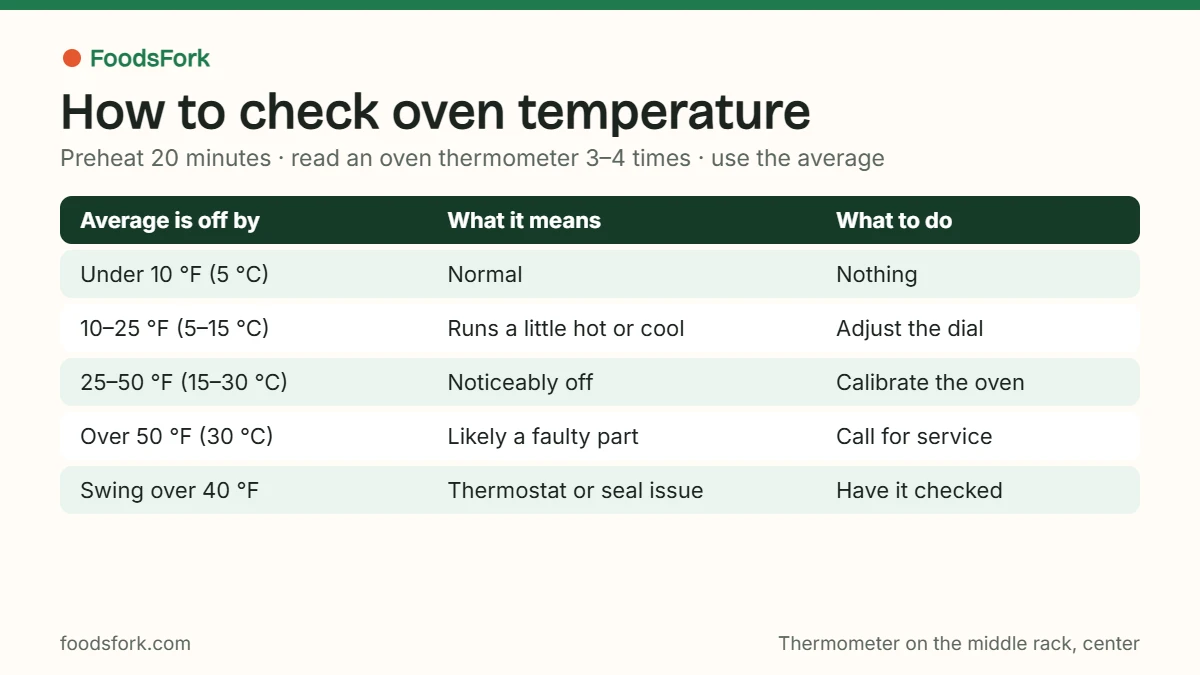
How to read your results
| Average is off by | What it means | What to do |
|---|---|---|
| Less than 10 °F (5 °C) | Normal | Nothing |
| 10 to 25 °F (5 to 15 °C) | Runs a little hot or cold | Set the dial to make up the difference |
| 25 to 50 °F (15 to 30 °C) | Noticeably off | Calibrate the oven |
| More than 50 °F (30 °C) | Likely a faulty sensor or thermostat | Call a technician |
What is a normal swing?
The difference between your highest and lowest reading is the swing. Many ovens swing 10 to 30 °F as they cycle. That is normal and does not affect most baking, as long as the average is close. A swing of 40 °F or more can point to a problem with the thermostat, igniter or door seal.
A quick example
You set the oven to 350 °F and read 335, 355 and 340 °F. The average is 343 °F, about 7 °F cool. That is within the normal range. If the readings were 320, 330 and 325 °F, the average of 325 °F is 25 °F cool, so you would set the oven to about 375 °F to bake at 350 °F, or calibrate it.
Oven temperature calibration
If your oven is consistently off, you can usually correct it yourself. The method depends on your oven.
Digital ovens
Most digital ovens have a temperature offset setting, often allowing an adjustment of about 35 °F up or down. It is usually found in the settings menu, or by holding a button such as Bake for a few seconds. Your manual will give the exact steps. If your oven runs 20 °F cool, set the offset to +20 °F.
Dial ovens
Some older dial ovens have a calibration screw. Pull the temperature knob straight off and look for a small screw or a movable plate on the back of the knob or behind it. Turning it shifts the dial’s settings. Check the manual before you try this.
Just adjust the dial
If you cannot calibrate the oven, simply set it higher or lower to make up the difference. If it runs 25 °F cool, set it to 375 °F when a recipe says 350 °F. Keep a note on the oven door so everyone in the house knows.
Check again after calibrating
After any change, repeat the thermometer test to make sure the oven now reads correctly.
How to check oven temperature without a thermometer
The sugar test
Granulated sugar melts at about 366 °F (186 °C). Put a spoonful of sugar on a small piece of foil in an oven-safe dish.
- Bake it at 350 °F for 15 minutes. It should not melt. If it does, your oven runs hot.
- Then bake a fresh spoonful at 375 °F for 15 minutes. It should melt. If it does not, your oven runs cool.
The sugar test only tells you if the oven is badly off. It cannot tell you by how much. An oven thermometer is cheap and much more useful.
Use a probe thermometer
A leave-in probe thermometer with a cable can measure air temperature if you clip it so the tip hangs in the middle of the oven, not touching anything. Check the probe’s maximum temperature first.
How to find hot spots
Even an accurate oven can be hotter in some places than others. To find out where:
- Cover a large baking sheet with slices of white bread, edge to edge.
- Bake at 350 °F on the middle rack for about 5 to 10 minutes, until the bread starts to toast.
- Look at the pattern. Darker slices show hotter areas.
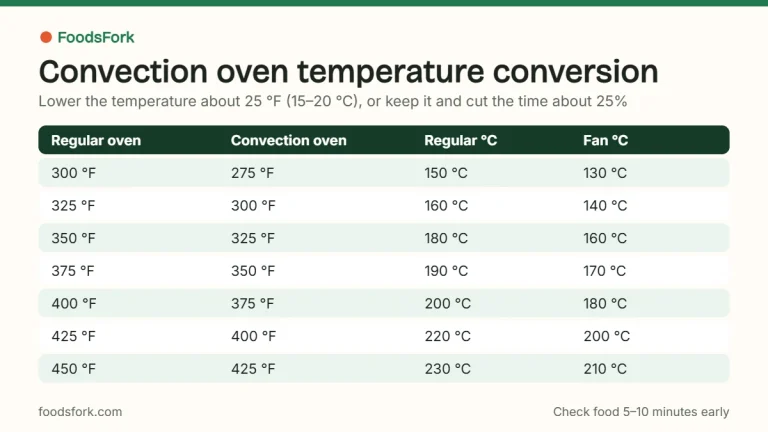
Many ovens are hotter at the back or near one side. Rotate pans halfway through baking to even it out. A convection setting also helps; see our convection oven temperature conversion guide.
Signs your oven temperature is off
Your oven may be running hot if
- Cookies brown or burn on the bottom before the centers set.
- Cakes dome, crack on top or have dark crusts.
- Food is done well before the recipe’s time.
- Roasts are well past their target temperature by the time you check.
Your oven may be running cold if
- Food takes much longer than the recipe says.
- Cookies spread and stay pale.
- Cakes sink in the middle or stay gummy.
- Bread has a pale crust and a dense crumb.
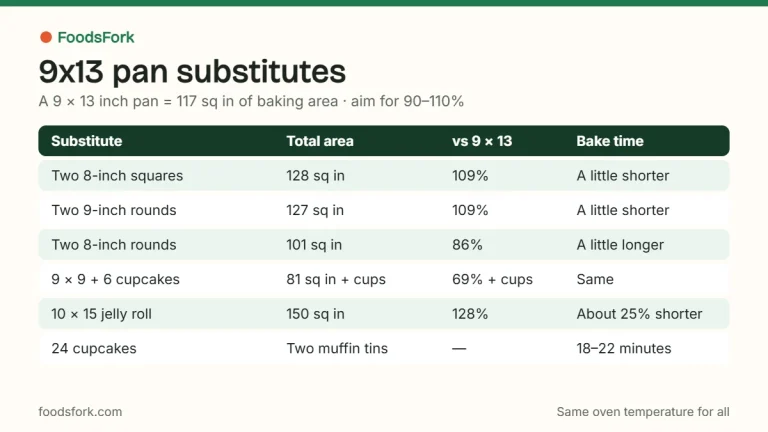
If you see these signs often, test the oven before blaming the recipe. Pan choice can matter too; read our 9×13 pan substitute guide for how pans change bake time.
Why ovens run hot or cold
- Age. Temperature sensors and thermostats drift over the years.
- Door seals. A worn or loose door gasket lets heat escape.
- Opening the door. Every time you open it, the oven can lose a lot of heat.
- Not preheating long enough. The air may be hot, but the walls are not yet.
- Crowding. A full oven heats more slowly and less evenly.
- Moving the oven. A new or moved oven may need to be leveled and checked.
Choosing a good oven thermometer
Look for a thermometer that can stand or hang from a rack, with large, clear numbers you can read through the oven window. Stainless steel dial thermometers are cheap and last for years. Digital models with a probe and an outside display let you read the temperature without opening the door.
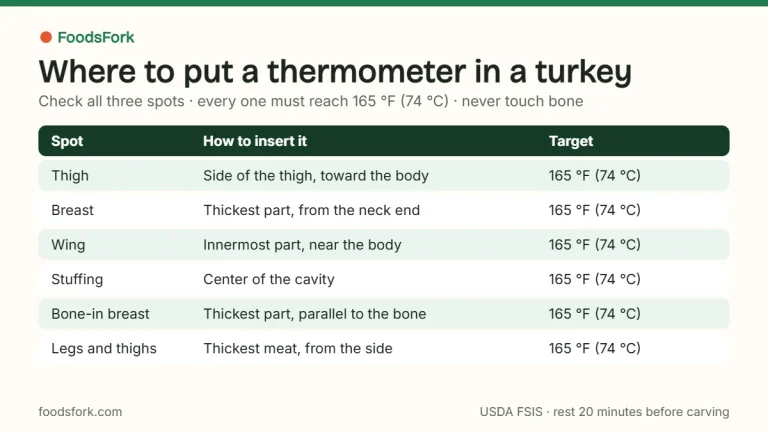
Leave it in the oven. It is the easiest way to catch problems early, and you will learn how long your oven really takes to preheat. Remember that an oven thermometer measures air temperature. To check food, use a meat thermometer; our turkey thermometer guide shows where to put it.
When to call a technician
- The oven is more than 50 °F off, even after calibrating.
- It swings by more than 40 °F between readings.
- It will not reach temperature at all, or takes far too long.
- It overheats or keeps heating after it should switch off.
- You smell gas, or see sparks or damaged wiring. Turn it off and get help right away.
Frequently asked questions
How do I check my oven temperature?
Put an oven thermometer in the center of the middle rack, set the oven to 350 °F and let it preheat for 20 minutes. Read the thermometer three or four times, 5 to 10 minutes apart, and average the readings.
How accurate should an oven be?
Within about 10 °F of the setting on average is normal. Ovens also cycle on and off, so readings rise and fall around the set temperature.
How do I calibrate my oven?
Many digital ovens have a temperature offset setting in the menu, often allowing about ±35 °F. On some dial ovens, you can pull off the knob and turn a small screw. Check your manual for your model.
Can I check my oven temperature without a thermometer?
Roughly. Granulated sugar melts at about 366 °F. Bake a spoonful on foil at 350 °F for 15 minutes; it should not melt. At 375 °F it should. This only tells you if the oven is badly off.
Where should I put an oven thermometer?
In the center of the middle rack, where most food bakes. Keep it away from the walls, the door and the heating elements, and do not let it touch a pan.
Why does my oven temperature go up and down?
Ovens heat until they pass the set point, switch off, cool a little and switch on again. That cycling is normal and is why you should average several readings.
How do I know if my oven runs hot?
Food browns too fast, burns on the bottom, or is done well before the recipe time. Cakes dome and crack. An oven thermometer reading above the setting confirms it.
How do I know if my oven runs cold?
Food takes longer than the recipe says, browns poorly and cakes may sink. An oven thermometer reading below the setting confirms it.
How long should an oven preheat?
Most ovens need 15 to 20 minutes to reach and settle at 350 °F, even if the preheat signal goes off sooner. Ovens with baking stones need longer.
How do I test for hot spots?
Lay slices of white bread across a baking sheet and bake at 350 °F for about 5 to 10 minutes. Darker slices show the hotter areas of your oven.
Related tools and guides
How we checked this guide: the method follows common oven manufacturer guidance on testing and calibration; sugar’s melting point of about 366 °F (186 °C) is a published physical value. Your oven manual comes first. Checked November 2026.