
Ml to Cups Converter
Convert milliliters to cups and cups to milliliters for US, metric, UK and Japanese cups. Get an easy cups-and-spoons measurement for every result.
Milliliters and cups both measure volume, so the answer is the same for water, milk, oil or juice. To weigh an ingredient, use our cups to grams converter.
Cup sizes from NIST (US customary), FDA 21 CFR 101.9 (legal cup) and metric standards
Common ml amounts in cups
Quick answer
1 US cup = 236.6 ml (often rounded to 240 ml), and 1 metric cup = 250 ml. To convert ml to cups, divide by 236.6 for US cups or by 250 for metric cups. So 100 ml is 0.42 cups (a scant ½ cup), 250 ml is 1.06 cups, 500 ml is 2.11 cups and 1 liter is 4.23 US cups.
Key facts
- Milliliters and cups both measure volume, so ml to cups works the same for every liquid.
- US kitchen cup: 236.6 ml. US nutrition-label cup: 240 ml. Metric cup: 250 ml.
- Old UK imperial cup: 284 ml. Japanese cup: 200 ml.
- 1 US tablespoon = 14.8 ml, 1 teaspoon = 4.9 ml, 1 US fluid ounce = 29.6 ml.
- Only water converts 1:1 between ml and grams. Other liquids are heavier or lighter.
How to use the ml to cups converter
This ml to cups converter handles every common cup size, so it works for American, Australian, Canadian, British and Japanese recipes. It also tells you how to measure the result with the cups and spoons in your drawer.
The Measure it as box is the most useful part when you’re cooking. Instead of “0.85 cups”, it tells you to measure ¾ cup + 2 tbsp, using standard measuring cups and spoons. Below the converter, a grid shows the amounts you’re most likely to need. It updates when you change the cup size.
How many ml are in a cup?
There isn’t one answer, because different countries use different cups. Here are the five you’ll meet in recipes:
| Cup | Milliliters | Where it’s used |
|---|---|---|
| US customary cup | 236.6 ml | American recipes and measuring cups |
| US legal cup | 240 ml | US nutrition facts labels |
| Metric cup | 250 ml | Australia, New Zealand, Canada, South Africa, modern UK |
| UK imperial cup | 284.1 ml | Old British recipes (half an imperial pint) |
| Japanese cup | 200 ml | Japanese recipes and measuring cups |
The US customary cup is defined as half a US pint, or 8 US fluid ounces. That works out to 236.5882365 ml. The US Food and Drug Administration (FDA) rounds this to 240 ml for nutrition labels, so a “1 cup” serving on a carton of milk is 240 ml. Most other countries use a 250 ml metric cup.
Which cup does my recipe use?
- American blogs and cookbooks: US cup (236.6 ml).
- Australian, New Zealand and Canadian recipes: metric cup (250 ml).
- Modern British recipes: usually grams and ml. If cups appear, they’re usually 250 ml.
- British recipes from before the 1970s: possibly the 284 ml imperial cup, though most used ounces and pints.
- Japanese recipes: 200 ml cup, and a 180 ml rice cup for rice.
Does the difference matter?
A metric cup is about 13 ml (just under 1 tablespoon) bigger than a US cup. For soups, stews and sauces, that’s irrelevant. For baking, it can add up. In a recipe with 3 cups of milk, it’s an extra 40 ml of liquid, enough to make a cake batter noticeably thinner. When it matters, match the cup to where the recipe comes from.
The ml to cups formula
Because both units measure volume, converting is simple division or multiplication:
Worked examples
- 400 ml can of coconut milk: 400 ÷ 236.6 = 1.69 cups, about 1⅔ cups.
- 180 ml of water for rice: 180 ÷ 236.6 = 0.76 cups, just over ¾ cup.
- 330 ml bottle of beer: 330 ÷ 236.6 = 1.39 cups, about 1⅓ cups plus 1 tablespoon.
- 1½ cups of stock: 1.5 × 236.6 = 355 ml.
Quick mental maths: divide ml by 240 and you’ll be within 1.5% of the exact US answer. 480 ml is about 2 cups, 720 ml is about 3 cups.
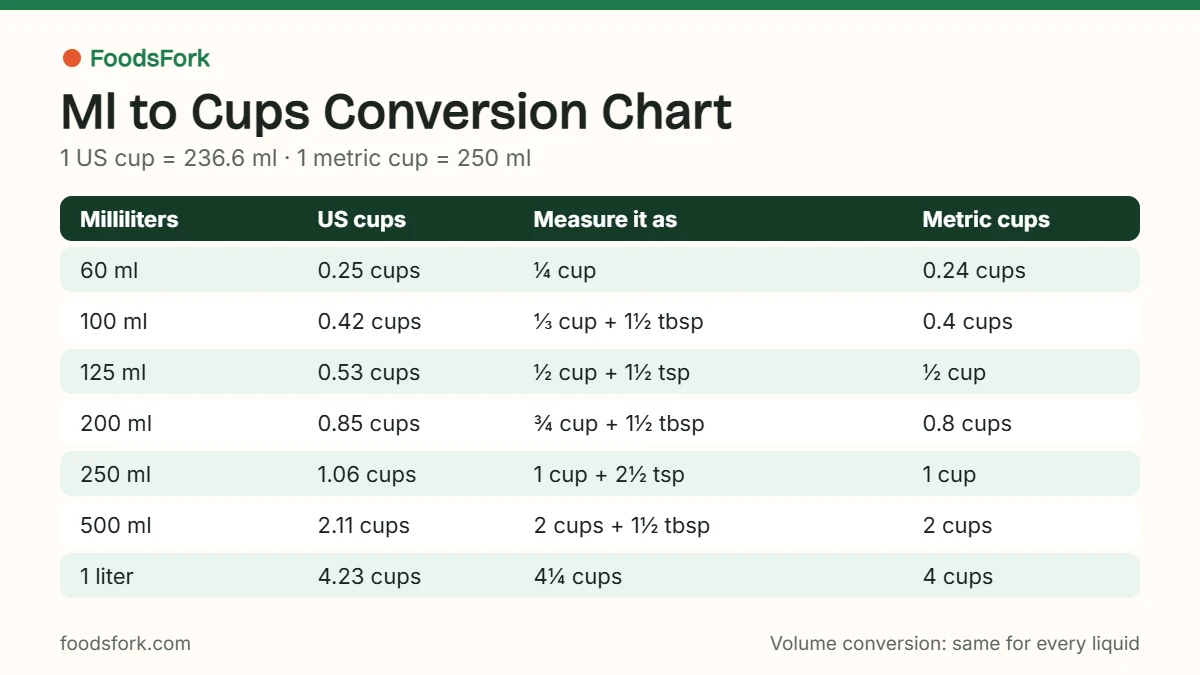
Ml to cups conversion chart
This chart covers the milliliter amounts that turn up most in recipes and on packaging. The “measure it as” column uses standard US cups and spoons.
| Milliliters | US cups | Nearest fraction | Measure it as | Metric cups |
|---|---|---|---|---|
| 5 ml | 0.02 | under ⅛ cup | 1 tsp | 0.02 |
| 10 ml | 0.04 | under ⅛ cup | 2 tsp | 0.04 |
| 15 ml | 0.06 | ⅛ cup | 1 tbsp | 0.06 |
| 20 ml | 0.08 | ⅛ cup | 1 tbsp + 1 tsp | 0.08 |
| 25 ml | 0.11 | ⅛ cup | 1 tbsp + 2 tsp | 0.10 |
| 30 ml | 0.13 | ⅛ cup | 2 tbsp | 0.12 |
| 40 ml | 0.17 | ⅛ cup | 2 tbsp + 2 tsp | 0.16 |
| 50 ml | 0.21 | ¼ cup | 3 tbsp + 1 tsp | 0.20 |
| 60 ml | 0.25 | ¼ cup | ¼ cup | 0.24 |
| 75 ml | 0.32 | ⅓ cup | ¼ cup + 1 tbsp | 0.30 |
| 80 ml | 0.34 | ⅓ cup | ⅓ cup | 0.32 |
| 100 ml | 0.42 | ⅜ cup | ⅓ cup + 1 tbsp + 1½ tsp | 0.40 |
| 120 ml | 0.51 | ½ cup | ½ cup | 0.48 |
| 125 ml | 0.53 | ½ cup | ½ cup + 1½ tsp | 0.50 |
| 150 ml | 0.63 | ⅝ cup | ½ cup + 2 tbsp + ½ tsp | 0.60 |
| 175 ml | 0.74 | ¾ cup | ¾ cup | 0.70 |
| 180 ml | 0.76 | ¾ cup | ¾ cup | 0.72 |
| 200 ml | 0.85 | ⅞ cup | ¾ cup + 1 tbsp + 1½ tsp | 0.80 |
| 225 ml | 0.95 | 1 cup | ¾ cup + 3 tbsp + ½ tsp | 0.90 |
| 240 ml | 1.01 | 1 cup | 1 cup | 0.96 |
| 250 ml | 1.06 | 1 cup | 1 cup + 2½ tsp | 1.00 |
| 300 ml | 1.27 | 1¼ cups | 1¼ cups + 1 tsp | 1.20 |
| 330 ml | 1.39 | 1⅜ cups | 1⅓ cups + 1 tbsp | 1.32 |
| 350 ml | 1.48 | 1½ cups | 1⅓ cups + 2 tbsp + 1 tsp | 1.40 |
| 375 ml | 1.59 | 1⅝ cups | 1½ cups + 1 tbsp + 1 tsp | 1.50 |
| 400 ml | 1.69 | 1⅔ cups | 1⅔ cups + 1 tsp | 1.60 |
| 450 ml | 1.90 | 1⅞ cups | 1¾ cups + 2 tbsp + 1½ tsp | 1.80 |
| 500 ml | 2.11 | 2⅛ cups | 2 cups + 1 tbsp + 2½ tsp | 2.00 |
| 600 ml | 2.54 | 2½ cups | 2½ cups + 1½ tsp | 2.40 |
| 700 ml | 2.96 | 3 cups | 2¾ cups + 3 tbsp + 1 tsp | 2.80 |
| 750 ml | 3.17 | 3⅛ cups | 3 cups + 2 tbsp + 2 tsp | 3.00 |
| 800 ml | 3.38 | 3⅜ cups | 3⅓ cups + 2½ tsp | 3.20 |
| 900 ml | 3.80 | 3¾ cups | 3¾ cups + 2½ tsp | 3.60 |
| 1,000 ml | 4.23 | 4¼ cups | 4 cups + 3 tbsp + 2 tsp | 4.00 |
Ml to cups for common drinks and containers
Packaging is often labeled only in ml, especially outside the US. These are the sizes you’ll see most:
- 330 ml can (common in Europe): 1.39 US cups, about 1⅓ cups.
- 355 ml can (12 fl oz, standard US soda can): 1.5 US cups.
- 400 ml can of coconut milk: 1.69 US cups, about 1⅔ cups.
- 500 ml bottle of water: 2.11 US cups, just over 2 cups.
- 750 ml bottle of wine: 3.17 US cups, about 3 cups plus 2½ tablespoons.
- 1 liter carton of stock: 4.23 US cups, just over 4 cups.
Cups to ml conversion chart
Going the other way, this chart shows each cup measure in milliliters for all the main cup sizes. Use the column that matches your recipe.
| Cups | US cup | US legal cup | Metric cup | UK imperial |
|---|---|---|---|---|
| ⅛ cup | 29.6 ml | 30 ml | 31.2 ml | 36 ml |
| ¼ cup | 59.1 ml | 60 ml | 62.5 ml | 71 ml |
| ⅓ cup | 78.9 ml | 80 ml | 83.3 ml | 95 ml |
| ½ cup | 118.3 ml | 120 ml | 125 ml | 142 ml |
| ⅔ cup | 157.7 ml | 160 ml | 166.7 ml | 189 ml |
| ¾ cup | 177.4 ml | 180 ml | 187.5 ml | 213 ml |
| 1 cup | 236.6 ml | 240 ml | 250 ml | 284 ml |
| 1¼ cups | 295.7 ml | 300 ml | 312.5 ml | 355 ml |
| 1½ cups | 354.9 ml | 360 ml | 375 ml | 426 ml |
| 2 cups | 473.2 ml | 480 ml | 500 ml | 568 ml |
| 3 cups | 709.8 ml | 720 ml | 750 ml | 852 ml |
| 4 cups | 946.4 ml | 960 ml | 1000 ml | 1137 ml |
For everyday cooking, these round numbers are easy to remember: ¼ cup ≈ 60 ml, ⅓ cup ≈ 80 ml, ½ cup ≈ 120 ml, ¾ cup ≈ 180 ml and 1 cup ≈ 240 ml.
Ml to tablespoons, teaspoons and fluid ounces
For small amounts, spoons are more accurate than cups. These are the standard sizes:
| Measure | Milliliters | Rounded |
|---|---|---|
| 1 teaspoon (US) | 4.93 ml | 5 ml |
| 1 tablespoon (US) | 14.79 ml | 15 ml |
| 1 fluid ounce (US) | 29.57 ml | 2 tbsp |
| 1 tablespoon (Australia) | 20 ml | 4 tsp |
| 1 fluid ounce (UK) | 28.41 ml | about 2 tbsp |
So 30 ml is 2 tablespoons, 45 ml is 3 tablespoons, and 60 ml is 4 tablespoons, which is also ¼ cup. Note that Australian tablespoons hold 20 ml, not 15 ml. If you’re following an Australian recipe with a US spoon, add an extra teaspoon for each tablespoon. Our tablespoons to cups converter covers spoons in more detail.
US vs UK fluid ounces
A US fluid ounce is 29.57 ml, and a US cup holds 8 of them. A UK fluid ounce is slightly smaller at 28.41 ml. The UK pint, though, holds 20 UK fluid ounces (568 ml) while the US pint holds 16 US fluid ounces (473 ml). So a British pint of milk is about 20% bigger than an American one.
Liters, pints, quarts and gallons
For larger volumes, such as stock, soup or batch drinks, you’ll often switch between liters and US units:
| Measure | Milliliters | Equivalent |
|---|---|---|
| 1 US cup | 236.6 ml | 0.24 L |
| 1 US pint (2 cups) | 473.2 ml | 0.47 L |
| 1 US quart (4 cups) | 946.4 ml | 0.95 L |
| 1 US gallon (16 cups) | 3,785 ml | 3.79 L |
| 1 liter | 1,000 ml | 4.23 US cups |
| 1 UK pint | 568.3 ml | 2.4 US cups |
A handy rule: a liter is a little more than a US quart (946 ml). So a recipe that calls for 2 quarts of stock needs about 1.9 liters, and a 1-liter carton is just over 4 cups.
Ml vs grams: they’re not the same
Milliliters measure volume: how much space a liquid takes up. Grams measure weight. They only match for water, where 1 ml weighs 1 g. Most other liquids are a little heavier or lighter, as this table shows.
| Liquid | Weight of 1 ml | Weight of 1 US cup |
|---|---|---|
| Water | 1 g | 237 g |
| Milk | 1.03 g | 244 g |
| Heavy cream | 1.0 g | 238 g |
| Vegetable oil | 0.92 g | 218 g |
| Honey | 1.43 g | 339 g |
| Maple syrup | 1.33 g | 315 g |
For milk, juice and stock, treating 1 ml as 1 g is close enough. For honey, syrup and oil, it isn’t. A cup of honey weighs about 43% more than a cup of water. If your recipe gives a liquid in grams, weigh it on a scale or use our cups to grams converter to find the right volume.
Figures in this table
Cup weights for milk, cream, oil and honey come from USDA FoodData Central. They’re rounded, and real values vary a little with temperature and brand.
Converting a whole recipe from ml to cups
Here’s how a simple metric pancake batter converts to US cups. The recipe gives liquids in ml, which is the easy part.
| Ingredient | Metric recipe | US cups (exact) | Measure it as |
|---|---|---|---|
| Milk | 300 ml | 1.27 cups | 1¼ cups + 1 tsp |
| Melted butter | 50 ml | 0.21 cups | 3 tbsp + 1 tsp |
| Vanilla extract | 5 ml | 0.02 cups | 1 tsp |
| Flour | 200 g | weigh it | about 1⅔ cups |
| Eggs | 2 large | not converted | 2 large |
Notice two things. First, the liquids convert cleanly, because ml and cups both measure volume. Second, the flour doesn’t. It’s given in grams, which is weight, so it needs an ingredient-specific conversion. Our grams to cups converter knows that 200 g of all-purpose flour is about 1⅔ cups.
- Convert all the liquids with the same cup size. Don’t mix US and metric cups in one recipe.
- Round sensibly. “1¼ cups + 1 tsp” can become 1¼ cups in pancakes. In a delicate custard, keep the extra teaspoon.
- Leave eggs as a count. Only convert them if the recipe gives a weight or volume.
Why cup sizes differ around the world
The cup started as an everyday measure: whatever teacup or mug was in the kitchen. As cookbooks spread in the 1800s, cooks needed something consistent. The United States defined its cup as half a US pint, and the US pint came from an old English wine gallon. That’s why a US cup is the slightly odd 236.6 ml.
Britain kept a different, larger pint. Half of it, the imperial cup, is 284 ml. When Australia, New Zealand and Canada switched to metric units in the 1960s and 1970s, they adopted a neat 250 ml metric cup so cooks could keep using cups. The UK later moved to grams and ml for most recipes. Japan settled on 200 ml. The result is several “cups” that look the same in a recipe but hold different amounts, which is exactly why an ml to cups converter with a cup selector is so useful.
How to measure liquids accurately
- Use a liquid measuring cup. A clear jug with a spout and marked lines is designed for liquids. Dry measuring cups are meant to be filled to the brim and leveled off, which is hard to do with liquids without spilling.
- Read it at eye level. Set the jug on the counter and bend down so your eye is level with the line. Looking down from above makes it look fuller than it is.
- Read the bottom of the curve. Water curves up slightly at the edges. Read the line at the flat center.
- Coat spoons for sticky liquids. A thin film of oil helps honey and syrup slide out, so you get the full amount.
- Check which units your jug shows. Many jugs have ml on one side and cups on the other. Make sure you’re reading the right scale.
Common ml to cups mistakes
- Using the wrong cup. Measuring an Australian recipe with US cups makes every cup about 5% short.
- Assuming ml equals grams. Fine for water, wrong for honey, oil and syrup.
- Mixing fluid ounces and ounces. Fluid ounces measure volume. Ounces on a scale measure weight. Our grams to ounces converter handles weight.
- Rounding every ingredient differently. If you round the milk up, round the other liquids up too, so the proportions stay the same.
- Measuring dry ingredients in ml. A metric jug works for liquids, but flour and sugar measured by volume vary a lot. Weigh them instead.
Ml to cups FAQ
How many ml are in a cup?
A US cup holds 236.6 ml, which most people round to 240 ml. A metric cup, used in Australia, New Zealand, Canada and modern UK recipes, holds 250 ml. An old UK imperial cup holds about 284 ml, and a Japanese cup holds 200 ml.
Is 250 ml equal to 1 cup?
250 ml is exactly 1 metric cup. In US cups, 250 ml is 1.06 cups, or 1 cup plus about 1 tablespoon.
How many cups is 100 ml?
100 ml is 0.42 US cups. That's just under ½ cup, or about ⅓ cup plus 1½ tablespoons.
How many cups is 200 ml?
200 ml is 0.85 US cups, a little more than ¾ cup. Measure ¾ cup plus 2 tablespoons.
How many cups is 500 ml?
500 ml is 2.11 US cups, or 2 cups plus about 2 tablespoons. It is exactly 2 metric cups.
How many cups are in a liter?
One liter is 4.23 US cups, or 4 metric cups. In practice, 1 liter is a little over 4 US cups.
How many ml is half a cup?
Half a US cup is 118.3 ml, usually rounded to 120 ml. Half a metric cup is 125 ml.
How many ml is ¼ cup?
A quarter of a US cup is 59.1 ml, usually rounded to 60 ml. A quarter metric cup is 62.5 ml.
How many ml is ⅓ cup?
A third of a US cup is 78.9 ml, usually rounded to 80 ml. A third of a metric cup is 83.3 ml.
Is a cup 240 ml or 250 ml?
Both are correct in different places. US nutrition labels use a 240 ml cup, a US kitchen cup is 236.6 ml, and countries that use metric cups use 250 ml. The difference is small for cooking but can matter in baking.
How do I convert ml to cups?
Divide the number of milliliters by the size of the cup. For US cups, divide by 236.6. For metric cups, divide by 250. For example, 300 ml ÷ 236.6 = 1.27 US cups.
Is ml the same as grams?
Only for water and liquids with a similar density. One ml of water weighs 1 gram, but 1 ml of honey weighs about 1.4 grams and 1 ml of oil weighs about 0.9 grams. Milliliters measure volume, while grams measure weight.
How can I measure ml without a measuring jug?
Use measuring spoons. One US tablespoon is 14.8 ml and one teaspoon is 4.9 ml, so 15 ml is about 1 tablespoon and 5 ml is about 1 teaspoon. For larger amounts, a standard US measuring cup holds 236.6 ml.
Related tools
Sources: NIST Office of Weights and Measures (US customary units); FDA 21 CFR 101.9 (240 ml cup for nutrition labeling); USDA FoodData Central (liquid weights). See our disclaimer.