Dry vs Liquid Measuring Cups: What Is the Difference?
Dry vs liquid measuring cups hold the same amount, but they are filled in different ways. Pick your ingredient below to see which cup to use and how to fill it.
1 US cup = 236.6 ml = 16 tablespoons = 8 fluid ounces
Quick answer
In dry vs liquid measuring cups, the volume is the same: 1 US cup is 236.6 ml in both. The difference is design. Dry measuring cups are filled to the rim and leveled with a knife, so use them for flour, sugar and grains. Liquid measuring cups are clear jugs with a spout and lines below the rim, so you can pour without spilling and read them at eye level. Use them for water, milk and oil.
Key facts
- Both hold the same: 1 US cup = 236.6 ml.
- Dry cups: fill to the rim and level. Liquid cups: fill to the line, read at eye level.
- Dry cups for flour, sugar, grains and thick foods.
- Liquid cups for water, milk, oil and broth.
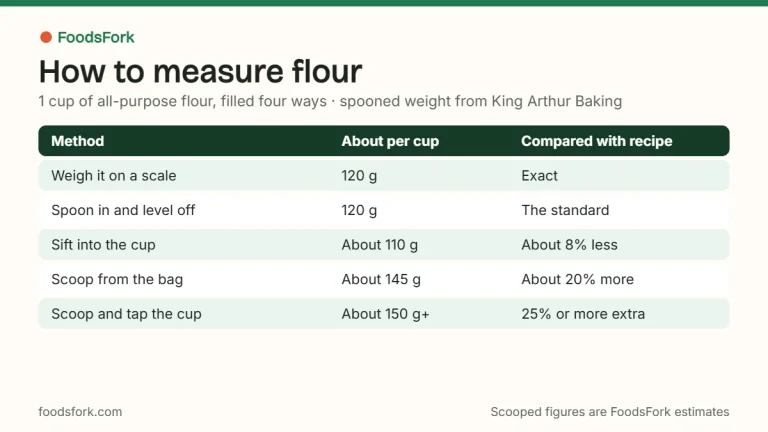
- A scale beats both: 1 cup of flour = 120 g.
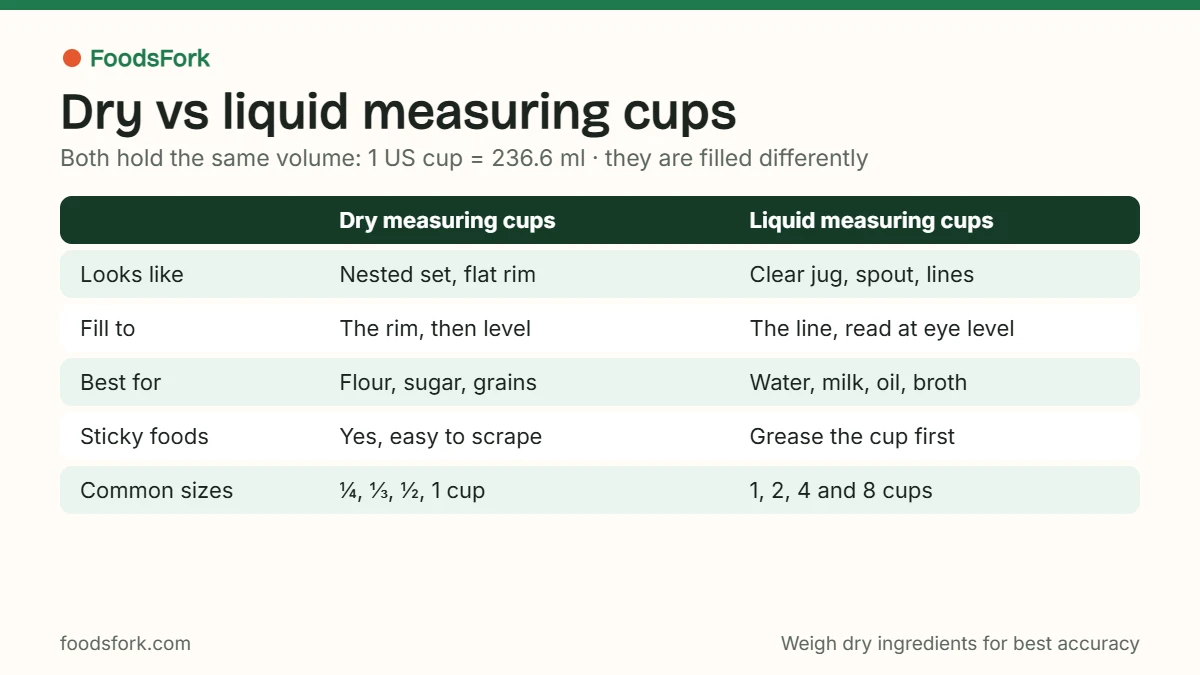
Dry vs liquid measuring cups: the difference
People are often surprised that a dry cup and a liquid cup hold the same amount. A 1-cup dry measure and the 1-cup line on a liquid jug both hold 236.6 ml. What changes is how easy it is to measure each kind of ingredient accurately.
| Dry measuring cups | Liquid measuring cups | |
|---|---|---|
| What they look like | Nested set of metal or plastic cups with flat rims | Clear glass or plastic jug with a spout and printed lines |
| How you fill them | To the very top, then level off | To a line below the rim |
| How you read them | The rim is the line | At eye level, on a flat surface |
| Best for | Flour, sugar, oats, rice, chopped nuts | Water, milk, juice, oil, broth |
| Sizes | Usually ¼, ⅓, ½ and 1 cup | 1, 2, 4 and 8 cup jugs |
| Extra markings | Rarely | Usually ml and fluid ounces too |
Why dry cups have a flat rim
Dry ingredients pile up and settle unevenly. A flat rim lets you sweep off the extra with a knife, so the cup is exactly full every time.
Why liquid cups have extra space
Liquids slosh and spill. The space above the top line lets you carry a full cup and pour it without making a mess. The spout helps it pour cleanly, and the clear sides let you see the level.
How to use dry measuring cups
Flour is the ingredient that most needs care. Scooping it straight from the bag packs it down. Our guide on how to measure flour explains the spoon and level method in detail.
When to pack the cup
Brown sugar is the main exception. Recipes almost always mean packed brown sugar: press it firmly into the cup until it holds the cup’s shape when you turn it out. Some recipes also ask for lightly packed shredded cheese or herbs.
How to use liquid measuring cups
Reading ml and ounces
Most liquid cups show cups, fluid ounces and milliliters. A US cup is 8 fluid ounces or about 237 ml. Need to convert a metric recipe? The ml to cups converter gives cups and spoons for any amount.
Small amounts of liquid
For anything under ¼ cup, measuring spoons are more accurate than a big jug. A quarter cup is 4 tablespoons, and 1 tablespoon is 3 teaspoons. The tablespoons to cups converter helps with odd amounts.
Can you use one instead of the other?
Liquid cup for dry ingredients
It works, but it is not accurate. You cannot level flour below a line, so you end up shaking the cup to flatten it. Shaking packs the flour down, and you can end up with noticeably more than the recipe wants. For flour and sugar, this is the swap to avoid.
Dry cup for liquids
This is the better of the two swaps. Fill the cup right to the rim over a bowl, so any drips land in the bowl. It is easy to spill a little on the way, so you may end up slightly short. For a splash of milk in pancakes, that is fine. For baking, a liquid cup is better.
What if you only own one kind?
If you only have a liquid jug, buy a cheap set of dry cups or a kitchen scale for baking. If you only have dry cups, they will do for liquids as long as you fill carefully.
Which measuring cup for which ingredient
| Ingredient | Cup to use | How to fill it |
|---|---|---|
| Flour, cake flour, almond flour | Dry | Spoon in, level off |
| Granulated sugar | Dry | Pour in, level off |
| Brown sugar | Dry | Pack firmly |
| Powdered sugar, cocoa | Dry | Spoon in, level, sift after if needed |
| Oats, rice, grains, lentils | Dry | Pour in, level off |
| Chocolate chips, nuts, berries | Dry | Fill loosely to the rim |
| Shredded cheese, fresh herbs | Dry | Press lightly |
| Water, milk, juice, broth | Liquid | Pour to the line, read at eye level |
| Oil, melted butter | Liquid | Pour to the line |
| Honey, syrup, molasses | Liquid or dry | Grease the cup first |
| Yogurt, sour cream, peanut butter | Dry | Spoon in, level, scrape out |
| Solid butter | Neither | Use the wrapper markings |
For butter, the wrapper is the easiest measure. One US stick is ½ cup or 8 tablespoons. The butter converter handles sticks, cups and grams.
Measuring sticky and thick ingredients
Honey, maple syrup, molasses, peanut butter and yogurt cling to the cup. Some always gets left behind, so you end up using less than the recipe says.
- Grease the cup. Wipe it with a little oil or spray it with cooking spray, and sticky liquids slide right out.
- Measure oil first. If a recipe uses both oil and honey, measure the oil first in the same cup.
- Use a spatula. A small silicone spatula scrapes thick foods out cleanly.
- Try a plunger cup. Adjustable measuring cups have a sliding base that pushes everything out.
- Weigh it. Put the bowl on a scale and pour honey straight in. No cup to clean.
Measuring cup sizes around the world
A “cup” is not the same everywhere. If a recipe comes from another country, the cup it uses may be a little bigger or smaller than yours.
| Cup | Volume | Where it is used |
|---|---|---|
| US customary cup | 236.6 ml | Most American recipes |
| US legal cup | 240 ml | Nutrition labels in the US |
| Metric cup | 250 ml | Australia, New Zealand, Canada and many others |
| UK cup (older recipes) | About 284 ml | Old British recipes |
| Japanese cup | 200 ml | Japanese recipes and rice cookers |
For most cooking, the difference between a US cup and a metric cup does not matter. For baking, it adds up over several cups. The cups to grams converter lets you pick the cup size.
Why a kitchen scale beats both kinds of cup
Cups measure volume. Volume is easy for liquids but tricky for anything that packs, settles or clumps. Weight does not change no matter how you fill the bowl.
- More accurate. 120 g of flour is always 120 g of flour.
- Faster. Pour ingredients straight into the bowl and press tare between each one.
- Fewer dishes. No cups or spoons to wash.
- Easy to scale. Doubling 120 g is simpler than doubling ⅔ cup. Try the recipe scaler.
Even with a scale, keep liquid cups for water and milk. For liquids, volume is quick and accurate enough.
How to choose good measuring cups
Dry measuring cups
Look for a sturdy metal set with flat rims and long handles. Etched or stamped markings last longer than printed ones. A set that includes ⅔ and ¾ cup saves a lot of guesswork.
Liquid measuring cups
A clear glass jug with a spout is the classic choice, and glass can go in the microwave. Choose one with large, easy-to-read markings in both cups and milliliters. A 2-cup size covers most recipes, and a 4-cup size is handy for big batches.
Check your cups
Cheap cups are not always accurate. Fill your 1-cup measure with water and pour it into a liquid cup, or weigh it: it should be close to 237 g. If it is far off, replace it.
Common measuring cup mistakes
- Reading a liquid cup from above. Looking down at the line makes you underfill. Bend down to eye level.
- Holding the jug in the air. A tilted cup reads high on one side and low on the other. Set it on the counter.
- Scooping flour. Plunging a dry cup into the bag packs in extra flour. Spoon it in instead.
- Measuring over the mixing bowl. Any overflow lands in the batter. Measure over the bag or the sink.
- Guessing fractions. Filling a 1-cup measure “about two-thirds full” is rarely accurate. Use the ⅔-cup measure, or ½ cup plus 2 tablespoons plus 2 teaspoons.
- Mixing cup systems. A metric cup is 250 ml, not 236.6 ml. Use cups from one set throughout a recipe.
Fix these few habits and most recipes will turn out the way their writers intended, whether you use cups or a scale.
Frequently asked questions
What is the difference between dry and liquid measuring cups?
They hold the same amount, but they are designed differently. Dry measuring cups are filled to the rim and leveled off. Liquid measuring cups are clear, have a spout and space above the top line, and are read at eye level.
Can I use a liquid measuring cup for dry ingredients?
You can, but it is less accurate. You cannot level flour or sugar in a liquid cup, and shaking it to flatten the top packs the ingredient down. Use dry cups or a scale for dry ingredients.
Can I use a dry measuring cup for liquids?
Yes, in a pinch. Fill it right to the rim over a bowl and pour carefully. It is easy to spill or underfill, so a liquid cup is better for milk, water and oil.
Is a cup of liquid the same as a cup of dry?
Yes, by volume. Both are 1 US cup, or 236.6 ml. What differs is the weight: a cup of water weighs about 237 g, but a cup of flour weighs about 120 g.
How many ounces are in a cup?
A US cup holds 8 fluid ounces of volume. Dry ingredients are different: a cup of flour weighs about 4.25 ounces, and a cup of sugar about 7 ounces.
Which measuring cup do you use for sour cream or yogurt?
A dry measuring cup. Spoon it in, level the top and scrape it out with a spatula. This is easier than getting thick foods out of a liquid cup.
How do you read a liquid measuring cup?
Put it on a flat surface, pour in the liquid, then bend down so your eyes are level with the line. Read the bottom of the curved surface of the liquid.
What sizes do dry measuring cups come in?
Most sets have 1 cup, ½ cup, ⅓ cup and ¼ cup. Larger sets add ⅛, ⅔ and ¾ cup, and sometimes 2 cups.
Are metric measuring cups the same as US cups?
No. A metric cup holds 250 ml, about 5% more than a US cup of 236.6 ml. For most recipes the difference is small, but it adds up in baking.
Do I need both kinds of measuring cups?
It helps. A set of dry cups and one 2-cup liquid cup cover almost every recipe. A kitchen scale is even better for dry ingredients.
Related tools and guides
Sources: NIST (US customary cup of 236.588 ml); FDA 21 CFR 101.9 (240 ml cup for nutrition labeling); King Arthur Baking ingredient weights. Checked November 2026.