
Recipe Scaler
Resize any recipe in seconds. Paste the ingredients, choose the number of servings and get every amount scaled into easy cups, spoons and grams.
Paste any ingredient list. The scaler understands fractions (1½, 1 1/2, ¾), ranges (2–3) and units such as cups, tbsp, tsp, g, ml, oz and lb. Lines without a number stay as they are.
Cups and spoons rounded to standard US measures (1 cup = 16 tbsp = 48 tsp)
Quick answer
To scale a recipe, divide the number of servings you want by the number the recipe makes, then multiply every ingredient by that scaling factor. Going from 8 to 12 servings is a factor of 1.5, so 2 cups of flour becomes 3 cups. Halving is a factor of 0.5: ⅓ cup becomes 2 tbsp + 2 tsp, and 1 egg becomes about 25 g of beaten egg.
Key facts
- Scaling factor = servings wanted ÷ servings in the recipe.
- Multiply every ingredient by the same factor so the proportions stay the same.
- Use tablespoons for awkward amounts: ½ of ⅓ cup = 2 tbsp + 2 tsp.
- A large egg is about 50 g without the shell. Beat and weigh for half eggs.
- Pan size, baking time and seasoning need a check after scaling.
How to use the recipe scaler
This recipe scaler resizes a whole ingredient list in one go. It also cleans up the results, so you get measurements you can actually use, like ¼ cup + 2 tbsp instead of 0.375 cups.
The scaler reads whole numbers, decimals, fractions like 1/2, mixed numbers like 1 1/2, symbols like ¾ and ranges like 2–3. It recognizes cups, tablespoons, teaspoons, grams, kilograms, milliliters, liters, ounces, pounds, fluid ounces and pinches. Ingredients counted without a unit, like eggs, lemons or garlic cloves, are scaled to the nearest quarter.
Scaling eggs automatically
When the result includes part of an egg, the scaler tells you how many to beat and roughly how many grams to use. For example, scaling 2 eggs by 0.75 gives “1½ eggs (beat 2 and use about 75 g)”. You’ll find more on eggs below.
How to scale a recipe by hand
Every recipe scaler, including this one, uses the same simple maths:
- Work out the factor. If the recipe serves 4 and you need 10, the factor is 10 ÷ 4 = 2.5.
- Multiply every ingredient. Write the new amounts down before you start, so nothing gets missed.
- Round to real measures. 2.5 × ⅓ cup is 0.83 cups. Round to ¾ cup + 1 tbsp + 1 tsp, or just a scant cup.
- Check the equipment. Make sure the bowl, pan and pot can hold the new amount.
- Taste at the end. Season the scaled dish carefully, especially when multiplying by 3 or more.
Scaling by the amount you have
Sometimes you scale to match an ingredient rather than a headcount. If a recipe needs 3 cups of berries and you only have 2, the factor is 2 ÷ 3 = 0.67. Enter 3 as the original and 2 as the new amount, and the recipe scaler will resize everything else to match.
Halving and doubling chart
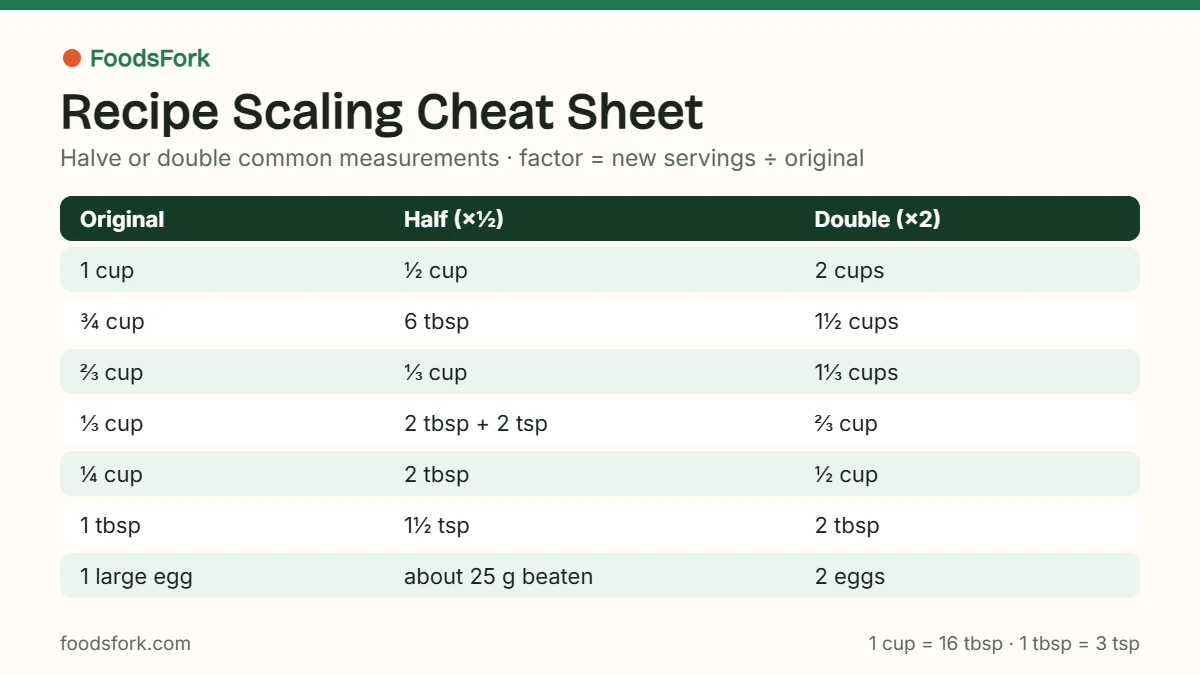
Halving and doubling are the most common ways to scale a recipe. This chart covers the measurements that cause the most trouble:
| Original | Half | Double |
|---|---|---|
| 1 cup | ½ cup | 2 cups |
| ¾ cup | 6 tbsp | 1½ cups |
| ⅔ cup | ⅓ cup | 1⅓ cups |
| ½ cup | ¼ cup | 1 cup |
| ⅓ cup | 2 tbsp + 2 tsp | ⅔ cup |
| ¼ cup | 2 tbsp | ½ cup |
| 1 tbsp | 1½ tsp | 2 tbsp |
| 1 tsp | ½ tsp | 2 tsp |
| ½ tsp | ¼ tsp | 1 tsp |
| ¼ tsp | ⅛ tsp | ½ tsp |
Notice how often the half amounts turn into tablespoons. Halving ¾ cup gives 6 tablespoons, and halving ⅓ cup gives 2 tablespoons plus 2 teaspoons. Our tablespoons to cups converter helps with any other amount.
Cutting a recipe into thirds
A third of a recipe is handy for one or two people. It’s also where measurements get the most awkward:
| Original | One third | In teaspoons |
|---|---|---|
| 1 cup | ⅓ cup | 5 tbsp + 1 tsp |
| ¾ cup | ¼ cup | 4 tbsp |
| ½ cup | 2 tbsp + 2 tsp | 8 tsp |
| ⅓ cup | 1 tbsp + 2⅓ tsp | about 5⅓ tsp |
| ¼ cup | 1 tbsp + 1 tsp | 4 tsp |
| 1 tbsp | 1 tsp | 1 tsp |
| 1 tsp | ⅓ tsp | a generous ¼ tsp |
For a third of a recipe, weighing is much easier than measuring. A third of 300 g of flour is simply 100 g.
How to scale eggs
Eggs are the ingredient people worry about most when scaling a recipe. You can’t crack half an egg, but you can beat one and measure it. A large egg weighs about 50 g without its shell, and the white makes up about two-thirds of that.
| You need | Weight | How to measure it |
|---|---|---|
| 1 large egg | about 50 g | Use 1 whole egg |
| ½ egg | about 25 g | Beat 1 egg, use half (about 1½ tbsp + ½ tsp) |
| 1½ eggs | about 75 g | 1 egg + half of a second beaten egg |
| ¼ egg | about 12 g | Beat 1 egg, use about 2½ tsp |
| ⅓ egg | about 17 g | Beat 1 egg, use about 1 tbsp |
| 1 egg yolk | about 17–19 g | About 1 tbsp |
| 1 egg white | about 30–33 g | About 2 tbsp |
Leftover beaten egg keeps in a covered container in the fridge for a day or two. Use it for scrambled eggs, an egg wash for pastry, or to bind meatballs.
Rounding eggs instead
In forgiving recipes such as pancakes, meatloaf or muffins, you can usually round to the nearest whole egg. Round up when the batter seems dry and down when it seems wet. In delicate bakes like custards, soufflés and sponge cakes, measure the egg exactly.
What doesn’t scale evenly
Most ingredients scale in a straight line. A few things don’t, and they’re worth knowing about:
- Salt and strong spices. Scale them, but hold back a little when multiplying a lot and add it to taste at the end.
- Liquid in soups and sauces. A bigger pot has more surface area, so liquid can evaporate at a different rate. Keep some stock or water on hand to adjust.
- Thickeners. Flour and cornstarch in sauces scale well, but check the thickness before adding more.
- Cooking and baking time. Time depends on the size and depth of what you’re cooking, not just the quantity. A double batch of stew may take longer to come to a simmer. A half batch of brownies in a smaller pan may bake in about the same time.
- Very large batches of baking. Mixers and ovens have limits. Three batches of cookie dough usually turn out better than one triple batch.
Pan size and baking time when scaling
When you scale a baked recipe, the pan has to change too. The goal is to keep the batter at about the same depth, so it bakes in roughly the same time. That means matching the area of the pan to the amount of batter.
- Doubling: use two of the original pans, or one pan with about twice the area. Two 8-inch square pans (64 sq in each) are about the same as one 9 × 13-inch pan (117 sq in).
- Halving: a 9 × 13-inch recipe halves nicely into an 8 or 9-inch square pan.
- Deeper batter takes longer to bake and may need a slightly lower temperature. Shallower batter bakes faster.
Our cake pan size calculator compares any two pans and tells you how much to scale the recipe. Whatever pan you use, start checking 5 to 10 minutes before the original time.
Why scaling by weight is easier
Recipes written in grams scale with no fractions at all. Halving 250 g of flour gives 125 g. Tripling 85 g of butter gives 255 g. There’s no need to turn cups into tablespoons, and the result is more accurate, because a scale doesn’t care how firmly the flour was packed.
If your recipe uses cups, you can convert it to grams first with our cups to grams converter, scale it, and keep the weights for next time. For butter, our butter conversion page turns sticks and cups into grams.
Tidy up the units after scaling
Scaled amounts often land in the wrong unit: 12 teaspoons, 20 tablespoons or 0.06 cups. These equivalents help you tidy them up. The recipe scaler applies them for you.
- 3 teaspoons = 1 tablespoon
- 4 tablespoons = ¼ cup
- 5 tablespoons + 1 teaspoon = ⅓ cup
- 8 tablespoons = ½ cup
- 16 tablespoons = 1 cup
- 2 cups = 1 pint, 4 cups = 1 quart
- 16 ounces = 1 pound, 1,000 g = 1 kg
Scaling for a crowd or for meal prep
Cooking for a party or a week of lunches is where a recipe scaler earns its keep. Scale the recipe, then make a shopping list from the new amounts. Check your largest pot and pan before you start: a 10-serving soup won’t fit in a 3-quart saucepan. For a holiday meal, start with our turkey per person calculator, then scale each side dish to the same headcount.
Common recipe scaling mistakes
- Forgetting one ingredient. Write the new amounts down first, or copy the scaled list, so nothing stays at the old amount.
- Keeping the same pan. A half batch spread thin in a big pan overbakes. A double batch in the same pan underbakes in the middle.
- Rounding everything up. Small roundings add up. Round some ingredients up and some down, or use weights.
- Multiplying the time. Doubling a recipe doesn’t double the baking time. Check doneness instead.
- Over-seasoning big batches. Add the last of the salt and spice to taste.
Recipe scaler FAQ
How do I scale a recipe?
Divide the number of servings you want by the number the recipe makes. That's your scaling factor. Multiply every ingredient by it. For example, to turn 8 servings into 12, the factor is 12 ÷ 8 = 1.5, so 2 cups of flour becomes 3 cups.
How do I cut a recipe in half?
Multiply every ingredient by ½. Use tablespoons for awkward cup amounts: half of ⅓ cup is 2 tablespoons plus 2 teaspoons, and half of ¾ cup is 6 tablespoons.
How do I halve an egg?
Beat the egg until smooth, then use half of it. A large egg weighs about 50 g without the shell, so half an egg is about 25 g, or roughly 1½ tablespoons.
Can I double any recipe?
Most recipes double well. Soups, stews, sauces, marinades, cookies and muffins are easy. Cakes and bread may need a bigger pan or two pans, and very large batches can be harder to mix and bake evenly.
Do I need to change the baking time when I scale a recipe?
Often, yes. Baking time depends on the size and depth of the pan, not just the amount of batter. Deeper batter needs longer, and a smaller batch in a smaller pan may be done sooner. Start checking early and use the usual doneness tests.
Should I scale salt and spices exactly?
Scale them as a starting point, then taste. When you multiply a recipe several times, strong seasonings like salt, chili and garlic can come across as too much, so it's safer to add the last part to taste.
Does baking powder scale like other ingredients?
For halving or doubling, scale baking powder and baking soda like everything else. For much larger batches, many bakers prefer to mix several normal-size batches instead of one giant batch.
Is it easier to scale recipes by weight?
Yes. Grams multiply cleanly with no fractions. Halving 250 g is simply 125 g, while halving ⅔ cup means converting to tablespoons. If your recipe is in cups, our cups to grams converter can switch it to weights first.
What pan should I use when I scale a cake recipe?
Choose a pan with an area that matches the new amount of batter. Doubling a recipe needs about double the pan area, for example two 9-inch round pans instead of one. Our cake pan size calculator works this out for you.
How do I scale a recipe that serves 4 to serve 6?
The scaling factor is 6 ÷ 4 = 1.5. Multiply every ingredient by 1.5: 1 cup becomes 1½ cups and 2 eggs become 3 eggs.
How do I scale a recipe by a third?
Multiply each ingredient by ⅓. One cup becomes ⅓ cup, ¾ cup becomes ¼ cup and 1 tablespoon becomes 1 teaspoon. Eggs are easiest to handle by beating them and measuring by weight.
Why do my scaled recipes taste different?
Common causes are rounding errors, using a pan that's too big or small, evaporation in larger or smaller pots, and seasoning that doesn't scale perfectly. Weigh ingredients when you can, match the pan to the batch, and season to taste at the end.
Related tools
Sources: NIST Office of Weights and Measures (US volume units); USDA FoodData Central (egg weights). See our disclaimer.