
How Many Calories in an Egg White?
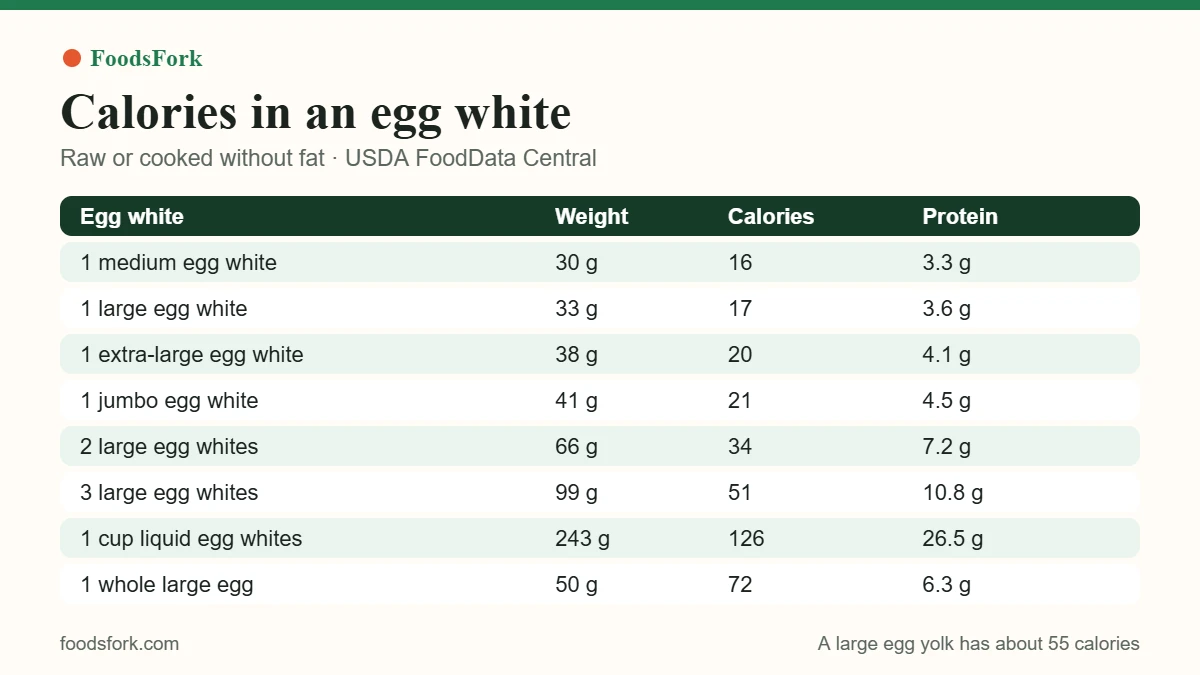
A large egg white has about 17 calories and 3.6 g of protein. Use the calculator to count calories and protein for any number of egg whites, by egg size, or for liquid egg whites by the tablespoon or cup.
USDA values for egg white: 52 calories and 10.9 g of protein per 100 g. Cooking without fat does not change the calories.
| Compare | Calories | Protein |
|---|
Source: USDA FoodData Central · whole large egg about 72 calories · oil 40 and butter 34 calories per teaspoon
Quick answer
There are about 17 calories in an egg white from a large egg. That 33 g white has 3.6 g of protein, 0.2 g of carbohydrate and almost no fat, according to USDA FoodData Central. A medium egg white has about 16 calories and a jumbo one about 21. The yolk of a large egg has about 55 calories, so a whole large egg has about 72.
Key facts
- 1 large egg white: about 17 calories and 3.6 g of protein.
- Egg white: about 52 calories per 100 g.
- 1 cup of liquid egg whites: about 126 calories and 26.5 g of protein.
- About 90% of egg white calories come from protein.
- Cooking without fat does not change the calories.
How to use the egg white calorie calculator
How many calories in an egg white by egg size?
Egg whites get bigger as eggs get bigger, so the calories change a little with size. The weights below are typical averages for U.S. egg sizes.
| Egg size | Egg white weight | Calories | Protein |
|---|---|---|---|
| Medium | 30 g | 16 | 3.3 g |
| Large | 33 g | 17 | 3.6 g |
| Extra-large | 38 g | 20 | 4.1 g |
| Jumbo | 41 g | 21 | 4.5 g |
U.S. egg sizes are set by the minimum weight of a dozen eggs, not by each egg, so eggs in the same carton can vary a little. For most people, 17 calories per egg white is close enough.
Brown, white, organic and pasture-raised eggs
Shell color comes from the breed of hen and has no effect on calories. A brown egg white and a white egg white of the same size both have about 17 calories.
Organic, free-range and pasture-raised eggs also have almost the same calories and protein in the white; any differences in feed show up mostly in the yolk, such as omega-3 fats or vitamin D in specially fed hens.
Freshness does not change the calories either. As eggs age, the white gets thinner and runnier because it loses a little water and carbon dioxide through the shell, but the protein and calories stay about the same. For recipes that need firm, tall whites, such as poached eggs, the freshest eggs work best.
Egg white vs egg yolk vs whole egg
The white and the yolk are very different. The white is mostly water and protein. The yolk holds nearly all of the egg’s fat, cholesterol and fat-soluble vitamins.
| Large egg | Calories | Protein | Fat | Cholesterol |
|---|---|---|---|---|
| Egg white (33 g) | 17 | 3.6 g | 0.1 g | 0 mg |
| Egg yolk (17 g) | 55 | 2.7 g | 4.5 g | about 184 mg |
| Whole egg (50 g) | 72 | 6.3 g | 4.8 g | about 186 mg |
The white provides a little more than half of the egg’s protein but less than a quarter of its calories. That is why egg whites are popular for high-protein, lower-calorie meals. The yolk is not “bad”, though: it provides vitamin A, vitamin D, vitamin B12 and choline that the white does not.
Calories in 2, 3, 4 or more egg whites
| Large egg whites | Weight | Calories | Protein |
|---|---|---|---|
| 1 | 33 g | 17 | 3.6 g |
| 2 | 66 g | 34 | 7.2 g |
| 3 | 99 g | 51 | 10.8 g |
| 4 | 132 g | 69 | 14.4 g |
| 5 | 165 g | 86 | 18.0 g |
| 6 | 198 g | 103 | 21.6 g |
| 8 | 264 g | 137 | 28.8 g |
| 10 | 330 g | 172 | 36.0 g |
A 3-egg-white omelet has about 51 calories before you add oil, cheese or fillings. A 6-egg-white scramble has about 103 calories and 21.6 g of protein.
Calories in liquid egg whites
Cartons of liquid egg whites are pasteurized egg whites, ready to pour. USDA lists 1 cup (243 g) of egg white at about 126 calories.
| Liquid egg whites | Weight | Calories | Protein |
|---|---|---|---|
| 1 tablespoon | 15 g | 8 | 1.7 g |
| 2 tablespoons (about 1 white) | 30 g | 16 | 3.3 g |
| 3 tablespoons (about 1 whole egg) | 46 g | 24 | 5.0 g |
| ¼ cup | 61 g | 32 | 6.6 g |
| ½ cup | 122 g | 63 | 13.2 g |
| 1 cup | 243 g | 126 | 26.5 g |
Carton labels usually list about 25 calories and 5 g of protein for a 3-tablespoon serving (46 g), very close to these USDA values. Need to convert spoons and cups? See our tablespoons to cups converter or the cups to ml converter.
Calories in cooked egg whites
Cooking does not add or remove calories. A hard-boiled, poached or microwaved egg white has the same 17 calories as a raw one. What changes the total is what you cook it with.
| Cooked dish | Calories (about) | What adds calories |
|---|---|---|
| 1 hard-boiled egg white | 17 | Nothing |
| 3 scrambled egg whites, nonstick pan | 51 | Nothing |
| 3 egg whites scrambled with 1 tsp oil | 91 | Oil adds 40 |
| 3 egg whites scrambled with 1 tsp butter | 85 | Butter adds 34 |
| 3-egg-white omelet with 1 oz cheddar | 166 | Cheese adds about 115 |
| Egg white and veggie omelet, 1 tsp oil | about 110 | Oil and vegetables |
Cooking spray or a good nonstick pan keeps egg whites close to their base calories.
How much protein is in an egg white?
A large egg white has about 3.6 g of protein, mostly a protein called ovalbumin. Egg white protein is considered high quality because it contains all the essential amino acids.
About 90% of the calories in egg white come from protein, so it is one of the leanest protein foods. Each 100 calories of egg white gives about 21 g of protein. You can check the math with the 4-4-9 rule: 3.6 g protein × 4 = 14.4 calories, plus a little from carbohydrate, gives about 15 to 17 calories.
To plan how much protein you need, start with your daily calories from our calories burned per day calculator, then use the 4-4-9 macro calculator to set a protein target.
Other nutrients in egg white
- Sodium: about 55 mg per large white.
- Potassium: about 54 mg per large white.
- Riboflavin (vitamin B2): a useful amount, about a tenth of the daily value per white.
- Selenium: a small amount, about a tenth of the daily value per white.
- Fat and cholesterol: almost none.
Most of the egg’s vitamins A, D, E and B12, its iron and its choline are in the yolk.
Calories in egg white recipes
Egg whites are the base of meringues, macarons and angel food cake. The whites add very few calories; the sugar adds most of them.
- Basic meringue: 4 large egg whites (69 calories) plus 1 cup of sugar (774 calories) is about 840 calories for the batch.
- Angel food cake: about 12 egg whites (206 calories), but most of the cake’s calories come from sugar and flour. See our guides to the calories in sugar and the calories in flour.
- Egg white substitute: to replace 1 whole large egg with whites, use 2 large egg whites (34 calories) or about 3 tablespoons of liquid egg white.
Dried egg white powder
Dried egg white powder is egg white with the water removed. USDA lists it at about 382 calories and 81 g of protein per 100 g. About 2 teaspoons of powder mixed with 2 tablespoons of water replaces one egg white, with the same calories as a fresh white.
Egg whites vs other protein foods
Egg whites are one of the lowest-calorie ways to get protein. Here is how a serving compares with other common high-protein foods (approximate USDA values).
| Food | Serving | Calories | Protein |
|---|---|---|---|
| Egg whites | 3 large (99 g) | 51 | 10.8 g |
| Liquid egg whites | ½ cup (122 g) | 63 | 13.2 g |
| Whole eggs | 2 large (100 g) | 144 | 12.6 g |
| Chicken breast, cooked | 3 oz (85 g) | 140 | 26 g |
| Plain nonfat Greek yogurt | 6 oz (170 g) | 100 | 17 g |
| Tuna, canned in water | 3 oz (85 g) | 73 | 16.5 g |
Per calorie, egg whites match or beat most other lean proteins. They are also quick to cook and easy to add to oatmeal, omelets or baking.
How to separate and store egg whites
- Separate cold eggs. Yolks hold together better when the eggs come straight from the fridge.
- Use three bowls. Crack each egg over a small bowl, move the yolk to a second bowl, then pour the clean white into the main bowl. One broken yolk will not ruin the whole batch.
- Refrigerate raw whites in a covered container and use them within 2 to 4 days.
- Freeze extra whites for up to 12 months. Freeze them in an ice cube tray, one white per cube, then thaw in the fridge.
Thawed egg whites whip just as well as fresh ones, so they are perfect for meringues later.
Is it safe to eat raw egg whites?
Raw and undercooked eggs can carry Salmonella bacteria. Food safety agencies advise cooking eggs until the white and yolk are firm, and cooking egg dishes to 160 °F (71 °C). For recipes that use raw whites, such as some cocktails, mousses or royal icing, use pasteurized eggs or pasteurized liquid egg whites.
Raw egg white also contains avidin, a protein that binds the vitamin biotin. Cooking breaks down avidin. This is only a concern if someone eats large amounts of raw egg white every day for a long time.
Frequently asked questions
How many calories in an egg white?
One large egg white (33 g) has about 17 calories and 3.6 g of protein, according to USDA FoodData Central. It has almost no fat or carbohydrate.
How many calories in 2 egg whites?
About 34 calories and 7.2 g of protein for two large egg whites.
How many calories in 3 egg whites?
About 51 calories and 10.8 g of protein for three large egg whites, before any oil or butter.
How many calories in a cup of egg whites?
About 126 calories and 26.5 g of protein in 1 cup (243 g) of liquid egg whites, or the whites of about 7 to 8 large eggs.
How many calories in an egg white vs a whole egg?
A large egg white has about 17 calories, the yolk about 55 and the whole egg about 72. The white has a little more than half of the egg's protein but almost none of its fat.
Do cooked egg whites have the same calories as raw?
Yes. Boiling, poaching or cooking egg whites in a nonstick pan does not change their calories. Oil, butter or cheese added during cooking does.
How much protein is in an egg white?
About 3.6 g in a large egg white, 3.3 g in a medium one and 4.5 g in a jumbo one. Egg white is about 11% protein by weight.
Is it safe to eat raw egg whites?
Raw eggs can carry Salmonella. If a recipe uses raw or lightly cooked whites, such as a mousse or a drink, use pasteurized eggs or pasteurized liquid egg whites.
How many tablespoons is one egg white?
About 2 tablespoons of liquid egg white equals 1 large egg white. About 3 tablespoons equals 1 whole large egg.
Are egg whites good for weight loss?
Egg whites are low in calories and high in protein, which can help meals feel more filling for fewer calories. Whole eggs also fit a balanced diet, and the yolk provides vitamins A, D and B12 and choline.
Related tools and guides
How we checked this page: calories and nutrients for egg white, yolk and whole egg are from USDA FoodData Central. Egg white weights by size are typical averages based on America’s Test Kitchen measurements and USDA size classes. Egg safety advice follows FoodSafety.gov. Checked November 2026.