
Kg to Pounds Converter: Kilograms to Pounds (lb)
Convert kg to pounds, or pounds to kg, instantly. Get pounds with decimals, pounds and ounces, grams and stones, plus a kg to pound chart for food, body weight and luggage.
1 kilogram = 2.20462 pounds. 1 pound = 0.45359237 kg exactly.
1 lb = 0.45359237 kg exactly (international pound, 1959) · 1 lb = 16 oz · 1 stone = 14 lb
Common kg to pound conversions
Quick answer
1 kg = 2.20462 pounds. To convert kg to pounds, multiply the kilograms by 2.20462, or by 2.2 for a quick answer. So 5 kg = 11.02 lb, 10 kg = 22.05 lb and 50 kg = 110.23 lb. Going the other way, 1 lb = 0.4536 kg (454 g).
Key facts
- 1 kilogram = 2.20462 lb = 35.27 oz.
- 1 pound = 0.45359237 kg exactly = 453.6 g = 16 oz.
- Quick estimate: double the kg and add 10%.
- 1 stone = 14 lb = 6.35 kg.
- A 1 kg bag of flour or sugar weighs about 2 lb 3 oz.
How to use the kg to pounds converter
This converter is for weight (mass). If you need to turn a volume, such as cups, into a weight, use our cups to pounds converter or the cups to grams converter, which use the weight of each ingredient.
The kg to pounds formula
The exact relationship is fixed by definition: 1 pound is exactly 0.45359237 kilograms. Dividing 1 by that number gives 2.20462262 pounds per kilogram. For cooking and shopping, 2.2 is accurate enough; for medicine, shipping or science, use more decimals.
Worked example
A recipe from Europe asks for a 2.4 kg leg of lamb. Multiply 2.4 × 2.20462 = 5.29 lb. The decimal 0.29 × 16 = 4.6 oz, so look for a joint of about 5 lb 5 oz.
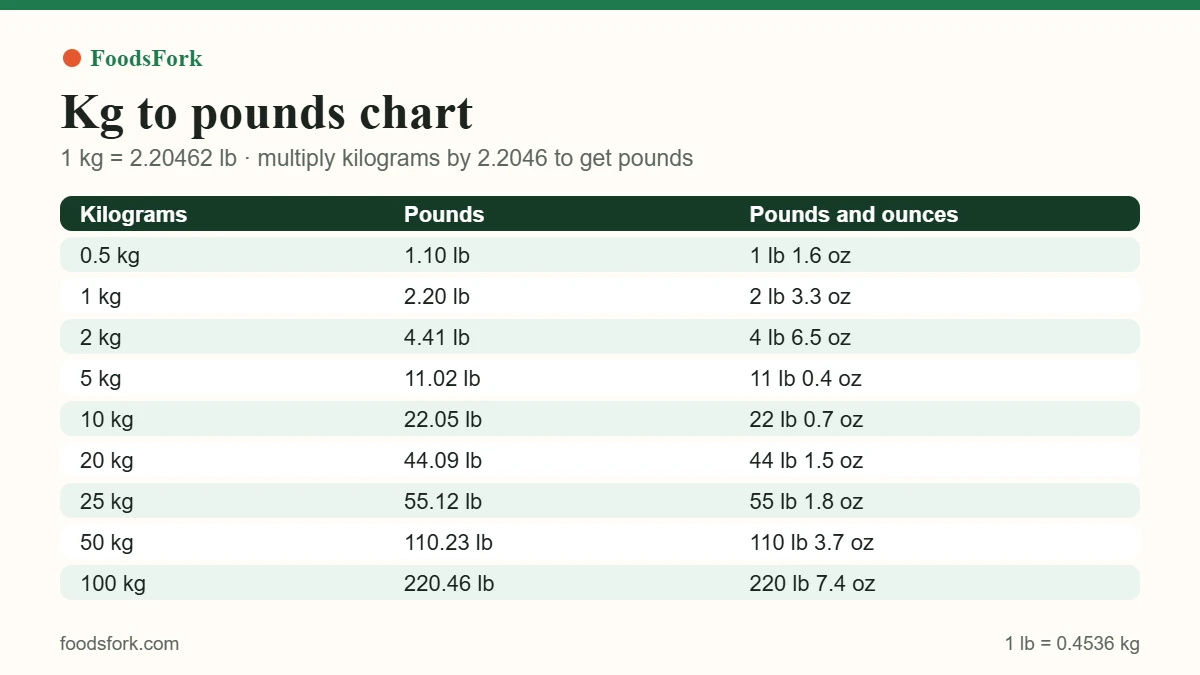
Kg to pounds conversion chart
| Kilograms | Pounds | Pounds and ounces |
|---|---|---|
| 0.1 kg | 0.22 lb | 0 lb 3.5 oz |
| 0.25 kg | 0.55 lb | 0 lb 8.8 oz |
| 0.5 kg | 1.10 lb | 1 lb 1.6 oz |
| 1 kg | 2.20 lb | 2 lb 3.3 oz |
| 1.5 kg | 3.31 lb | 3 lb 4.9 oz |
| 2 kg | 4.41 lb | 4 lb 6.5 oz |
| 2.5 kg | 5.51 lb | 5 lb 8.2 oz |
| 3 kg | 6.61 lb | 6 lb 9.8 oz |
| 4 kg | 8.82 lb | 8 lb 13.1 oz |
| 5 kg | 11.02 lb | 11 lb 0.4 oz |
| 6 kg | 13.23 lb | 13 lb 3.6 oz |
| 7 kg | 15.43 lb | 15 lb 6.9 oz |
| 8 kg | 17.64 lb | 17 lb 10.2 oz |
| 9 kg | 19.84 lb | 19 lb 13.5 oz |
| 10 kg | 22.05 lb | 22 lb 0.7 oz |
| 12 kg | 26.46 lb | 26 lb 7.3 oz |
| 15 kg | 33.07 lb | 33 lb 1.1 oz |
| 20 kg | 44.09 lb | 44 lb 1.5 oz |
| 25 kg | 55.12 lb | 55 lb 1.8 oz |
| 30 kg | 66.14 lb | 66 lb 2.2 oz |
| 40 kg | 88.18 lb | 88 lb 3 oz |
| 50 kg | 110.23 lb | 110 lb 3.7 oz |
| 60 kg | 132.28 lb | 132 lb 4.4 oz |
| 70 kg | 154.32 lb | 154 lb 5.2 oz |
| 75 kg | 165.35 lb | 165 lb 5.5 oz |
| 80 kg | 176.37 lb | 176 lb 5.9 oz |
| 90 kg | 198.42 lb | 198 lb 6.7 oz |
| 100 kg | 220.46 lb | 220 lb 7.4 oz |
Pounds to kg conversion chart
Use this when a US recipe or package lists pounds and you think in kilograms.
| Pounds | Kilograms | Grams |
|---|---|---|
| 1 lb | 0.454 kg | 454 g |
| 2 lb | 0.907 kg | 907 g |
| 3 lb | 1.361 kg | 1,361 g |
| 4 lb | 1.814 kg | 1,814 g |
| 5 lb | 2.268 kg | 2,268 g |
| 8 lb | 3.629 kg | 3,629 g |
| 10 lb | 4.536 kg | 4,536 g |
| 12 lb | 5.443 kg | 5,443 g |
| 15 lb | 6.804 kg | 6,804 g |
| 16 lb | 7.257 kg | 7,257 g |
| 20 lb | 9.072 kg | 9,072 g |
| 25 lb | 11.340 kg | 11,340 g |
| 50 lb | 22.680 kg | 22,680 g |
| 100 lb | 45.359 kg | 45,359 g |
| 150 lb | 68.039 kg | 68,039 g |
| 200 lb | 90.718 kg | 90,718 g |
How to convert kg to pounds and ounces
American recipes and grocery labels often write weights as pounds and ounces, like 3 lb 8 oz, not 3.5 lb. Here is how to get there.
- Convert to pounds. Multiply the kilograms by 2.20462. Example: 1.8 kg × 2.20462 = 3.968 lb.
- Keep the whole pounds. That is 3 lb.
- Turn the rest into ounces. Multiply the decimal by 16: 0.968 × 16 = 15.5 oz.
- Combine. 1.8 kg = 3 lb 15.5 oz, almost exactly 4 lb.
For small amounts, ounces alone are easier: multiply kilograms by 35.274. Our grams to ounces converter is handy for anything under 1 kg.
Mental math shortcuts
Kg to pounds: double it, then add 10%
Double the kilograms, then add a tenth of that number. For 30 kg: 30 × 2 = 60, plus 6 = 66 lb. The exact answer is 66.14 lb, so the shortcut is within 0.2%.
Pounds to kg: halve it, then take away 10%
Halve the pounds, then subtract a tenth of the result. For 150 lb: 150 ÷ 2 = 75, minus 7.5 = 67.5 kg. The exact answer is 68.04 kg, close enough for most uses.
Why the shortcut works
The real factor is 2.2046, which is 2 plus a little over a tenth of 2. Doubling covers the 2, and adding 10% of the doubled number covers the 0.2. The tiny leftover, 0.0046 per kilogram, is less than a quarter of a percent, so it only matters for very large or very precise weights.
Easy anchors to remember
- ½ kg ≈ 1.1 lb
- 1 kg ≈ 2.2 lb
- 5 kg ≈ 11 lb
- 10 kg ≈ 22 lb
- 45 kg ≈ 100 lb
Kg to pounds in the kitchen
Cooks switch between kilograms and pounds all the time: European packages, British recipes, roasting charts and turkey sizes. Here are typical food weights.
| Food | Typical weight | In pounds |
|---|---|---|
| Bag of flour (Europe, UK) | 1 kg | 2.20 lb (2 lb 3.3 oz) |
| Bag of flour (UK, large) | 1.5 kg | 3.31 lb (3 lb 4.9 oz) |
| Pack of butter (Europe) | 250 g | 0.55 lb (0 lb 8.8 oz) |
| Bag of sugar | 1 kg | 2.20 lb (2 lb 3.3 oz) |
| Bag of rice | 2 kg | 4.41 lb (4 lb 6.5 oz) |
| Bag of pasta | 500 g | 1.10 lb (1 lb 1.6 oz) |
| Whole chicken | 1.5 kg | 3.31 lb (3 lb 4.9 oz) |
| Small turkey | 5 kg | 11.02 lb (11 lb 0.4 oz) |
| Large turkey | 8 kg | 17.64 lb (17 lb 10.2 oz) |
| Christmas ham, half | 3 kg | 6.61 lb (6 lb 9.8 oz) |
| Prime rib roast, 3 bones | 3.5 kg | 7.72 lb (7 lb 11.5 oz) |
| Watermelon | 5 kg | 11.02 lb (11 lb 0.4 oz) |
Roasting times need pounds
Most American roasting charts give minutes per pound. If your turkey or roast is labeled in kilograms, convert first. A 6 kg turkey is 13.2 lb, so look up the 12 to 14 lb row in our turkey cooking time calculator. Planning portions? The turkey per person and ham per person calculators work in pounds.
Baking from a metric recipe
Baking recipes from Europe, the UK and Australia usually list ingredients in grams. You do not need to convert them to pounds at all; a kitchen scale set to grams is the most accurate way to follow them. If you only have cups, use our grams to cups converter.
Kg to pounds for body weight and luggage
The same conversion works for anything you weigh. Two common uses:
| Weight | Kilograms | Pounds |
|---|---|---|
| Checked bag limit (many airlines) | 23 kg | 50.7 lb |
| Heavy bag limit | 32 kg | 70.5 lb |
| Carry-on limit (some airlines) | 7 kg | 15.4 lb |
| Carry-on limit (other airlines) | 10 kg | 22 lb |
| Body weight example | 60 kg | 132.3 lb |
| Body weight example | 75 kg | 165.3 lb |
| Body weight example | 90 kg | 198.4 lb |
Airline limits vary, so always check your ticket. Bathroom scales sold in the US usually show pounds; most others show kilograms, and many can switch between the two.
Kilograms and pounds on food labels
US food packages must show the net weight in both systems. That is why a bag of sugar reads “Net Wt 4 lb (1.81 kg)” and a box of pasta reads “Net Wt 16 oz (1 lb) 454 g.” In most other countries, packages show only grams and kilograms.
The two systems lead to different standard pack sizes. A US bag of flour is 5 lb (2.27 kg), while a European bag is usually 1 kg (2.2 lb). A US stick of butter is 4 oz (113 g), while a European block is 250 g (8.8 oz). When a recipe from another country asks for “a bag” or “a pack,” convert the actual weight instead of assuming the packages match.
| US package | Weight | Common metric package | Weight |
|---|---|---|---|
| Bag of flour | 5 lb (2.27 kg) | Bag of flour | 1 kg (2.2 lb) |
| Bag of sugar | 4 lb (1.81 kg) | Bag of sugar | 1 kg (2.2 lb) |
| Box of butter (4 sticks) | 1 lb (454 g) | Block of butter | 250 g (8.8 oz) |
| Box of pasta | 1 lb (454 g) | Bag of pasta | 500 g (1.1 lb) |
| Bag of rice | 2 lb (907 g) | Bag of rice | 1 kg (2.2 lb) |
How precise do you need to be?
How many decimals you need depends on what you are weighing.
- Cooking and shopping: round to the nearest 0.1 lb or the nearest ounce. A roast that is 2 ounces heavier only changes the cooking time by a minute or two, and you will check it with a thermometer anyway.
- Baking: weigh in grams if you can. If a recipe is in pounds, convert to grams with 1 lb = 453.6 g and weigh each ingredient. Grams avoid the rounding that pounds and ounces need.
- Body weight: one decimal place in pounds or kilograms is plenty. Daily weight changes by a pound or two anyway.
- Shipping and luggage: round up, never down. A bag at 23.1 kg is over a 23 kg limit, even though it is “about 23.”
- Medicine: doses that depend on body weight must use exact values. Ask a doctor or pharmacist, and never estimate.
The converter shows two decimals for pounds and three for kilograms, which covers every everyday use.
Who uses kilograms and who uses pounds?
Almost every country uses kilograms for official weights, trade and food labels. The United States is the main country that still uses pounds in everyday life, and Liberia and Myanmar also use non-metric units in some settings.
The United Kingdom is a mix. Food is sold in grams and kilograms, but many people give their body weight in stones and pounds, and older recipes use pounds and ounces. Canada also mixes them: products are labeled in metric, but people often talk about body weight and some foods, like meat at the deli counter, in pounds.
Science, medicine and international sport use kilograms everywhere, including the United States. A US hospital records a patient’s weight in kilograms, even if the patient thinks of it in pounds.
Stones, pounds and kilograms
In the UK and Ireland, people often give body weight in stones and pounds. One stone is 14 pounds, or 6.35 kg.
| Kilograms | Pounds | Stones and pounds |
|---|---|---|
| 50 kg | 110.2 lb | 7 st 12.2 lb |
| 60 kg | 132.3 lb | 9 st 6.3 lb |
| 70 kg | 154.3 lb | 11 st 0.3 lb |
| 80 kg | 176.4 lb | 12 st 8.4 lb |
| 90 kg | 198.4 lb | 14 st 2.4 lb |
| 100 kg | 220.5 lb | 15 st 10.5 lb |
The converter shows stones and pounds for every result.
Why is a kilogram 2.20462 pounds?
For a long time, the pound was defined slightly differently in different countries. In 1959 the United States, the United Kingdom and other Commonwealth countries agreed on one international pound of exactly 0.45359237 kg. That fixed the conversion: 1 kg = 1 ÷ 0.45359237 = 2.20462262 lb.
The kilogram itself was redefined in 2019 using a constant of nature, the Planck constant, instead of a metal cylinder kept near Paris. Everyday weights did not change. Because the pound is defined from the kilogram, the conversion factor stayed exactly the same.
Pounds vs ounces vs fluid ounces
A pound has 16 ounces of weight. A fluid ounce is a volume, used for liquids, and is not the same thing. Only for water do they line up closely. If a US recipe lists “8 oz” of a liquid, it usually means fluid ounces, which is 1 cup; see our cups to ml converter for volumes.
Common kg to pound mistakes
| Mistake | What happens | Fix |
|---|---|---|
| Multiplying by 2 instead of 2.2 | 10% too low | Use 2.2 or the converter |
| Writing 3.5 lb as 3 lb 5 oz | Wrong: 0.5 lb is 8 oz | Multiply the decimal by 16 |
| Mixing ounces and fluid ounces | Wrong amount for liquids | Fluid ounces measure volume |
| Dividing instead of multiplying | Answer far too small | Kg × 2.2 = lb; lb ÷ 2.2 = kg |
| Rounding medicine doses loosely | Unsafe dose | Use exact values and ask a pharmacist |
Frequently asked questions
How many pounds are in a kilogram?
One kilogram equals 2.20462 pounds. For everyday use, round it to 2.2 pounds.
How do I convert kg to pounds?
Multiply the kilograms by 2.20462. For example, 5 kg × 2.20462 = 11.02 lb. For a quick estimate, double the kilograms and add 10%.
Is 1 kg the same as 2 pounds?
No. One kilogram is about 2.2 pounds, so it is 10% more than 2 pounds. Over larger amounts the gap adds up: 50 kg is 110 lb, not 100 lb.
How many pounds is 5 kg?
5 kg is 11.02 pounds, or 11 lb 0.4 oz.
How many pounds is 10 kg?
10 kg is 22.05 pounds, or 22 lb 0.7 oz.
How many pounds is 50 kg?
50 kg is 110.23 pounds.
How many pounds is 70 kg?
70 kg is 154.32 pounds, or 11 stone 0.3 lb.
How many pounds is 100 kg?
100 kg is 220.46 pounds.
How many kg is 1 pound?
One pound is exactly 0.45359237 kg, about 454 grams.
How do I convert kg to pounds and ounces?
Multiply the kilograms by 2.20462 to get pounds. Keep the whole number as pounds, then multiply the decimal part by 16 to get ounces. For example, 2.5 kg = 5.51 lb = 5 lb 8.2 oz.
Why does the US use pounds instead of kilograms?
The US kept its customary system of units for everyday life, while most countries adopted the metric system. Officially, the US pound is defined in kilograms: since 1959, 1 lb has been exactly 0.45359237 kg.
Related tools and guides
How we checked this page: the international pound is defined as exactly 0.45359237 kg (international yard and pound agreement, 1959; NIST). 1 lb = 16 oz and 1 stone = 14 lb. The kilogram has been defined from the Planck constant since 2019 (BIPM). All tables are calculated from these definitions. Checked November 2026.