
How Many Calories Does a 200, 230 or 250 lb Man Burn a Day?
Use this calories burned per day calculator to estimate your resting burn and your total daily burn from your weight, height, age and activity. Charts for 200, 230 and 250 lb men are below.
Uses the Mifflin-St Jeor equation, or Katch-McArdle if you enter body fat. Results are estimates for healthy adults.
| Activity level | Calories a day |
|---|
BMR (men) = 10 × kg + 6.25 × cm − 5 × age + 5 · women −161 · calories burned = BMR × activity factor
Quick answer
A man who is 35 years old and 5 ft 9 in burns about 2,199 to 2,840 calories a day at 200 lb, 2,362 to 3,051 at 230 lb and 2,471 to 3,192 at 250 lb, from a desk job up to moderate exercise 3–5 days a week. These calories burned per day figures come from the Mifflin-St Jeor equation. Use the calculator above for your own height, age and activity.
Key facts
- Calories burned per day = BMR × activity factor (1.2 to 1.9).
- BMR for men = 10 × kg + 6.25 × cm − 5 × age + 5.
- Each extra 10 lb adds about 45 calories a day at rest.
- About 500 calories a day below your burn loses roughly 1 lb a week at first.
- Equations are usually within about 10% of measured values.
How to use the calories burned per day calculator
How many calories does a 200 pound man burn a day?
A 200 lb man burns about 2,199 calories a day with a desk job and little exercise. With light exercise 1–3 days a week it is about 2,520, and with moderate exercise it is about 2,840. These figures are for a 35-year-old man who is 5 ft 9 in, close to the average height of an American man.
| Activity level | Calories burned a day |
|---|---|
| At rest (BMR) | 1,833 |
| Sedentary | 2,199 |
| Lightly active | 2,520 |
| Moderately active | 2,840 |
| Very active | 3,161 |
| Extra active | 3,482 |
The average American man weighs about 199 lb, according to CDC body measurements from 2021 to 2023. So these numbers fit a very typical adult man. A taller or younger man will burn a little more, and a shorter or older man a little less.
How many calories does a 230 pound man burn in a day?
A 230 lb man burns about 2,362 calories a day if he is sedentary, 2,707 if he is lightly active and 3,051 if he exercises 3–5 days a week. At complete rest his body uses about 1,969 calories just to breathe, pump blood and keep warm.
| Activity level | Calories burned a day |
|---|---|
| At rest (BMR) | 1,969 |
| Sedentary | 2,362 |
| Lightly active | 2,707 |
| Moderately active | 3,051 |
| Very active | 3,396 |
| Extra active | 3,740 |
That is about 160 calories a day more than a 200 lb man at the same activity level. The extra weight takes more energy to carry and maintain.
How many calories does a 250 lb man burn a day?
A 250 lb man burns about 2,471 calories a day when sedentary, 2,832 when lightly active and 3,192 when moderately active. A very active 250 lb man, such as someone who trains hard most days, can burn 3,552 calories or more.
| Activity level | Calories burned a day |
|---|---|
| At rest (BMR) | 2,059 |
| Sedentary | 2,471 |
| Lightly active | 2,832 |
| Moderately active | 3,192 |
| Very active | 3,552 |
| Extra active | 3,913 |
If you are 250 lb and want to lose weight, your higher daily burn is an advantage at the start. A sensible cut still leaves room for filling meals.
Calories burned per day by weight chart
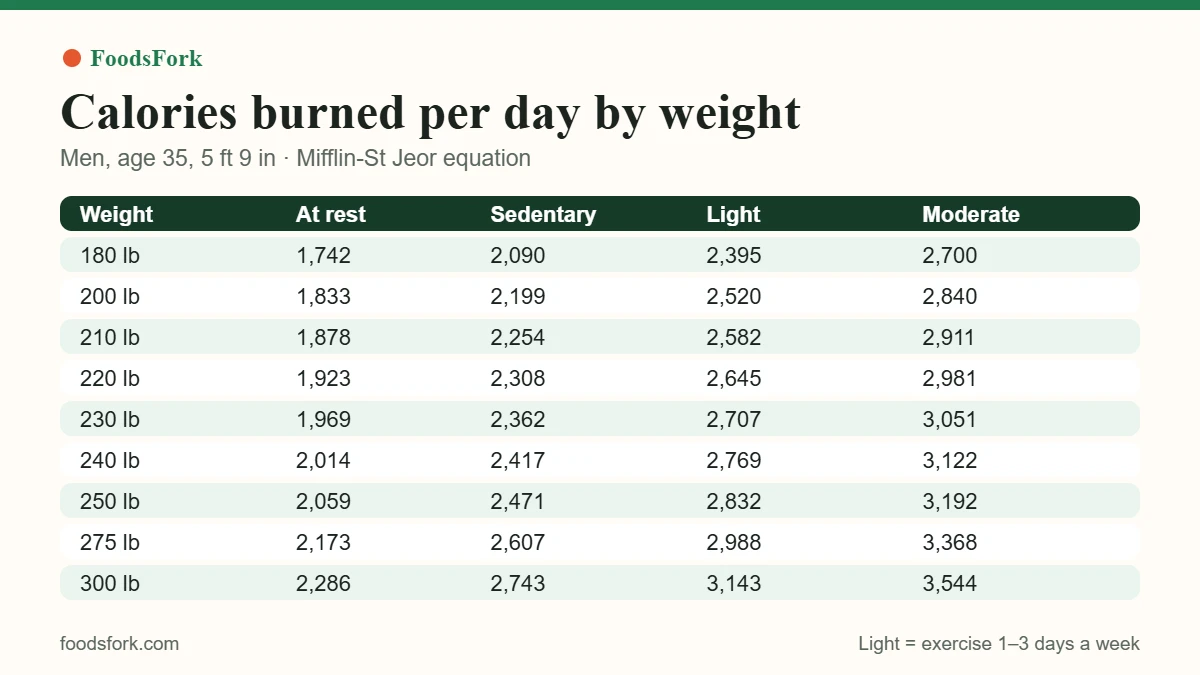
This chart shows daily calories for men from 180 to 300 lb. All rows assume age 35 and a height of 5 ft 9 in.
| Weight | At rest | Sedentary | Light | Moderate | Very active | Extra active |
|---|---|---|---|---|---|---|
| 180 lb | 1,742 | 2,090 | 2,395 | 2,700 | 3,005 | 3,309 |
| 200 lb | 1,833 | 2,199 | 2,520 | 2,840 | 3,161 | 3,482 |
| 210 lb | 1,878 | 2,254 | 2,582 | 2,911 | 3,239 | 3,568 |
| 220 lb | 1,923 | 2,308 | 2,645 | 2,981 | 3,318 | 3,654 |
| 230 lb | 1,969 | 2,362 | 2,707 | 3,051 | 3,396 | 3,740 |
| 240 lb | 2,014 | 2,417 | 2,769 | 3,122 | 3,474 | 3,827 |
| 250 lb | 2,059 | 2,471 | 2,832 | 3,192 | 3,552 | 3,913 |
| 275 lb | 2,173 | 2,607 | 2,988 | 3,368 | 3,748 | 4,128 |
| 300 lb | 2,286 | 2,743 | 3,143 | 3,544 | 3,944 | 4,344 |
How calories burned per day are calculated
The calculator works in two steps. First it estimates your basal metabolic rate (BMR), the calories your body uses at rest. Then it multiplies BMR by an activity factor to get your total daily energy expenditure, or TDEE.
Worked example: 230 lb man
Convert first: 230 lb × 0.4536 = 104.3 kg, and 5 ft 9 in = 69 in × 2.54 = 175.3 cm. BMR = (10 × 104.3) + (6.25 × 175.3) − (5 × 35) + 5 = 1,969 calories. With light activity: 1,969 × 1.375 = 2,707 calories a day.
The Mifflin-St Jeor equation was published in 1990. Studies comparing it with measured metabolism found it among the most accurate of the common equations for adults, including people who are overweight.
Activity levels explained
| Activity level | Factor | What it looks like |
|---|---|---|
| Sedentary | 1.2 | Desk job, little or no exercise |
| Lightly active | 1.375 | Exercise 1–3 days a week |
| Moderately active | 1.55 | Exercise 3–5 days a week |
| Very active | 1.725 | Hard exercise 6–7 days a week |
| Extra active | 1.9 | Physical job plus training |
Picking the right level matters more than any other input. Most people overestimate their activity. If you sit most of the day and go to the gym three times a week, start with “Lightly active”. Then watch your weight for a few weeks and adjust.
Step count as a guide
- Under 5,000 steps a day: sedentary.
- 5,000–7,500 steps: lightly active.
- 7,500–10,000 steps plus workouts: moderately active.
- Over 10,000 steps plus hard training: very active.
How age and height change your burn
Weight is not the only thing that counts. Taller people have more body to fuel, and resting burn drops slowly with age.
| 230 lb man, age | At rest | Sedentary | Light | Moderate |
|---|---|---|---|---|
| 25 | 2,019 | 2,422 | 2,776 | 3,129 |
| 35 | 1,969 | 2,362 | 2,707 | 3,051 |
| 45 | 1,919 | 2,302 | 2,638 | 2,974 |
| 55 | 1,869 | 2,242 | 2,569 | 2,896 |
| 65 | 1,819 | 2,182 | 2,501 | 2,819 |
| 230 lb man, height | At rest | Sedentary | Moderate |
|---|---|---|---|
| 5 ft 6 in | 1,921 | 2,305 | 2,978 |
| 5 ft 9 in | 1,969 | 2,362 | 3,051 |
| 6 ft 0 in | 2,016 | 2,420 | 3,125 |
| 6 ft 3 in | 2,064 | 2,477 | 3,199 |
Each extra inch of height adds about 16 calories a day at rest. Each extra decade of age takes away about 50.
Where your daily calories go
Your total daily burn has four parts:
- Resting metabolism (BMR): about 60–70% of the total. It keeps your heart, brain, lungs and organs running.
- Digesting food: about 10%. Protein takes the most energy to digest.
- Everyday movement: walking, standing, chores and fidgeting. This varies the most from person to person.
- Exercise: planned workouts. For most people this is a smaller share than they expect.
Because everyday movement can change your burn by several hundred calories, adding a daily walk is often as useful as an extra gym session.
Calories burned by exercise for 200, 230 and 250 lb men
Heavier bodies burn more calories doing the same activity. These are estimates for 30 minutes, using MET values from the Compendium of Physical Activities. The formula is calories per minute = MET × 3.5 × kg ÷ 200.
| Activity (30 minutes) | 200 lb | 230 lb | 250 lb |
|---|---|---|---|
| Brisk walking, 3.5 mph | 205 | 236 | 256 |
| Cycling, 12–14 mph | 381 | 438 | 476 |
| Jogging, 5 mph | 395 | 455 | 494 |
| Swimming laps, moderate | 276 | 318 | 345 |
| Weight training, moderate | 167 | 192 | 208 |
The activity level in the calculator already counts your usual exercise. Do not add workout calories on top, or you will count them twice.
Using your number to lose weight
Your daily burn is your maintenance number. Eat about that much and your weight should stay steady. To lose weight, eat a little less:
- 250 calories below maintenance: slow and easy, about ½ lb a week at first.
- 500 calories below maintenance: about 1 lb a week at first.
- More than 750 below: faster, but harder to keep up and more likely to cost muscle.
The old rule says 3,500 calories equals 1 lb of fat. It is a useful starting point, but real weight loss slows over time because your body burns less as you get lighter. The NIH Body Weight Planner models this change if you want a longer-term plan.
Most health guidance advises men not to eat fewer than about 1,500 calories a day, and women not fewer than about 1,200, unless a doctor is supervising. The calculator will not suggest a target below those floors.
Planning meals around your number? Our 4-4-9 rule guide and macro calculator turns calories into grams of protein, carbs and fat. You can weigh food portions with the grams to ounces converter or the cups to grams converter.
Why your real number may be different
- Muscle: a muscular 230 lb man burns more than a less muscular man of the same weight. Enter body fat to account for this.
- Daily movement: two people with the same job can differ by 300 calories or more.
- Genetics and hormones: thyroid levels and some medications change metabolism.
- Recent dieting: after a long diet, the body often burns a bit less than equations predict.
The best test is your own scale. Eat close to your estimated maintenance for 2 to 3 weeks and weigh yourself at the same time each morning. If your average weight stays flat, your number is right. If it climbs or falls, adjust by 100 to 200 calories. A kg to pounds converter helps if your scale reads in kilograms.
Frequently asked questions
How many calories does a 200 pound man burn a day?
A 200 lb man who is 35 and 5 ft 9 in burns about 1,833 calories a day at rest, 2,199 if sedentary, 2,520 with light exercise and 2,840 with moderate exercise, based on the Mifflin-St Jeor equation.
How many calories does a 230 pound man burn in a day?
A 35-year-old, 5 ft 9 in man weighing 230 lb burns about 2,362 calories a day with a desk job and little exercise, 2,707 with light exercise and 3,051 with moderate exercise. His resting burn is about 1,969 calories.
How many calories does a 250 lb man burn a day?
A 250 lb man (35 years old, 5 ft 9 in) burns about 2,471 calories a day if sedentary, 2,832 if lightly active and 3,192 if moderately active. Very active men can burn 3,552 or more.
How many calories should a 230 lb man eat to lose weight?
Start about 500 calories below your daily burn. For a lightly active 230 lb man that is roughly 2,207 calories a day, which usually leads to a loss of around 1 lb a week at first. Most guidance advises men not to go below about 1,500 calories without medical supervision.
Does a heavier man burn more calories?
Yes. A larger body needs more energy to maintain and to move. With the Mifflin-St Jeor equation, every extra 10 lb adds about 45 calories a day at rest. That is one reason weight loss slows as you get lighter.
Is BMR the same as calories burned per day?
No. BMR (basal metabolic rate) is the energy your body uses at complete rest. Your total calories burned per day, often called TDEE, is BMR multiplied by an activity factor of about 1.2 to 1.9.
How accurate is a calories burned calculator?
Equations like Mifflin-St Jeor usually land within about 10% of measured resting burn for most adults. Muscle mass, genetics and daily movement can push real numbers higher or lower, so track your weight for 2 to 3 weeks and adjust.
How many calories does a 250 pound man burn walking?
Brisk walking at 3.5 mph burns about 256 calories in 30 minutes for a 250 lb man, using a MET value of 4.3. Walking uphill or carrying a load burns more.
How many calories do you burn sleeping?
Roughly your BMR divided by 24 for each hour, or a little less. A 230 lb man with a BMR near 1,969 burns about 623 calories over 8 hours of sleep.
Does age change how many calories I burn?
Yes, a little. The Mifflin-St Jeor equation subtracts 5 calories a day for each year of age. Losing muscle as you get older lowers your burn more than age alone, so strength training helps.
Related tools and guides
How we checked this page: resting burn uses the Mifflin-St Jeor equation (Am J Clin Nutr, 1990) and the Katch-McArdle formula. Average height and weight of U.S. men are from CDC body measurements. Exercise MET values are from the Compendium of Physical Activities. Weight-change guidance follows the NIH Body Weight Planner. Checked November 2026.