
What Does the 4/4/9 Rule for Calories Mean? (Macro Calculator)
The 4-4-9 rule says carbs and protein have 4 calories per gram and fat has 9. Use the calculator to turn grams into calories, or calories into daily grams of carbs, protein and fat.
The 4-4-9 rule: carbs 4, protein 4 and fat 9 calories per gram. Alcohol adds 7 calories per gram.
Calories = carbs × 4 + protein × 4 + fat × 9 (+ alcohol × 7) · grams = calories × % ÷ 100 ÷ 4 or 9
Quick answer
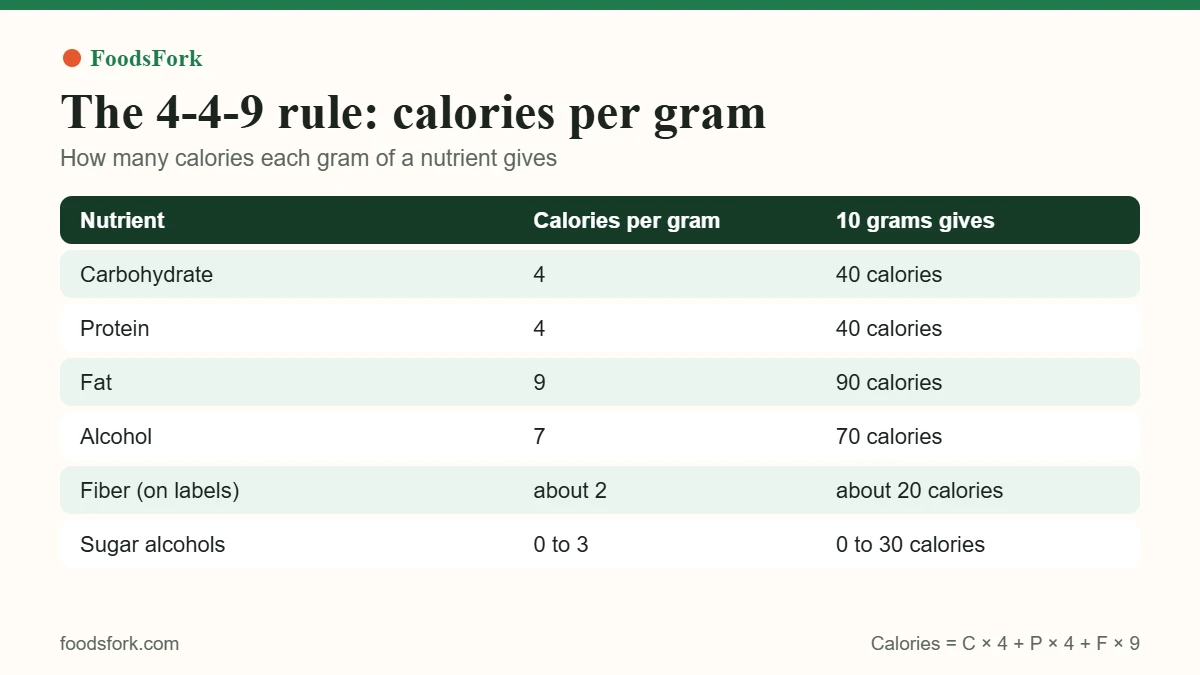
The 4-4-9 rule means 1 gram of carbohydrate = 4 calories, 1 gram of protein = 4 calories and 1 gram of fat = 9 calories. To estimate calories, multiply each by its number and add them up. A meal with 60 g carbs, 35 g protein and 20 g fat has (60 × 4) + (35 × 4) + (20 × 9) = 560 calories. Alcohol, which is not part of the rule, adds 7 calories per gram.
Key facts
- Carbs: 4 calories per gram.
- Protein: 4 calories per gram.
- Fat: 9 calories per gram.
- Alcohol: 7 calories per gram; fiber about 2.
- Grams of a macro = calories from it ÷ 4 (or ÷ 9 for fat).
How to use the 4-4-9 rule calculator
Not sure how many calories you need? Start with our calories burned per day calculator, then bring that number back here to split it into macros.
What does the 4/4/9 rule for calories mean?
The 4/4/9 rule is a quick way to work out calories from the three main nutrients in food, often called macronutrients or “macros”. Each gram of carbohydrate gives about 4 calories, each gram of protein about 4 calories and each gram of fat about 9 calories.
The rule is also called the 4-4-9 rule, the 4-9-4 rule or the Atwater general factors. All of these names mean the same thing. The numbers were worked out in the late 1800s by Wilbur O. Atwater, a chemist with the U.S. Department of Agriculture. He burned foods to measure their energy, then subtracted what the body does not absorb.
Today the 4-4-9 rule is used by nutrition apps, meal plans, dietitians and food makers. U.S. labeling rules list the general factors of 4, 4 and 9 as one of the approved ways to calculate the calories on a Nutrition Facts label.
Calories per gram table
| Nutrient | Calories per gram | Example |
|---|---|---|
| Carbohydrate | 4 | 30 g of carbs = 120 calories |
| Protein | 4 | 25 g of protein = 100 calories |
| Fat | 9 | 10 g of fat = 90 calories |
| Alcohol | 7 | 14 g of alcohol (one standard U.S. drink) = 98 calories |
| Dietary fiber | about 2 (often less) | 5 g of fiber = about 10 calories |
| Sugar alcohols | 0 to 3 | Erythritol is close to 0 |
Water, vitamins and minerals have no calories. That is why watery foods like cucumbers and lettuce are so low in calories.
How to calculate calories with the 4-4-9 rule
Example 1: a large egg
A large egg has about 6.3 g of protein, 4.8 g of fat and 0.4 g of carbs. Using the rule: (0.4 × 4) + (6.3 × 4) + (4.8 × 9) = 1.6 + 25.2 + 43.2 = 70 calories. That is very close to the 72 calories listed for a large egg in USDA data. Notice that fat gives more than half the calories, even though the egg has more protein by weight.
Example 2: peanut butter
Two tablespoons of peanut butter have about 6.9 g carbs, 7.7 g protein and 16.1 g fat. The rule gives 203 calories, while labels usually show about 190. The gap comes from fiber and from peanut fat and protein being absorbed a little less than average.
Example 3: a banana
A medium banana has about 27 g carbs, 1.3 g protein and 0.4 g fat. The plain rule gives 117 calories, but USDA lists about 105. About 3 g of the carbs are fiber, which gives far fewer than 4 calories per gram. Set fiber to 2 cal/g in the calculator and the estimate gets closer.
Why does fat have 9 calories per gram?
Fat molecules are packed with carbon-hydrogen bonds and hold very little oxygen or water. When your body breaks them down, it releases more energy per gram than it does from carbs or protein. That is also why the body stores spare energy as fat: it is the most compact fuel.
In everyday terms, a tablespoon of olive oil (about 14 g of fat) has around 120 calories, about the same as a large apple or two slices of thin bread. Fat is not bad, and you need it, but portions add up fast.
How to turn calories into grams of macros
The 4-4-9 rule also works backwards. If you know your daily calories and how you want to split them, you can work out the grams of each macro.
- Pick your calories, for example 2,000 a day.
- Choose a split, such as 50% carbs, 20% protein and 30% fat.
- Find calories per macro: 2,000 × 0.50 = 1,000 from carbs, 2,000 × 0.20 = 400 from protein, 2,000 × 0.30 = 600 from fat.
- Divide by 4, 4 and 9: 1,000 ÷ 4 = 250 g carbs, 400 ÷ 4 = 100 g protein, 600 ÷ 9 = 67 g fat.
Check your work by adding the calories back up: 250 × 4 + 100 × 4 + 67 × 9 = 2,003. The tiny difference is rounding.
Healthy macro ranges for adults
U.S. dietary guidance gives ranges for adults, called the Acceptable Macronutrient Distribution Ranges (AMDR):
| Macronutrient | Share of daily calories | At 2,000 calories |
|---|---|---|
| Carbohydrate | 45–65% | 225–325 g |
| Protein | 10–35% | 50–175 g |
| Fat | 20–35% | 44–78 g |
For protein, a common minimum is 0.8 g per kilogram of body weight a day. A 90 kg (about 200 lb) adult would need at least 72 g. Many active people aim higher, often 1.2 to 1.6 g per kg. Use our kg to pounds converter if you know your weight in pounds.
Popular macro splits in grams
Here is how common splits work out at 2,000 and 2,500 calories a day.
| Split (C / P / F) | 2,000 calories | 2,500 calories |
|---|---|---|
| Balanced (50 / 20 / 30) | 250 g C · 100 g P · 67 g F | 312 g C · 125 g P · 83 g F |
| Mid-range guideline (55 / 20 / 25) | 275 g C · 100 g P · 56 g F | 344 g C · 125 g P · 69 g F |
| Higher protein (40 / 30 / 30) | 200 g C · 150 g P · 67 g F | 250 g C · 188 g P · 83 g F |
| Lower carb (25 / 35 / 40) | 125 g C · 175 g P · 89 g F | 156 g C · 219 g P · 111 g F |
| Keto (5 / 25 / 70) | 25 g C · 125 g P · 156 g F | 31 g C · 156 g P · 194 g F |
No single split is best for everyone. The right one is the one you can stick with while hitting enough protein and fiber.
Why food labels don’t always match the 4-4-9 rule
Sometimes you add up the macros on a label and get a different number from the calories shown. That is normal. Here is why:
- Different methods: U.S. rules let food makers use several methods. The plain 4-4-9 rule is just one. Others use food-specific factors or subtract fiber.
- Fiber: labels may count insoluble fiber as 0 calories and soluble fiber as about 2, not 4.
- Sugar alcohols: these sweeteners have their own lower values, from about 0 to 3 calories per gram.
- Rounding: labels round calories to the nearest 5 (up to 50 calories) or 10 (above 50), and grams to the nearest whole gram. Small rounding errors add up.
The label is usually the better number for a single packaged food. The 4-4-9 rule is best for meals, recipes and macro planning.
How accurate is the 4-4-9 rule?
For a mixed diet, the 4-4-9 rule is accurate within a few percent, which is fine for everyday tracking. It is less exact for single foods. Atwater’s more detailed “specific factors” show, for example, that egg protein gives about 4.36 calories per gram while potato protein gives about 2.78.
Cooking, chewing and fiber also change how much energy you absorb. Whole nuts, for example, give fewer calories than their label suggests because some of the fat passes through undigested. These differences are small next to the errors most people make when guessing portion sizes, so weighing food with a grams to ounces converter or the cups to grams converter usually helps more.
Common 4-4-9 rule mistakes
| Mistake | What happens | Fix |
|---|---|---|
| Using 9 for protein | Calories far too high | Protein is 4, fat is 9 |
| Forgetting alcohol | Calories too low | Add 7 per gram of alcohol |
| Mixing up grams of food with grams of fat | Huge overcount | Use the fat grams on the label, not the food weight |
| Percentages that don’t total 100% | Macros don’t match calories | Make carbs + protein + fat = 100% |
| Dividing fat calories by 4 | Fat grams too high | Divide fat calories by 9 |
Frequently asked questions
What does the 4/4/9 rule for calories mean?
The 4/4/9 rule means each gram of carbohydrate gives about 4 calories, each gram of protein about 4 calories and each gram of fat about 9 calories. Multiply the grams of each by its number and add them up to estimate the calories in a food or a day of eating.
Is it the 4-4-9 rule or the 4-9-4 rule?
They are the same rule written in a different order. 4-4-9 lists carbs, protein and fat; 4-9-4 lists protein, fat and carbs. Either way, carbs and protein are 4 calories per gram and fat is 9.
How many calories are in 1 gram of fat?
About 9 calories. That is more than twice the 4 calories in a gram of protein or carbohydrate, which is why oils, butter and nuts are so calorie-dense.
How many calories are in a gram of alcohol?
About 7 calories per gram. Alcohol is not part of the 4-4-9 rule, so add it separately when you count drinks.
Does fiber count in the 4-4-9 rule?
The plain 4-4-9 rule counts all carbs, fiber included, at 4 calories per gram. In practice fiber gives about 2 calories per gram or less, and U.S. food labels may count it that way, so labels can show fewer calories than 4-4-9 predicts.
Why don't my macros add up to the calories on the label?
Food makers can use several approved methods to work out calories, and only one is the plain 4-4-9 rule. Fiber, sugar alcohols, food-specific factors and rounding on the label all cause small differences.
How do I convert calories to grams of protein?
Multiply your daily calories by the protein percentage, then divide by 4. For 2,000 calories at 25% protein: 2,000 × 0.25 = 500 calories ÷ 4 = 125 g of protein.
How many grams of carbs, protein and fat are in a 2,000 calorie diet?
At a balanced 50% carbs, 20% protein and 30% fat, a 2,000 calorie day is about 250 g carbs, 100 g protein and 67 g fat.
Is the 4-4-9 rule accurate?
It is a good average, usually within a few percent for mixed meals. It is less exact for single foods, because protein, carbs and fat from different foods are not digested equally. For tracking and meal planning it is accurate enough.
Who came up with the 4-4-9 rule?
The numbers come from Wilbur O. Atwater, a U.S. Department of Agriculture chemist who measured the energy in foods in the late 1800s. They are often called the Atwater general factors.
Related tools and guides
How we checked this page: the general factors of 4, 4 and 9 calories per gram and the approved label methods are from the FDA’s nutrition labeling rule, 21 CFR 101.9. Food values are approximate figures from USDA FoodData Central. Macro ranges follow the National Academies’ AMDR used in the Dietary Guidelines for Americans. Checked November 2026.