Where to Put a Thermometer in a Turkey
Where to put thermometer in turkey meat so the reading is right? Learn the three spots, how deep to push it and what the reading should be. Type in your readings below to see if the bird is done.
Type the reading from each spot. Leave a box empty if you have not checked it yet.
Safe temperature from USDA FSIS: 165 °F (74 °C) for all poultry
Quick answer
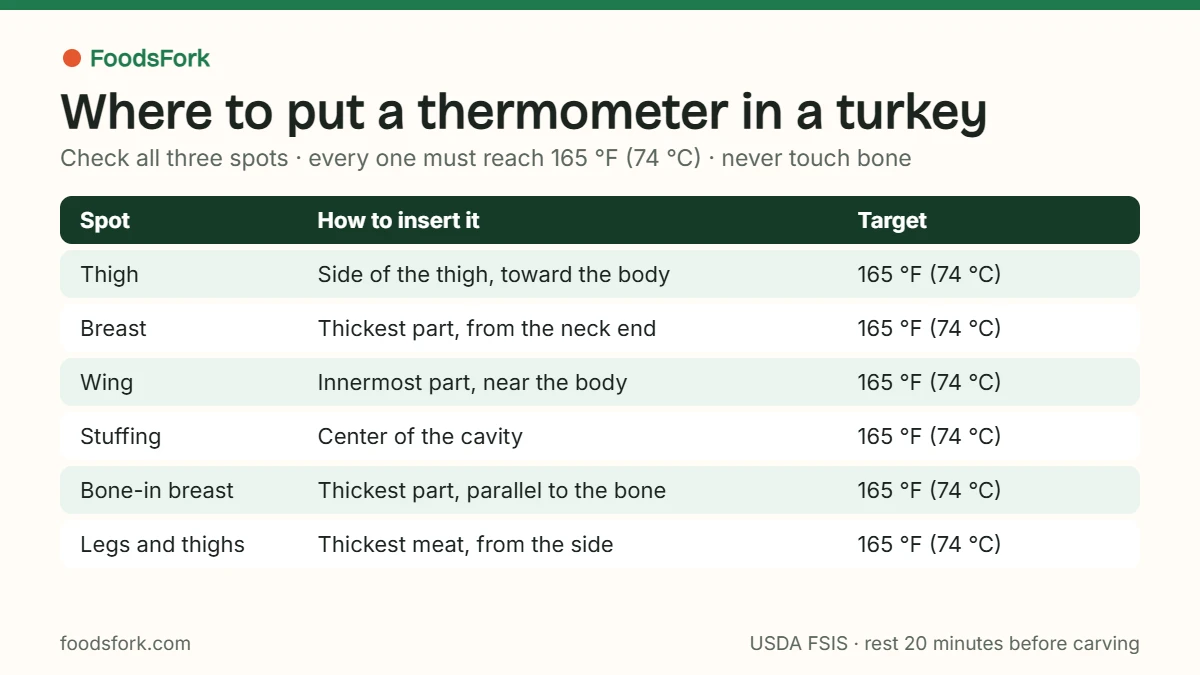
Where to put thermometer in turkey? Use three places: the innermost part of the thigh, the thickest part of the breast and the innermost part of the wing. Push the tip into the thickest meat and keep it off the bone. The turkey is done when every spot reads at least 165 °F (74 °C). The thigh is usually last to get there, so check it first.
Key facts
- Check the thigh, breast and wing; all must reach 165 °F (74 °C).
- Keep the tip in the thickest meat and away from bone, fat and the cavity.
- Instant-read digital: about ½ inch deep; dial thermometers: 2 to 2½ inches.
- Start checking about 30 to 45 minutes before the estimated end time.
- Rest the turkey for about 20 minutes before carving.
Where to put thermometer in turkey: the three spots
A turkey does not cook evenly. The breast sits on top and heats fast. The thighs are thick, close to the body and shaded by the legs, so they lag behind. That is why one reading is not enough. The USDA Food Safety and Inspection Service says to check three spots on a whole bird.
1. The thigh
The thigh is the most important spot. It is usually the last part of the turkey to reach a safe temperature.
- Find the crease where the leg meets the body.
- Push the thermometer in from the side, just above that crease, and angle it toward the body.
- Aim for the thickest, innermost part of the thigh meat.
- Stop before you feel the hard thigh bone. If you hit bone, pull back a little.
How to aim for the thickest part
Pinch the thigh between your thumb and fingers before it goes in the oven. You will feel where the meat is deepest. That is your target later. Some cooks mark the spot with a small cut in the skin.
2. The breast
The breast tells you when to stop cooking before the white meat dries out.
- Insert the thermometer at the neck end of the breast, or from the side.
- Slide it in parallel to the breastbone, into the thickest part.
- Keep the tip in the middle of the meat, not near the skin and not on the bone.
3. The wing
Check the innermost part of the wing, where it joins the body. This spot is small, so go in from the side and keep the tip in the meat, not in the joint.
| Spot | Where exactly | Why it matters |
|---|---|---|
| Thigh | Innermost part, toward the body, off the bone | Usually the slowest part to cook |
| Breast | Thickest part, from the neck end or side | Shows when to stop before it dries out |
| Wing | Innermost part, where it joins the body | Confirms heat has reached the inner joints |
| Stuffing | Center of the cavity | Must also reach 165 °F |
Turkey internal temperature: what it should read
The safe turkey internal temperature is 165 °F (74 °C). That number is the same for every part of the bird, for turkey breast, for ground turkey and for leftovers you reheat. The USDA turkey roasting guide uses it for all cooking methods.
| What you are cooking | Safe internal temperature |
|---|---|
| Whole turkey (breast, thigh, wing) | 165 °F (74 °C) |
| Turkey breast, bone-in or boneless | 165 °F (74 °C) |
| Turkey legs, thighs and wings | 165 °F (74 °C) |
| Stuffing cooked inside the bird | 165 °F (74 °C) in the center |
| Ground turkey and turkey burgers | 165 °F (74 °C) |
| Reheated leftovers | 165 °F (74 °C) |
Why many cooks take the thighs higher
Thighs and drumsticks are dark meat. They have more fat and connective tissue than the breast. They are safe at 165 °F, but they often taste more tender at 175 °F to 180 °F. Because the thighs cook slower anyway, this usually happens on its own while you wait for every spot to be safe.
Reading the temperature in Celsius
If your thermometer or recipe uses Celsius, the safe point is 74 °C. The Fahrenheit to Celsius converter handles oven settings and meat temperatures both ways.
How deep to insert the thermometer
Every thermometer has a sensing area near the tip. That part must sit in the center of the meat. How far you push it in depends on the type:
| Thermometer type | How deep | Reading time | Stay in the oven? |
|---|---|---|---|
| Digital instant-read (thermistor) | At least ½ inch | About 10 seconds | No |
| Thermocouple | ¼ inch or deeper | 2 to 5 seconds | No |
| Digital probe with oven cord | At least ½ inch | Reads all the time | Yes |
| Wireless or smart probe | At least 1 inch | Live updates | Yes |
| Oven-safe dial | 2 to 2½ inches | 1 to 2 minutes | Yes |
| Instant-read dial | 2 to 2½ inches | 15 to 20 seconds | No |
These figures come from the USDA Food Safety and Inspection Service. For a big turkey thigh, a digital instant-read thermometer is the easiest to use. It is quick, and its short sensing area makes it easier to stay off the bone.
Which thermometer is best for turkey?
A digital instant-read thermometer is the best all-round choice for home cooks. A leave-in probe with an alarm is handy for big birds, because you do not need to open the oven. Many cooks use both: the probe to watch the thigh, and the instant-read to double-check the breast and wing at the end.
How to tell if turkey is done, step by step
Not sure the bird is ready? Type your readings into the checker at the top of this page. It picks out the lowest one and tells you what to do next.
When to start checking the turkey
Roasting charts give a time range, not an exact minute. Ovens run hot or cold, and some birds come out of the fridge colder than others. Start checking at the low end of the range.
| Turkey weight (unstuffed, 325 °F) | Estimated roasting time | Start checking at |
|---|---|---|
| 8 to 12 lb | 2¾ to 3 hours | About 2¼ hours |
| 12 to 14 lb | 3 to 3¾ hours | About 2½ hours |
| 14 to 18 lb | 3¾ to 4¼ hours | About 3¼ hours |
| 18 to 20 lb | 4¼ to 4½ hours | About 3¾ hours |
| 20 to 24 lb | 4½ to 5 hours | About 4 hours |
Roasting times follow the USDA chart. Plan your whole day, including resting and carving, with the turkey cooking time calculator.
Can you trust the pop-up timer?
Many supermarket turkeys come with a red plastic pop-up timer in the breast. It pops when a small plug inside melts. USDA describes these as fairly accurate, but they only measure one spot, and that spot is in the breast, which cooks fastest.
Treat the pop-up as a reminder to check, not as the final word. Always confirm with a food thermometer in the thigh, wing and breast.
Resting the turkey and carryover cooking
Once every spot reads 165 °F, take the turkey out. Let it stand for about 20 minutes before carving, as the USDA turkey roasting guide advises. Cover it loosely with foil so it stays warm.
What carryover cooking means
A big roast holds a lot of heat. The outside keeps pushing heat inward after it leaves the oven, so the inside temperature often climbs a few more degrees while it rests. This is why the breast can creep from 165 °F into the low 170s on the counter.
Should you take it out early?
Some cooks pull the turkey a few degrees early and count on carryover. If you do, check again after resting. Every spot must reach 165 °F. If one does not, put the bird back in the oven.
How to tell if turkey is done without a thermometer
People often look for other signs. These can help, but none of them proves the turkey is safe:
- Clear juices. Juices can run clear before the meat reaches 165 °F, and pink juice can show up in turkey that is fully cooked.
- Loose legs. A leg that wiggles easily is a good hint, but it does not give you a temperature.
- Golden skin. The skin browns long before the inside is done, especially in a hot oven.
- Time alone. Roasting charts are estimates. Your oven and your bird may not match them.
A basic digital thermometer is cheap, and it is the only way to know for sure.
Checking a stuffed turkey
USDA advises cooking stuffing in a separate dish. If you do stuff the bird, the center of the stuffing must reach 165 °F too. Stuffing is often the slowest part, because it sits deep in the cavity.
- Push the thermometer into the very center of the stuffing.
- Check it after the meat is done.
- If the meat is done but the stuffing is not, spoon the stuffing into a baking dish and bake it until it reaches 165 °F.
A stuffed turkey also takes longer to roast. The turkey cooking time calculator lets you choose stuffed or unstuffed.
Smoked, grilled, fried and spatchcocked turkey
The safe temperature never changes. Only the way you reach the thick parts does.
Smoked or grilled turkey
A leave-in probe is ideal, because opening a smoker or grill lets out heat and smoke. Place it in the innermost part of the thigh, then check the breast with an instant-read thermometer near the end.
Deep-fried turkey
Turn off the burner and lift the turkey out of the oil before you check it. Never put a hand or a probe into hot oil. Check the thigh and breast once the bird is drained.
Spatchcocked turkey
A flattened turkey cooks faster and more evenly. The thighs sit at the edges and get more heat, so the breast often finishes close behind. Still check all three spots.
Turkey breast or legs only
For a bone-in breast, insert the thermometer into the thickest part, parallel to the bone. For legs and thighs, go in from the side into the thickest meat. Thin pieces are easier to read if you insert the probe sideways.
How to test your thermometer
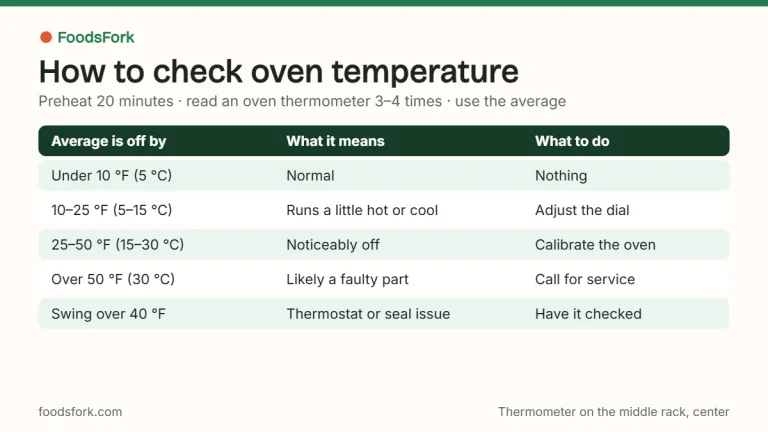
A thermometer that reads 5 degrees low can make you think a safe turkey is underdone, and one that reads high can do the opposite. Test it a few days before a big meal.
The ice water test
Fill a glass with ice, top it up with water and stir. Hold the stem at least 2 inches into the water without touching the glass. After 30 seconds, it should read 32 °F (0 °C).
The boiling water test
Dip the stem at least 2 inches into boiling water, away from the pot. At sea level, it should read 212 °F (100 °C). At high altitude, water boils at a lower temperature, so expect a lower reading.
If it is off
Many digital and dial thermometers can be reset. Check the instructions. If yours cannot, remember the difference and add or subtract it from each reading.
Common turkey thermometer mistakes
| Mistake | What happens | Fix |
|---|---|---|
| Touching bone | False reading | Pull back until the tip is in meat only |
| Too shallow | Reads the cooler outer meat or the hot surface | Push the sensing area into the center |
| Probing the cavity | Reads hot air, not meat | Aim for solid thigh or breast meat |
| Checking only the breast | Thigh may still be under 165 °F | Check the thigh, breast and wing |
| Trusting the pop-up alone | One spot may not tell the whole story | Double-check with a thermometer |
| Touching the pan | Reads the pan’s heat | Keep the tip inside the meat |
Frequently asked questions
Where do you put the thermometer in a turkey?
Check three spots: the innermost part of the thigh, the thickest part of the breast and the innermost part of the wing. Push the tip into the thickest meat without touching bone. All three should read at least 165 °F.
What temperature is turkey done?
Turkey is safe to eat when every part reaches 165 °F (74 °C), measured with a food thermometer. That includes the breast, thigh, wing and any stuffing.
Do you check turkey temperature in the breast or thigh?
Check both, and the wing too. The thigh usually takes longest, so it tells you when the whole bird is done. The breast tells you when to stop before the white meat dries out.
Should the thermometer touch the bone?
No. Bone heats differently from meat and can give a false reading. Keep the tip in the thickest part of the meat, about a finger's width away from the bone.
Is turkey done at 160 °F?
Not yet by USDA guidance, which sets 165 °F for all poultry. The temperature often rises a few degrees while the bird rests. Check again after resting, and return it to the oven if any spot is still below 165 °F.
How long should a turkey rest?
Let a whole turkey rest for about 20 minutes before you carve it. Cover it loosely with foil. Resting lets the juices settle so the slices stay moist.
Can you leave a thermometer in the turkey while it cooks?
Yes, if it is an oven-safe dial thermometer or a probe with a cord or wireless probe made to stay in. Instant-read thermometers are not oven-safe, so use them only for quick checks.
Can you trust the pop-up timer?
Use it as a first sign only. USDA recommends double-checking with a food thermometer in the thigh, wing and breast, because a pop-up timer only measures one spot.
How can you tell if turkey is done without a thermometer?
There is no reliable way. Clear juices and loose legs are hints, but turkey can look done before it is safe. A basic digital thermometer is cheap and gives you a real answer.
What temperature should turkey thighs be?
Thighs are safe at 165 °F. Many cooks like them at 175 °F to 180 °F, because dark meat has more connective tissue and becomes more tender at higher temperatures.
Related guides and tools
Sources: USDA Food Safety and Inspection Service, Kitchen Thermometers and Let’s Talk Turkey; University of Illinois Extension, Turkey for the Holidays. Checked November 2026.