How to Soften Butter Quickly: 7 Easy Ways
Forgot to take the butter out? Here is how to soften butter quickly without melting it. Pick a method below to see how long it takes for your amount.
1 US stick = ½ cup = 113 g. Softened butter is about 65–68 °F (18–20 °C).
Times are estimates for US sticks. Always use the finger test.
Quick answer
The fastest way to soften butter is to pound it flat with a rolling pin between two sheets of parchment, which takes about 3 to 5 minutes. You can also grate it (5 to 10 minutes), cut it into small cubes (15 to 30 minutes) or microwave slices at 30% power in 5-second bursts. Softened butter is about 65 to 68 °F: cool, but soft enough that a finger leaves a dent.
Key facts
- Softened butter is 65–68 °F (18–20 °C), cooler than most kitchens.
- Rolling pin: 3–5 minutes. Grating: 5–10 minutes. Cubes: 15–30 minutes.
- A whole stick on the counter takes about 60–90 minutes.
- Ready when a finger leaves a dent but does not sink in.
- Melted butter is not a swap for softened butter when creaming.
How to soften butter quickly: 7 easy ways
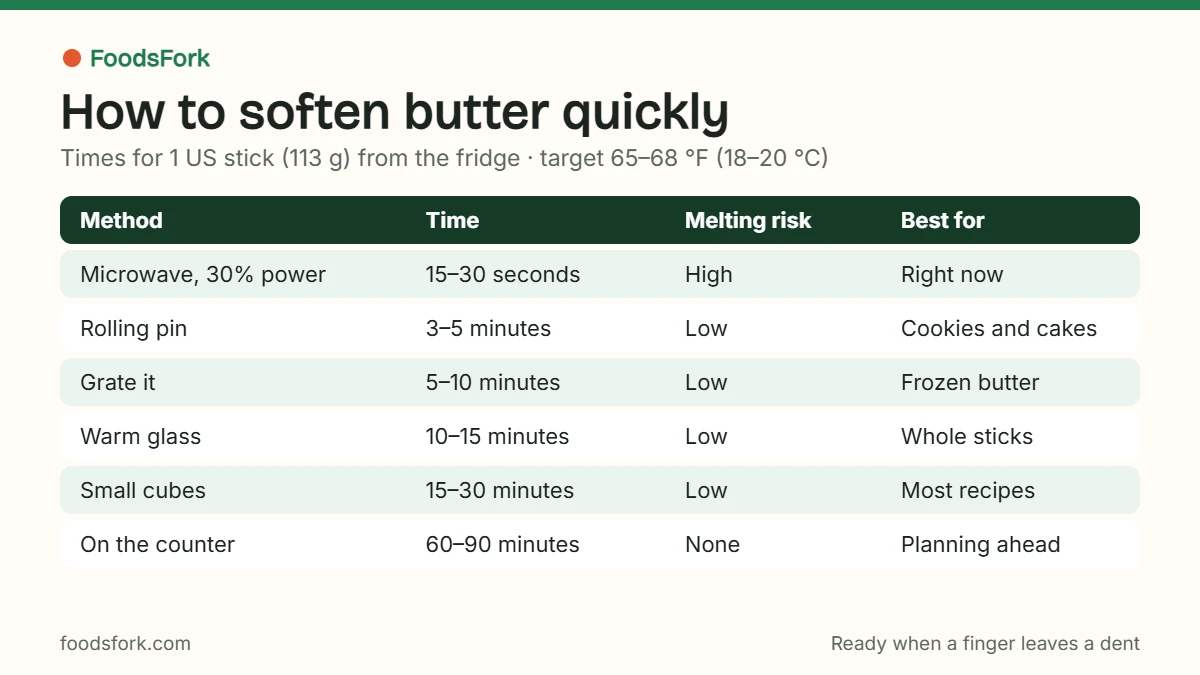
Every method works the same way. It either adds a little heat or gives the butter more surface area, so the cold middle warms up faster. The trick is to stop before the outside melts. Times below are for one US stick (113 g) straight from the fridge.
1. Pound it with a rolling pin (3 to 5 minutes)
This is the best all-round quick method. Put the stick between two sheets of parchment paper or in a zip-top bag. Hit it firmly with a rolling pin until it is about ¼ inch thick. Fold it over and roll again a few times.
The pressure and movement warm the butter evenly, with no risk of melting. It is also oddly satisfying.
2. Grate it (5 to 10 minutes)
Use the large holes of a box grater and grate the cold stick onto a plate. Thin shreds have lots of surface area, so they soften in minutes. This is the best method for butter straight from the freezer.
Grating tip
Hold the butter with the wrapper still on the end you are holding. Your hand will not warm it, and the butter will not slip.
3. Microwave it in short bursts (15 to 30 seconds)
The microwave is the fastest, but also the easiest to get wrong. Microwaves heat unevenly, and the center of a stick can melt while the outside is still firm.
- Cut the butter into tablespoon slices and spread them out on a plate.
- Set the microwave to 30% power, or use the defrost setting.
- Heat for 5 seconds, then press a slice. Repeat until it just gives.
King Arthur Baking says the microwave can be great for softening butter if you use it the right way. Low power and short bursts are the key.
4. Use a warm glass (10 to 15 minutes)
Fill a tall glass with very hot water and leave it for 2 minutes. Pour the water out and dry the glass. Turn it upside down over the stick of butter on a plate. The warm air inside softens the butter gently.
This is handy when you want a whole stick for spreading or you need your hands free for other steps.
5. Cut it into small cubes (15 to 30 minutes)
Cut the stick into ½-inch cubes and spread them out on a plate in a single layer. Smaller pieces warm up much faster than a whole stick. Cubes are also easy to add to a mixer.
6. Warm the bowl (10 to 15 minutes)
Fill your mixing bowl with hot water, wait a minute, then empty and dry it. Add the butter in cubes. The warm bowl takes the chill off the butter while you measure the other ingredients.
7. Leave it on the counter (60 to 90 minutes)
The classic way. Take the butter out of the fridge an hour or two before you bake and leave it in its wrapper on the counter, away from the stove and sunny windows. In a cool kitchen, it can take longer.
Which way to soften butter is best?
| Method | Time from fridge | Melting risk | Best for |
|---|---|---|---|
| Microwave at 30% power | 15–30 seconds | High | When you need it right now |
| Rolling pin | 3–5 minutes | Low | Cookies and cakes |
| Grating | 5–10 minutes | Low | Frozen butter, quick bakes |
| Warm glass | 10–15 minutes | Low | Whole sticks, hands-off |
| Warm bowl | 10–15 minutes | Low | Recipes that start with creaming |
| Small cubes | 15–30 minutes | Low | Most recipes |
| On the counter | 60–90 minutes | None | Planning ahead |
For most bakers, the rolling pin is the winner. It is fast, needs no special tools and almost never melts the butter. Use the timer at the top of this page to see times for your amount and kitchen.
Softening more than one stick
Soften each stick on its own, or cut them all into cubes and spread them out. A pile of butter softens slowly in the middle. If a recipe calls for a cup of butter, that is two sticks. The butter converter turns sticks, cups, tablespoons and grams into each other.
What does softened butter mean?
Recipes say “softened” or “room temperature” butter, but they rarely mean the temperature of your room. Most kitchens sit around 70 °F to 75 °F. Softened butter is cooler than that, about 65 °F to 68 °F (18 °C to 20 °C).
| Butter state | Temperature | How it feels | Used for |
|---|---|---|---|
| Cold | Below 60 °F (16 °C) | Hard, snaps when bent | Pie crust, biscuits, scones |
| Softened | 65–68 °F (18–20 °C) | Cool, bends, finger leaves a dent | Cookies, cakes, frosting |
| Too soft | Above 70 °F (21 °C) | Shiny, greasy, finger sinks in | Chill it before using |
| Melted | Above 90 °F (32 °C) | Liquid | Brownies, some cookies and quick breads |
If you have a probe thermometer, you can check for sure. Most of the time, the finger test is all you need.
How to tell when butter is softened
- The finger test. Press the butter gently. It should leave a clear dent, but your finger should not sink in or slide.
- The bend test. A softened stick bends without cracking or breaking.
- The look. It should look matte, not shiny or wet.
- The feel. It should still feel cool in your hand, not warm.
If the butter looks greasy or your finger slides through, it has gone too far. See the fixes below.
Why recipes ask for softened butter
Many cakes and cookies start with creaming: beating butter and sugar together until light and fluffy. The sugar crystals cut tiny air pockets into the butter. Those air pockets expand in the oven and give the bake its lift and soft crumb.
Butter that is too cold
Cold butter will not blend with sugar. You get lumps, the batter does not trap air, and the cake bakes up dense and uneven.
Butter that is too warm
Warm butter cannot hold the air pockets. They collapse, and cookies spread into thin, greasy puddles. Cakes sink in the middle.
The same goes for other ingredients
Eggs and milk straight from the fridge can make softened butter firm up again, and the batter can look curdled. If you can, take them out with the butter, or set the eggs in warm water for 5 to 10 minutes.
How to soften frozen butter
Frozen butter needs a different plan. It is too hard to roll or cube neatly.
- Grate it. The best choice. Grate it straight from the freezer and let the shreds sit for 10 to 15 minutes.
- Microwave it. Use the defrost setting in 10-second bursts, turning the stick each time. Watch closely.
- Move it to the fridge. If you can plan ahead, thaw it in the fridge overnight, then soften it as usual.
- Counter. A frozen stick takes about 3 to 4 hours on the counter.
What to do if butter gets too soft or melts
Too soft
Put it back in the fridge for 10 to 15 minutes and test again. It will firm up quickly. If you have already started creaming and the mix looks greasy, chill the whole bowl for 10 minutes, then beat again.
Partly melted
Chill it until it is solid again, then soften it gently with the rolling pin or cubes. Butter that melted and set again can lose some of its structure, so cookies may spread a little more.
Fully melted
Do not use it in a creamed recipe. Save it for brownies, muffins, pancakes or any recipe that asks for melted butter. Or chill it until solid and start again.
Can you swap melted butter for softened?
Not in cakes and cookies that start with creaming. Melted butter gives a denser cake and flatter, chewier cookies. In recipes that only stir butter in, such as some quick breads, melted butter can work.
When you should not soften butter
Some recipes need cold butter. Softening it would ruin the texture.
- Pie crust and pastry. Cold butter pieces melt in the oven, release steam and create flaky layers.
- Biscuits and scones. The same idea. Many bakers grate frozen butter straight into the flour.
- Laminated dough. Croissants and puff pastry need cold, firm butter sheets.
- Finishing sauces. Many pan sauces whisk in cold butter at the end so the sauce stays smooth.
Is it safe to leave butter out to soften?
Yes, for a short time. USDA says butter is safe at room temperature, but it can turn rancid if it sits out for several days. The advice is to leave out only what you will use within a day or two. Leaving a stick out overnight to soften for baking is fine.
Keep counter butter covered, away from heat and light. In a hot kitchen, above about 70 °F to 75 °F, keep it in the fridge and use one of the quick methods instead.
Salted or unsalted?
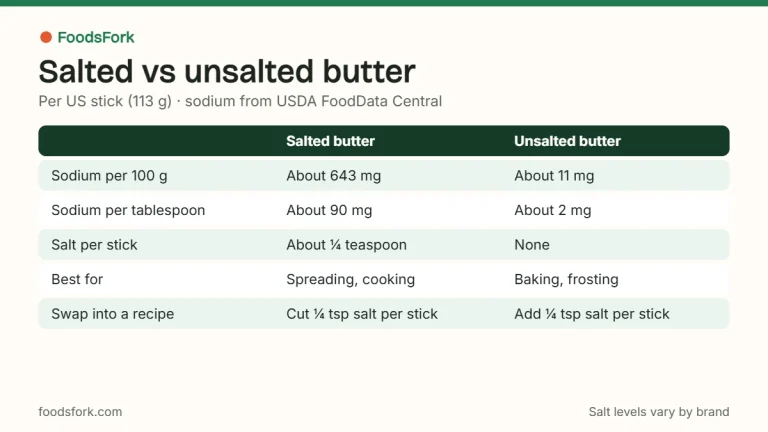
Both soften the same way. Salted butter keeps a little better on the counter, because salt slows spoilage. Most baking recipes use unsalted butter so you can control the salt.
Frequently asked questions
What is the fastest way to soften butter?
The microwave is fastest. Slice the butter, spread it on a plate and heat it at 30% power in 5-second bursts, checking each time. Without a microwave, pounding it flat with a rolling pin takes about 3 to 5 minutes.
How long does it take to soften butter at room temperature?
A whole stick from the fridge takes about 60 to 90 minutes in a normal kitchen, and longer in a cool one. Cut into ½-inch cubes, it softens in about 15 to 30 minutes.
What temperature is softened butter?
Softened butter is about 65 °F to 68 °F (18 °C to 20 °C). It should feel cool, hold its shape and leave a dent when you press it with a finger.
How do you know when butter is softened?
Press it with your finger. It should leave a dent without your finger sinking in or sliding. The stick should bend without cracking and should not look shiny or greasy.
Can I use melted butter instead of softened butter?
Not in recipes that start by creaming butter and sugar. Melted butter cannot hold air, so cakes turn dense and cookies spread more. Use melted butter only when the recipe asks for it.
What do I do if my butter gets too soft?
Put it back in the fridge for 10 to 15 minutes, then check again. If it fully melted, chill it until solid and soften it again, or save it for a recipe that uses melted butter.
How do you soften frozen butter quickly?
Grate it straight from the freezer on the large holes of a box grater. The shreds soften in about 10 to 15 minutes. You can also microwave it on the defrost setting in short bursts.
Is it safe to leave butter out overnight to soften?
Yes. USDA says butter is safe at room temperature and suggests leaving out only what you will use within a day or two, because it can turn rancid over time.
Does the warm glass trick work?
Yes. Warm a tall glass with hot water, dry it and turn it over a stick of butter. The trapped warm air softens the butter in about 10 to 15 minutes, without melting it.
Should butter be softened for pie crust and biscuits?
No. Pie crust, biscuits and scones need cold butter. The cold pieces melt in the oven and leave flaky layers. Keep the butter in the fridge until you use it.
Related tools and guides
Sources: King Arthur Baking, softening butter quickly; USDA Food Safety and Inspection Service and FoodKeeper guidance on butter storage. Checked November 2026.