Chicken Internal Temp: When Is Chicken Done?
The safe chicken internal temp is 165 °F (74 °C) for every cut. Pick your cut and cooking method below for USDA cooking times, or type in your thermometer reading to check if it is done.
Times and the 165 °F target from USDA FSIS, Chicken from Farm to Table
Quick answer
The safe chicken internal temp is 165 °F (74 °C). That applies to breasts, thighs, wings, drumsticks, whole birds and ground chicken. Check the thickest part with a food thermometer, away from the bone. For a whole chicken, check the thigh, wing and breast. Many cooks take thighs and drumsticks higher, to 175–185 °F, for more tender dark meat.
Key facts
- Safe chicken internal temp: 165 °F (74 °C), for every cut.
- Check the thickest part, never touching bone.
- Dark meat is safe at 165 °F but tastes best at 175–185 °F.
- Color is not a test: safe chicken can still look pink.
- Rest pieces about 5 minutes; whole birds 10–20 minutes.
Chicken internal temp: why 165 °F?
Raw chicken can carry bacteria such as Salmonella and Campylobacter. Heat kills them. At 165 °F (74 °C), the kill is instant, so the meat is safe the moment the thickest part reaches that number. That is why the USDA Food Safety and Inspection Service uses 165 °F for all chicken and other poultry.
The number is the same whether you roast, grill, fry, air fry, smoke or simmer. It is also the same for chicken breast, thighs and ground chicken. One number makes it easy to remember.
What about lower temperatures?
Bacteria also die at slightly lower temperatures if the meat stays there long enough. Restaurants and food makers use exact time charts for this. At home, it is hard to hold meat at a precise temperature, so the simple, safe rule is 165 °F.
Chicken internal temperature in Celsius
165 °F is 73.9 °C, which everyone rounds to 74 °C. Need to convert oven settings too? Use the Fahrenheit to Celsius converter.
Chicken internal temperature by cut
| Cut | Safe minimum | Many cooks prefer | Why |
|---|---|---|---|
| Breast, boneless or bone-in | 165 °F (74 °C) | 165 °F | Lean meat dries out quickly past 165 °F |
| Thighs | 165 °F (74 °C) | 175–185 °F | Connective tissue softens at higher heat |
| Drumsticks | 165 °F (74 °C) | 175–185 °F | Same as thighs |
| Wings | 165 °F (74 °C) | 175–190 °F | Small and forgiving; skin crisps more |
| Whole chicken | 165 °F (74 °C) in all spots | Breast 165 °F, thigh 175 °F | White and dark meat cook at different rates |
| Ground chicken | 165 °F (74 °C) | 165 °F | Bacteria can be mixed all through |
Safe minimum temperatures come from USDA. Going higher on dark meat is about texture, not safety.
Why dark meat can go higher
Thighs and drumsticks have more fat and more collagen, the tough connective tissue in working muscles. Collagen softens as the meat gets hotter, so dark meat at 180 °F is often more tender than at 165 °F. The extra fat keeps it moist.
Where to put the thermometer in chicken
Chicken breast
Slide the thermometer in from the side, into the thickest part of the breast. Going in from the side keeps the sensing tip in the center of thin cuts.
Thighs and drumsticks
Push the tip into the thickest part of the meat, about a finger’s width from the bone. Bone heats differently and can fool the reading.
Wings
Wings are small and cook fast. Check the thickest part of the flat or the drumette.
Whole chicken
Check three places: the innermost part of the thigh, the innermost part of the wing and the thickest part of the breast. The thigh is usually last to reach 165 °F. For a turkey, the steps are the same. See our turkey thermometer guide.
Which thermometer to use
A digital instant-read thermometer is the easiest. It reads in a few seconds, and its short tip suits thin pieces. A leave-in probe with an alarm is handy for whole birds in the oven or smoker.
How long to cook chicken
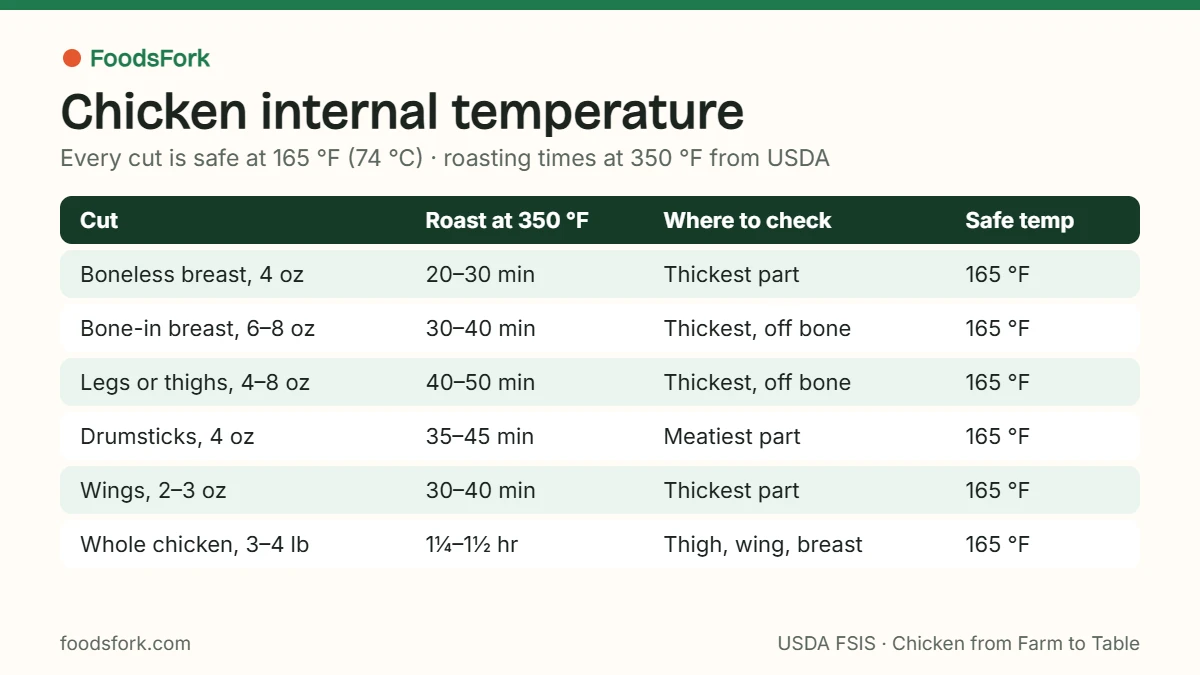
These are the approximate times from USDA. Use them to plan, and use a thermometer to decide when it is done.
| Type of chicken | Weight | Roast at 350 °F | Simmer | Grill |
|---|---|---|---|---|
| Whole broiler-fryer | 3–4 lb | 1¼–1½ hours | 60–75 min | 60–75 min (indirect) |
| Whole roasting hen | 5–7 lb | 2–2¼ hours | 1¾–2 hours | 18–25 min per lb (indirect) |
| Cornish hen | 18–24 oz | 50–60 min | 35–40 min | 45–55 min (indirect) |
| Breast half, bone-in | 6–8 oz | 30–40 min | 35–45 min | 10–15 min per side |
| Breast half, boneless | 4 oz | 20–30 min | 25–30 min | 6–8 min per side |
| Legs or thighs | 4–8 oz | 40–50 min | 40–50 min | 10–15 min per side |
| Drumsticks | 4 oz | 35–45 min | 40–50 min | 8–12 min per side |
| Wings | 2–3 oz | 30–40 min | 35–45 min | 8–12 min per side |
Times are for unstuffed birds. A stuffed whole chicken needs about 15 to 30 minutes more, and the stuffing must also reach 165 °F.
Cooking at higher temperatures
Many recipes roast chicken pieces at 400 °F to 425 °F for crispier skin. Cooking times drop, so start checking earlier. Boneless breasts at 425 °F can be done in 18 to 22 minutes. Using an air fryer? The oven to air fryer converter adjusts the time and temperature.
Is pink chicken safe to eat?
It can be. USDA says the color of cooked chicken is not a sign of its safety. Chicken that reached 165 °F can still look pink near the bone, especially in young birds or when smoked or grilled. Smoke and certain cooking gases react with the meat and leave a pink ring.
The reverse is also true. Chicken can look white and cooked before it is safe. That is why a thermometer is the only real test.
What about pink juices?
The pink liquid in a pack of raw chicken is mostly water the bird absorbed while chilling, not blood. Clear juices are a common sign of doneness, but they are not a safety test either.
How to keep chicken juicy and safe
- Pound breasts even. A breast that is thick at one end and thin at the other cooks unevenly. Pound it to an even thickness.
- Brine or salt ahead. Salting chicken an hour or more before cooking helps it hold on to moisture.
- Check early. Start checking at the low end of the time range. Overcooking is the main cause of dry chicken.
- Take breasts off right at 165 °F. Every extra degree dries lean meat.
- Cook thighs longer. Do not pull dark meat at 165 °F if you want it tender.
- Rest it. Give the juices a few minutes to settle before slicing.
Chicken internal temp by cooking method
Baked or roasted
Check whole birds in the thigh first. For pieces, check the biggest one, since it finishes last.
Grilled
Use direct heat for boneless breasts and wings, and indirect heat for bone-in pieces and whole birds. Check each piece, because grills have hot spots.
Fried
Lift a piece out of the oil and check it on a rack. Bone-in fried chicken often needs a few minutes in the oven to finish the middle without burning the crust.
Air fried
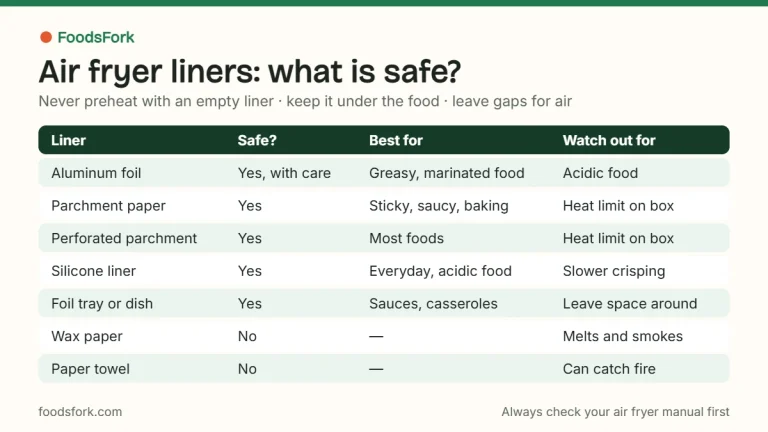
Air fryers brown the outside fast. Check the thickest piece, and flip halfway. Using liners? Read can you put foil in an air fryer first.
Slow cooker and simmered
Simmered chicken is usually well above 165 °F by the time it is tender. Still check the largest piece, especially with thighs on the bone.
Smoked
Low heat means long cook times. A leave-in probe in the thickest part saves opening the smoker. Expect a pink smoke ring under the skin even when fully cooked.
Resting chicken and carryover cooking
Meat keeps cooking for a few minutes after it leaves the heat. The hot outside pushes heat into the center, so the temperature can climb a few degrees. Small pieces rise only a little. A whole bird can rise more.
| What you cooked | Rest time |
|---|---|
| Wings | No rest needed |
| Boneless breasts, thighs, drumsticks | About 5 minutes |
| Bone-in breasts | 5 to 10 minutes |
| Whole chicken | 10 to 15 minutes |
| Large roasting hen | 15 to 20 minutes |
If you take chicken off a few degrees early, check it again after resting. It must reach 165 °F.
Before and after cooking: thawing, storing and reheating
Thawing chicken safely
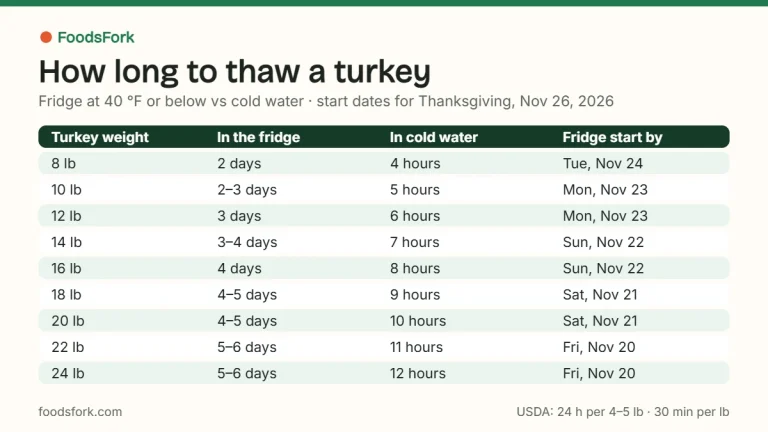
Thaw chicken in the fridge, in cold water or in the microwave, never on the counter. In the fridge, small packs of pieces thaw in about a day and a whole chicken in a day or two. In cold water, keep the chicken in a leak-proof bag and change the water every 30 minutes; a 1 lb pack takes about an hour. Cook chicken thawed in cold water or the microwave right away.
You can also cook chicken from frozen. It takes about 50% longer, and you still cook it to 165 °F. The same rules apply to turkey, as explained in how to thaw a turkey.
Storing cooked chicken
Get leftovers into the fridge within 2 hours of cooking, or within 1 hour if it is above 90 °F outside or in the room. Cooked chicken keeps in the fridge for about 3 to 4 days. For longer, freeze it in flat bags or shallow containers so it chills quickly.
Reheating chicken
Reheat leftovers until they reach 165 °F in the center. Thick pieces reheat more evenly if you cover them and add a splash of water or broth. In the microwave, stir or turn the chicken halfway and let it stand for a minute before checking.
Can you eat cold cooked chicken?
Yes, if it was cooked to 165 °F and stored in the fridge within 2 hours. Cold chicken in salads and sandwiches is fine for the same 3 to 4 days.
Safe internal temperatures for other meats
The same thermometer rule works for everything else you cook. These are the safe minimum internal temperatures from FoodSafety.gov:
| Food | Safe minimum internal temperature |
|---|---|
| All poultry (chicken, turkey, duck), whole or pieces | 165 °F (74 °C) |
| Ground chicken and turkey | 165 °F (74 °C) |
| Ground beef, pork, veal and lamb | 160 °F (71 °C) |
| Beef, pork, veal and lamb steaks, chops and roasts | 145 °F (63 °C), then rest 3 minutes |
| Fresh or raw ham | 145 °F (63 °C), then rest 3 minutes |
| Fish and shellfish | 145 °F (63 °C) |
| Egg dishes | 160 °F (71 °C) |
| Leftovers and casseroles | 165 °F (74 °C) |
Common chicken temperature mistakes
| Mistake | What happens | Fix |
|---|---|---|
| Cutting it open to check | Juices run out and you still do not know the temperature | Use a thermometer |
| Touching the bone | False reading | Keep the tip in the meat |
| Checking a small piece | The biggest piece may still be underdone | Check the thickest piece |
| Pulling thighs at 165 °F | Safe but chewy | Take dark meat to 175–185 °F |
| Washing raw chicken | Spreads bacteria around the sink | Pat dry with paper towels instead |
| Reusing the raw-chicken plate | Cooked chicken picks up raw juices | Use a clean plate |
Frequently asked questions
What is the safe internal temp for chicken?
165 °F (74 °C). USDA sets this for all chicken, including breasts, thighs, wings, whole birds and ground chicken. Measure it with a food thermometer in the thickest part.
Where do you check the temperature of chicken?
In the thickest part of the meat, without touching bone. For a whole chicken, check the innermost part of the thigh, the innermost part of the wing and the thickest part of the breast.
Is chicken safe at 160 °F?
Not by USDA guidance, which uses 165 °F. Chicken often rises a few degrees as it rests, so check again after resting and keep cooking if it is still below 165 °F.
What temperature should chicken thighs be?
Thighs are safe at 165 °F. Many cooks prefer 175 °F to 185 °F, because dark meat has more connective tissue that softens at higher temperatures.
What temperature should chicken breast be?
165 °F in the thickest part. Breasts have little fat, so take them off the heat as soon as they reach it to keep them juicy.
Can chicken be pink and still be cooked?
Yes. USDA says the color of cooked chicken is not a sign of safety. Safely cooked chicken can stay pink, especially young birds and smoked or grilled chicken. Only a thermometer tells you for sure.
How long does it take to bake chicken breast at 350 °F?
A 4 oz boneless breast takes about 20 to 30 minutes, and a 6 to 8 oz bone-in breast takes about 30 to 40 minutes, according to USDA. Check that it reaches 165 °F.
How long should chicken rest after cooking?
About 5 minutes for pieces and 10 to 20 minutes for a whole bird. Resting lets the juices settle so they stay in the meat when you cut it.
What temperature is ground chicken done?
165 °F (74 °C), the same as all poultry. Check burgers and meatballs in the center.
Should I wash raw chicken before cooking?
No. Washing raw chicken spreads bacteria around your sink and counters. Cooking to 165 °F is what makes it safe.
Related tools and guides
Sources: USDA Food Safety and Inspection Service, Chicken from Farm to Table; FoodSafety.gov, safe minimum internal temperatures. Checked November 2026.